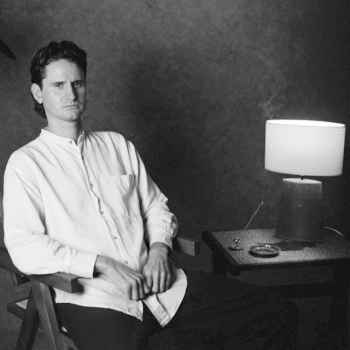

As a child, April Harper Grey didn’t play with toys. Instead, she had two main obsessions. The first was hotels: six-year-old Grey would pore over interior design books, and when she visited her grandparents in New York, her grandmother convinced the Hotel Gansevoort to let them peek inside a room. “That was one of the best days of my life,” she grins.
The second was her father’s computer. She’d create YouTube videos and mess about on GarageBand, eventually starting a small dubstep project called Underscores aged 12. Now 25, Underscores has become one of the biggest names from the online hyperpop community thanks to her 2021 debut ‘Fishmonger’ and 2023’s ‘Wallsocket’. On her upcoming third album ‘U’, she’s blending all the sounds from her last two albums to create an escapist “pop bible”.
‘U’ was written among the hoi polloi of megamalls, ritzy hotels and posh airports, as Grey attempted to “connect with what I was feeling really inspired [by] as a six-year-old”. “I knew at some point I would make a project that made sense in this fluorescent, consumerist architecture,” she tells NME. “I don’t want to glamorise this kind of architecture, but it has always inspired me since before I knew what its connotations were. And I don’t know – I like the luxurious vibe right now.”
When we spoke to Grey last year for The Cover, she was basking in the success of ‘Wallsocket’ and its intricately woven narrative. Since the record’s release in 2023, Grey has toured with EDM legend Porter Robinson and contributed to fellow Cover star Oklou’s breakout debut album, ‘Choke Enough’. Grey’s albums even revived Danny Brown’s love for electronic music, going on to collaborate with the rapper for his last album, ‘Stardust’. But despite these milestones, she told NME at the time that she was “fucking terrified” of making music, worried she was “going to constantly let down” her fans.
Exhausted from the labyrinthine lore of ‘Wallsocket’, Grey wrote ‘U’ – a self-titled of sorts, combining elements of her past albums to create a defining “thesis statement” on Underscores’ M.O. There’s storytelling, but no story, leaving Grey all the energy to indulge in her favourite pop sounds: “This time I wanted to focus on the music, because that’s what people come here for the most.”
The singles released from ‘U’ seem to establish a quintessential Underscores sound. Over a juddering, jackhammer bass, Grey coos on the cheeky but sincere ‘Music’: “Last night, I had a wet dream ’bout the perfect song”. It’s no surprise, then, when she reels off Jane Remover, 2hollis and Osamason as equally inspiring as Brandy, Britney Spears and Justin Timberlake while making ‘U’.
But as you go deeper into the album, plenty of songs subvert Underscores’ bass-blasting formula. They’re tender and minimalist, relying more on vocal charisma and emotional songwriting than ear-destroying wubs. Take ‘The Peace’, which tracks a relationship in three pivotal smoke breaks. It’s Grey’s take on an acapella Auto-Tuned ballad in the vein of Imogen Heap, though she counters: “I wanted it to sound like the Mac startup sound was singing ‘Eleanor Rigby’.”
The quieter songs, she adds, were made to challenge her usual process of making music. “I really wanted to try and strip back for some of these songs,” she explains. “I’m a very maximalist producer, and it’s a mechanism of mine when I don’t know what to do: I’ll just overproduce it.” To counteract this, she took inspiration from Oklou and Mk.gee and how they use their instruments as a “sound bed”: “With this album I wanted to create patches and sounds that I could play and be expressive with on my MIDI keyboard.”

Though Grey’s lyrical style hasn’t changed much since ‘Wallsocket’, the lack of an overarching narrative creates an intimacy that amplifies the introspective moments on ‘U’. Take ‘Lovefield’, for example, which replays a hypnotic loop as Grey mourns an unrequited love, her voice completely unfiltered: “It hurts for me to wait on you / I bet you’re waiting on me too”. Grey concedes the lyrics can still be a little vague, but agrees that the songs are “less camouflaged by characters” on the album. “‘Wallsocket’ was super conceptual, but it was still very personal,” she says. “This feels more like I’m telling you upfront.”
Being a popstar has always required some level of financial and reputational power, and on ‘U’, that relationship doesn’t go unnoticed. Grey playfully assumes the role of a celebrity negotiating a hookup on ‘Do It’ (which NME named one of the best songs of 2025), telling their prospective partner: “I’m tryna run a business here – come on, babe”. But they retreat from the relationship, justifying that they’re “married to the music”. Clearly, there’s more to marriage than just love.
Grey has consistently satirised the rich and the famous, even years before her come up as an unknown 21-year-old on ‘Fishmonger’. On one level, her fascination with celebrity culture was a form of wish fulfilment – “that’s where I saw myself, and I was confident about that,” she admits – but it also comes from a darkly psychological place. “I’ve always scrutinised myself like I was famous. I’ve always been like, ‘someone’s gonna pick my life apart to pieces someday, so I need to prepare for that’. But obviously some of that is some mental shit.”
Grey might be a star in the underground realm, but ‘U’ makes clear that being in that position isn’t all it’s cracked up to be. On ‘Spoiled Little Brat’, her biggest hit from ‘Fishmonger’, Grey proudly professes: “I get what I want”. Now, album opener ‘Tell Me (U Want It)” sees her backtrack: “I get what I want and then find out right after I get it, I don’t even want it”.
“‘Wallsocket’ was super conceptual, but it was still very personal – this feels more like I’m telling you upfront”
“I do think my relationship with making music has changed after being able to do it for a living,” Underscores professes. “There’s 10 other jobs that you have to do along with your dream job – which I’m perfectly fine with, but it does sometimes suck the fun out of it a little.”
“With each album, I’m trying to restore my relationship with making music,” she adds. “And as frustrating as it can be to make music by yourself, that frustration puts something really interesting in the work.” Grey says her recent collaborations have also been part of her attempt to repair that connection. “Some of the most fulfilling experiences [I’ve had] have been being in a band or collaborating with other people. I was pretty closed off before, but I’ve been trying to work more with people.”
Among the many collaborations she’s done in the last few months – Umru, Yaeji and Aries, to name a few – Grey’s biggest get so far has been LOONA singer and rising pop favourite Yves, who helped remix ‘Do It’. “I’m still shocked that it exists! We reached out not expecting anything at all and she was so open to do literally everything. To come out of that system and then become such a charismatic artist with such a unique sound… that’s really inspirational and new ground for what I’ve seen in K-pop.”
It’s especially meaningful to Grey. It’s her first time working with a K-pop star, and she tells us she’s always wanted to be part of that world, having followed the genre since 2012. But as a young transgender woman, Grey always thought being part of K-pop was impossible. “Creating [K-pop] for myself seemed like the only option,” she affirms. “Any pop music that I make, it’s going to be part of that.”

It’s hard to imagine that, three years ago, Grey proclaimed to NME that hyperpop was dead. But we’re in a post-‘Brat’ world now; dance-pop is once again back in vogue, and musicians like Grey can thrive making the music they originally started exploring when these brash, extroverted sounds were considered “uncool”.
“[Hyperpop] seemed like a fad at the start of the decade to a lot of people,” she observes. “But it’s the dominant genre right now: the ideals and sonics of it are present in all the biggest pop and rap music. Right now is the right time and place – so I’m glad to be there.”
Grey could choose to become complacent and pump out left-field dance-pop hits. But culture moves fast, and she predicts pop will experience a “twee revival” in three years’ time, citing artists like Brat Star as examples (think The Moldy Peaches, if they were “Bladee at the same time”).
“I think the true Kimya Dawson twee is impossible for our generation to access because we’re just so ironic and self-aware, but I do think some attempt to get to this millennial twee will result in something new,” she estimates. Grey says she plans to become a hipster when that happens: she’ll go to bars, get into speciality coffee, maybe make a record reflecting her new life. For now, she’s going to savour the glory of ‘U’ and its full-circle vindication of hyperpop – just not for too long.
“I started [Underscores] when I was 12, and it’s gone through a lot of iterations over the years,” Grey tells us. “I tried to encapsulate as much as I could of [my] previous music, but I’ll probably switch up again after this – I tend to wring the sonic identity of each album dry until there’s nothing left. Then, I’ll move on.”
Underscores’ ‘U’ is released on March 20 via Mom+Pop.
The post Underscores: “I’m trying to restore my relationship with making music” appeared first on NME.