The reaper has been lurking in our round
And I heard him whispering in my ear,
Long before he visited you,
He was trying to make me disappear
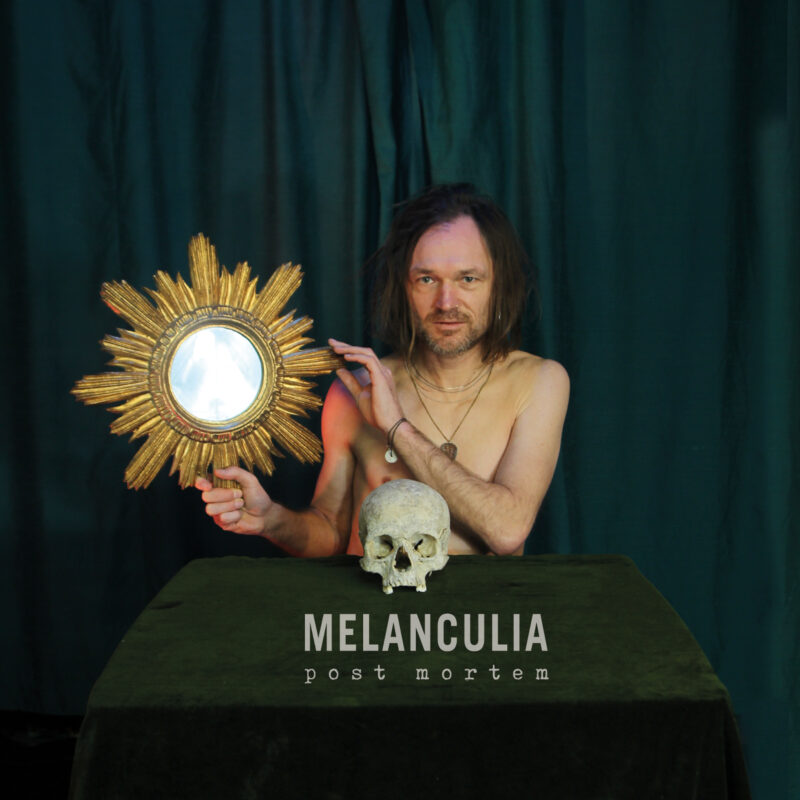
Melanculia’s post mortem begins from a place that is both geographic and psychic: a childhood split between the sunlit northern coast of Portugal and the industrial Ruhr, a life marked by relocation, return, and the private architecture of loss. In a small studio in Essen, Nine Sable writes, plays, records, produces, and designs everything himself, and the album bears the mark of that total authorship. It feels handmade in the oldest sense of the word, as though each chord has been sanded down, stained, and left to dry under a low German sky.
Melanculia is not a new mask so much as a return to an earlier self. Before his band Aeon Sable, and prior to its sixteen years of gothic rock grandeur and wide-screen lamentation, there was this rawer instinct from Sable: voice, guitar, atmosphere, and the kind of lyric that prefers the exposed nerve to the ornamental flourish. post mortem pares the room down to acoustic guitar, spectral keyboards, spare percussion, and Sable’s bruised, theatrical baritone. The result is a record of endings that keeps searching, often stubbornly, for some small aperture of grace. Its lineage runs through Nick Cave’s graveyard romanticism, Peter Murphy’s dramatic poise, the devotional weight of Dead Can Dance, the desolate elegance of Rowland S. Howard, and the bruised grandeur of early Placebo and Katatonia.
Dark Days begins with bright synths, acoustic guitar strumming, and heartfelt vocals, resembling a letter sent across distance. Sable describes watching rain fall as he shares a message with someone far away. The rain acts as the album’s first symbol of mercy—bringing pain but also cleansing. Sable addresses upcoming challenges with a calm confidence, having endured enough to understand their form. Its lonely guitar and passionate singing evoke a touch of Bowie’s later style—marked by elegant exhaustion and cosmic solace.
On the Western-tinged folk-ballad The Tower, Sable walks through an old town and finds the past already condemned, “declared dead and gone.” A solemn synth line gives way to a hypnotic guitar figure, suggesting a desert road, a church bell, a horseman without a horse. The song has a Nick Cave-like sense of moral dust and theatrical distance, yet Sable’s preoccupation is less with damnation than self-invention.
Runaways brightens the palette without losing the album’s ache. Its romance is brief, fragrant, already touched by departure. Love here is a shared route out of a collapsing world. The track has a little psychedelic sweetness at the edges, with vocals that hover above the guitar like heat over pavement. At moments, it brushes against the woozy pop drift of the Dandy Warhols, though Sable’s sense of flight is more desperate, less decadent. The world, he tells us, “is made for ghosts to consume.”
The Healer follows with a darker kind of seduction. Sable arrives as doctor, lover, and flame, carrying “a bottle of unicorn blood” under a black coat. The image might buckle under a lesser singer, but he delivers it with enough old-world conviction to make it feel like a secret love note. A mournful accordion curls around the voice, and the song becomes a strange pact of care and possession. Healing, in Sable’s hands, is intimate, theatrical, and slightly dangerous.
Emptiness deepens the album’s gothic-ballad mode and draws near the romantic fatalism of Rowland S. Howard. Its beauty lies in restraint, in the way Sable allows space to do some of the speaking.
We Are Only Human turns from the beloved to the cosmos, addressing “Old sister moon,” “Old mother earth,” and “Oh great helios” with the humility of a man who knows scale is not on his side. Tears, light, fire, and thought are offered upward and outward. The song moves slowly, almost like a hymn overheard from a chapel at the edge of town.
Confessions and I Just Wanna Be a Good Guy form the album’s moral center. In the first, Sable insists that he has been kind, that he has tried, while demons inside him push to get out. It’s slow, devotional atmosphere recalls Dead Can Dance as filtered through the skeletal tension of Bauhaus, solemn but still alive with dread.
In I Just Wanna Be a Good Guy, all escape routes collapse into one blunt desire. The song has a Bowie-esque quality in its grave theatrical poise, the sound of someone singing from the end of his rope while still trying to keep his collar straight.
Sunboat Ascension lifts the record into mythic heat. Fever, summer blaze, red skies, vultures, dawn, and falling wax all gather around an image of ascent that feels both ecstatic and doomed. The drums move with a trance-like sway, and the atmosphere suggests a psychedelic sea shanty pulled into a solar ceremony. Sable’s language grows grander here, but the song remains rooted in bodily sensation: burning, sinking, lifting, surrendering. Its drama comes from the tension between flesh and release.
In a Forest of Stars takes up death directly, imagining the reaper first as a presence circling the singer and then as the visitor who finds someone else’s door. Sable turns grief into a vision of reunion beyond the grave. The guitar has an Iberian lilt, simple and sturdy, while the percussion keeps the song close to the earth even as its gaze rises. It has the folk-grave elegance one associates with Nick Cave when he lets the room go still. By the time Falling Into the Sun arrives, love has become the final shelter before sleep, collapse, or disappearance. The bass moves with an ominous steadiness, almost as if a motorik pulse had wandered into a folk lament. Its eerie synths bring Dead Can Dance to mind again, though the song’s propulsion gives it a stranger edge, a devotional march toward brightness.
For a Better Future offers one of the album’s clearest images of endurance. The singer climbs cliffs for a better view, falls into unknown waves, and swims underground with rats for “many many years.” The absurdity of the image only makes it more affecting; survival, after all, is often humiliating before it becomes noble. Once again, there are echoes of Dead Can Dance in the solemn architecture of the song, while Sable’s impassioned vocal keeps it grounded in personal ordeal rather than pageantry.
Saboia returns to Portugal with a blood moon over the hills of Luzia, stars brightened by love and presence. The Portuguese lines give the song the quality of a private vow: “Ofereço-te a ti, meu amor / A chave dos meus sonhos.” The key to dreams, the flame of the soul, the instruction to use both with precision – these are romantic gestures, certainly, but they are also acts of trust. The track feels dreamy, almost Lynchian, a love song glimpsed through red curtains and rural moonlight.
Imago then closes the album like a strange lullaby, placing rebirth inside a circle of fire, storm, wet earth, and chosen sisterhood. After so much flight, confession, mourning, and cosmic address, the ending feels unexpectedly gentle, like being gathered into someone’s arms after a long passage through bad country. It is a soft landing, though not a simple one.
post mortem is a record about aftermath, but it rarely mistakes pain for depth. Its best moments are plainspoken, even when the imagery turns lunar or mythic. Sable’s voice carries the gravitas of someone standing at the end of a long corridor, unsure whether the door ahead opens to a room, a chapel, or the open air. He has made an album of small arrangements and large feelings, a work that treats grief as a geography one must cross by foot, with a guitar in hand and a little light saved for the road.
Listen to post mortem below and order the album here.
Follow Nino Sable:
The post “Old Sister Moon, Take My Tears With You” — Melanculia Turns Loss into Nocturnal Gothic Folk on “post mortem” appeared first on Post-Punk.com.