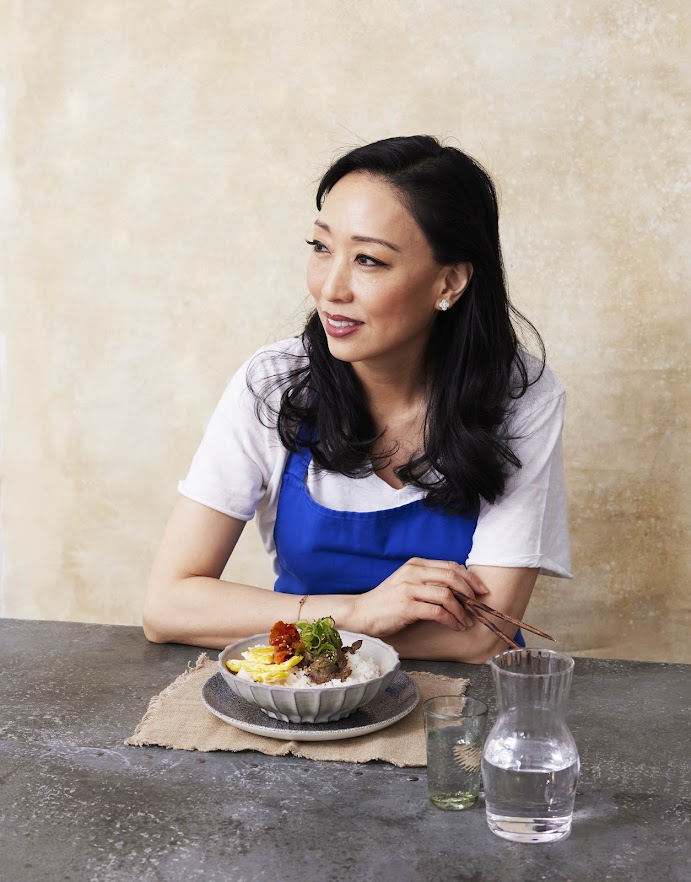
Many of us have fallen for Korean cuisine over the years, whether that's sitting with friends for a Korean BBQ or a comforting bowl of kimchi jjigae to make one feel warm and back to normal. Korean food may have exploded in recent years, but it wasn’t always this way. Korean-American chef Judy Joo has seen the love grow firsthand, and although welcoming the global appreciation while still amazed, she reflects on a very different experience growing up: ”As a kid I was completely embarrassed by Korean food and would beg my mom not to pack it for my school lunch. The smells were strong, the ingredients were weird to my friends, and I desperately wanted to fit in.
To think now people around the world want to create those very meals and snacks in their own homes shows how fast the Korean wave has exploded. But it is the stories of those who’ve seen the shift that are the most interesting to hear. Judy talks with such passion for Korean food. One that is a place of comfort but also pride in sharing that love with those who want to create it in their own homes. Her bestselling cookbooks, Food Made Simple, Judy Joo’s Korean Soul Food, and K-Quick: Korean Food in 30 Minutes or Less, encourage beginners to start small, while her accompanying television work on Amazon Prime provides the educational side to help deepen the culture behind the meals. Traditions such as the art of fermenting kimchi are an interesting little reminder to slow down and enjoy the process, perhaps a lesson we can all apply to our fast-paced way of life.
It is a privilege to have Judy as my first interview for Seoul Stories. The people who educate us, share their culture, and encourage curiosity deserve to be celebrated. With three bestselling books and restaurants from London to New York, Judy has become the go-to chef to teach the ways of Korean cuisine.
At the heart of our interview, Judy perfectly sums up why I and so many others have fallen for Korean food: “It's intuitive, joyful nutrition, and I find that incredibly exciting to explore and share.”
When you were growing up, was there a particular memory with food that made you realise this was something you wanted to pursue as your career?
Judy Joo: There wasn't one single lightning-bolt moment — it was more like a slow, delicious accumulation. Growing up in a Korean-American household in New Jersey, food was the language my family spoke most fluently. My mother and grandmother were always in the kitchen, and the smells that came out of that room — fermented, spicy, deep and savoury — were my entire world. I remember sitting on the kitchen floor watching my mom make kimchi, her hands moving so fast and with such confidence, and thinking there was something almost magical about it. She never measured anything. It was all feeling, instinct, and love. I wanted to understand that language. I wanted to be fluent in it too.
But if I'm being really honest, the career pivot didn't come from a childhood memory — it came from burnout. I was working in finance on Wall Street, and one day I just realised I was completely hollow. The only time I felt truly alive was when I was cooking. So I walked away from banking and enrolled in culinary school. That kitchen table in New Jersey? That's where it all started, even if it took me a while to find my way back to it.
How much has your family history shaped your relationship with Korean food and culture?
Judy Joo: Enormously. Completely. There's no version of me that exists separately from my family's food history. My parents immigrated to the United States from Korea, and food was the thread that kept our culture alive. We ate Korean at home every single day. Kimchi and eggs for breakfast, kimchi, in fact, was at every meal, and rice was always on the table. My mother cooked these dishes to feed us, but it also anchored us — to remind us who we were and where we came from.
As a kid I was completely embarrassed by Korean food and would beg my mom not to pack it for my school lunch. The smells were strong, the ingredients were weird to my friends, and I desperately wanted to fit in.
Now I feel a deep sense of gratitude that I grew up eating my culture’s food — because those dishes were an act of love and cultural preservation. Understanding that has made me a much more intentional cook and storyteller. I'm not just cooking recipes; I'm carrying forward a legacy.
Today many people are invested in Korean food, growing up, I imagine attitudes towards Korean food were much different.
Judy Joo: Oh, absolutely. The contrast is almost surreal to me. Growing up, being Korean was something I hid, not outwardly celebrated. Korean restaurants existed, but they were tucked away in Koreatown, almost invisible to mainstream America. Korean culture was not something the broader world was particularly curious about.
Now I can walk into any grocery store and see gochujang on the shelves next to ketchup. Teenagers are obsessed with Korean barbecue and tteokbokki. That's a seismic shift that happened in less than a generation. And it's not just food — it's K-pop, K-dramas, K-beauty — there's a whole Korean wave that has swept the world. For those of us who grew up feeling like outsiders because of our culture, it's an incredibly emotional thing to witness.
How does it feel to see such a global enthusiasm for Korean cuisine today?
Judy Joo: It makes me emotional, genuinely. There's joy, there's pride, there's a little disbelief — and honestly, there's also a strong sense of responsibility. When a cuisine becomes globally popular, there's always a risk of it being flattened or simplified, reduced to its most photogenic elements while the deeper cultural context gets stripped away.
So yes, I'm thrilled that the world has fallen in love with Korean food. But I also feel a duty to make sure that love is informed — that people understand the history, the philosophy, and the family stories behind these dishes. Korean food is not just trendy. It is ancient, complex, full of tradition, and deeply meaningful. If my work helps people appreciate that fuller picture, then I feel like I'm doing something worthwhile.
Your book, Korean Food Made Simple, is incredibly popular. When compiling recipes together, who did you have in mind as the audience for the book, and who did you hope would benefit the most from it?
Judy Joo: I had a very specific person in mind: the curious home cook who had maybe eaten Korean food at a restaurant, loved it, and had absolutely no idea how to begin making it at home. Someone who found the ingredient list intimidating, who didn't know where to buy gochujang or doenjang, and who thought Korean cooking was somehow out of reach. That's exactly who I was writing for.
I also had a version of my younger self in mind — the American-Korean kid who loved Korean food but didn't have the vocabulary or confidence to explain it to others. I wanted to create a bridge. A book that said, 'This food is delicious, welcoming, and learnable, and it will change the way you cook forever.' The title says it all, really. I wanted to make it simple. Not dumbed down — just approachable. Those are very different things.
The video series on Amazon Prime gives great context behind the recipes. What made you want to highlight the traditions and cultural stories behind the food as you travelled across South Korea?
Judy Joo:Because without the story, food is just fuel. And Korean food has some of the most extraordinary stories behind it. Every dish carries centuries of history — political, agricultural, spiritual. The way Koreans think about food is deeply holistic: it's tied to seasons, to the body, to the idea of balance. You can't just pluck a recipe out of that context and fully understand it.
I also felt a personal urgency to tell those stories before they fade. Korea has modernised at an extraordinary pace, and some of the traditional practices, the grandmother knowledge, and the regional variations are at risk of being lost. Getting to travel across South Korea and sit with the people who carry that knowledge, to film it and share it with the world — that felt like an honour and a responsibility in equal measure.
What was the most memorable lesson you took away from that journey? Did you learn anything about yourself?
Judy Joo: The most profound lesson was about patience and slowness. So much of traditional Korean food — the long ferments, the hours of preparation, the rituals around certain dishes — is built on a relationship with time that modern life has almost entirely dismantled. There were women I met who had been making the same doenjang paste for decades, tending it like something sacred. That level of devotion humbled me.
As for what I learnt about myself — I think I made peace with something. Growing up between two cultures, I always felt slightly out of place in both. Not Korean enough in Korea, not American enough in America. That trip helped me understand that my in-between position is actually a gift. I see both worlds clearly precisely because I've lived in the hyphen between them. That's where my work lives, and I'm proud of it now in a way I wasn't always able to be.
As someone who cooks all the time, what restaurants do you enjoy going to, and are there any that stick out as must-visits?
Judy Joo: I genuinely love eating out — it keeps me curious and inspired, and it forces me to be a guest rather than a host, which is good for the soul. I'm always drawn to places that feel deeply personal, where you can taste the chef's conviction in every dish. I love a place with a clear point of view. Technique matters, but soul matters more.
In terms of must-visits, I'm always cautious about naming specific spots because the restaurant world changes so fast — places open and close, chefs move on. But broadly: seek out the restaurants run by first- or second-generation immigrants who are cooking their family food with serious skill and love. Those are almost always the most electrifying meals. The combination of memory and mastery is unstoppable.
Across your books — Korean Food Made Simple, Judy Joo’s Korean Soul Food, and K-Quick: Korean Food in 30 Minutes or Less. Have you seen a shift into what people want to learn when it comes to Korean cuisine?
Judy Joo: Massively. When Korean Food Made Simple came out, I was essentially starting from zero with a lot of readers — explaining what gochujang was and walking people through a Korean pantry for the first time. It was introductory by necessity. People needed permission to even try.
By the time Korean soul food came along, there was a real hunger for depth — the history, the regional differences, and the lesser-known dishes beyond bibimbap and bulgogi. And then K-Quick responded to something else entirely: people who already loved Korean food and wanted to make it part of their everyday cooking, not just a weekend project. The audience has grown with me, which I find really exciting. We're not in the introduction phase anymore. We're having a much more sophisticated conversation, and that feels wonderful.
What’s great about your approach to helping people is encouraging them to start small – like adding gochujang to sauces or putting kimchi alongside familiar dishes. Do you think that accessibility has been key to helping more people gain confidence with cooking?
Judy Joo: One hundred per percent. Fear is the biggest barrier in the kitchen. People convince themselves they can't cook something before they've even tried, and with Korean food specifically, the unfamiliar ingredients can feel like a wall. My whole philosophy is about lowering that wall, brick by brick.
If I can get someone to add a spoonful of gochujang to their pasta sauce and have their mind blown, that's a win. Because now they're curious. Now they'll buy that jar of doenjang. Now they'll try the kimchi pancakes. Confidence builds on itself. You just have to give people that first small victory and then get out of the way. Cooking should feel joyful, not like a test you might fail.
Is there one recipe that’s especially meaningful to you personally, or one that readers constantly tell you they love making?
Judy Joo: Personally, it has to be kimchi jjigae — a spicy bubbling stew. It's not glamorous, it's not photogenic, it's not the dish that goes viral on Instagram. But it is the most deeply comforting thing I know how to make. It tastes like my mother's kitchen, my grandmother's kitchen, like every morning of my Korean childhood. When I make it, I feel held. That's the only word for it.
As for what readers tell me, kimchi fried rice comes up constantly, and I completely understand why. It's the perfect gateway dish. It's easy, it's endlessly adaptable, it uses ingredients you might already have, and the result is so satisfying that it almost feels like cheating. I love that it's brought so many people their first real Korean cooking success.
You spent years pitching Korean Food Made Simple before it was finally commissioned. Did that persistence change the way you view success in the food and media industries?
Judy Joo: It taught me everything. Those years of rejection were brutal in the moment, but they were also clarifying in a way I couldn't see at the time. Every 'no' forced me to sharpen my argument for why this book needed to exist, why Korean food deserved the same shelf space as French or Italian or Japanese cuisine. By the time someone finally said yes, I was absolutely certain about what I wanted to make and why.
I think the food and media industries are particularly susceptible to trend-chasing—there's always a question of whether the market is 'ready' for something. And that framing puts the wrong people in charge of the decision. The market is never ready for something that doesn't exist yet. You have to make it exist first. That's a lesson I carry everywhere now.
What advice would you give to budding chefs that want to create their national dishes for a western market but may be hesitant?
Judy Joo: Don't compromise the soul or the DNA of the food to make it palatable. That is the biggest trap, and I've seen so many talented people fall into it. There's a version of 'making it accessible' that tips over into erasure — removing the fermentation, completely changing the spices and herbs, deleting the flavor profile— and at a certain point you're no longer cooking your food, you're cooking a caricature of it.
Trust your food. Trust the people who raised you on it. The dishes that feel most unfamiliar to Western palates are often the ones that, once people try them, become the ones they're most obsessed with. Give people the closest version to the real thing possible and let them rise to meet it. Of course, you will have to change some things, that is a given. And with that you’ll find your own voice within your culinary tradition — not a translation, but an honest expression of who you are. That's what cuts through.
How do you keep so creative and motivated considering you juggle so many projects at once? Do you have a routine that works for you to prevent getting overwhelmed?
Judy Joo: Honestly? I'm not sure I've ever fully solved the overwhelm problem — I've just got better at living with it. I thrive on momentum and I get bored easily, so having multiple projects running at once actually suits my brain. The variety keeps me sharp. When I'm stuck on one thing, I can pivot to another and come back with fresh eyes.
In terms of routine: I always work out in the early mornings. I love Pilates, and it is my happy place. I find it clears my mind, and moving my body first thing in the morning is the perfect way to start the day.
Your career has been nothing short of inspirational, from quitting banking to writing books, creating TV cooking shows, and opening restaurants in London, NYC, and Edinburgh. Where do you get that motivation to keep reaching new heights?
Judy Joo: I think it comes from a deep-seated conviction that Korean food and culture deserve a bigger seat at the global table — and that I am in a position to help make that happen. That feels less like ambition and more like purpose. When something feels purposeful, it doesn't drain you the same way. You can sustain it.
 |
| Photo Credit: lateef.photography |
I also think about my parents a lot. They left everything they knew to build a life in a country that didn't always make them feel welcome. The least I can do is make the most of the opportunities that sacrifice created. That's not pressure — it's fuel. Every time I'm tired or discouraged, I think about what they built with so much less, and I find another gear.
Having achieved so much, there must be so many moments you’re proud of. If you could only pick one, which would you choose?
Judy Joo: Giving the commencement speech at Columbia. Without a doubt.
I stood up there looking out at all those graduates and felt the full weight of my own journey. Columbia represents a certain kind of ambition — the prestigious career, the trajectory everyone approves of. I know that world. I lived inside it. I was doing everything "right" and quietly not feeling exactly happy.
So to stand at that podium and talk honestly about walking away from all of it, about choosing the thing that made me feel alive over the thing that made me look impressive, and to see people in the crowd nodding — that hit me somewhere very deep.
I wanted those graduates to feel permission. Permission to disappoint expectations, to pivot, to trust the thing that won't leave them alone. That day, everything I'd been through — every rejection, every risk, every moment of doubt — felt like it had been building to something worth sharing. That's a rare feeling. I'm grateful I got to have it.
Following those achievements, what still motivates you creatively after all these years?
Judy Joo: The food itself, always. Korean cuisine is so vast and deep that I genuinely feel like I've barely scratched the surface, even after all these years. There are regional specialities I haven't cooked, fermentation traditions I'm still learning, and historical dishes that have almost disappeared. The subject matter is inexhaustible, and that's a gift.
I'm also motivated by the people I meet — the grandmothers preserving traditions in their kitchens, the young Korean chefs doing extraordinary things in cities all over the world, and the home cooks who send me photos of their first successful kimchi. There's a whole living, evolving community around this food, and being part of that community keeps me energised in a way I can't quite put into words.
What’s the next goal or challenge you’d still love to pursue?
Judy Joo: Korean food has always been inherently healthy — fermented, plant-forward, built around balance and seasonal ingredients — but I don't think that story has been told loudly enough yet. That's what I want to focus on next.
There's so much noise right now around wellness and what we should and shouldn't be eating, and meanwhile, Korean grandmothers have been quietly doing it right for centuries. Fermented foods like kimchi and doenjang are packed with probiotics. The banchan culture — all those small side dishes — naturally creates variety and balance without anyone having to think about it. It's intuitive, joyful nutrition, and I find that incredibly exciting to explore and share.
Follow Judy Joo:
Instagram I Books I YouTube I Official Website