Aleesha Dibbs has spent enough time inside other people’s music to know the difference between presence and ornament. As a keys player, vocalist, and session musician, she has moved through large stages and strange rooms alike, working with Karen O, Angus & Julia Stone, Lisa Mitchell, MT Warning, Prudence, Lorelei, All Sparks Burn Out, and her own earlier projects Dive Bell and Double Vision. On Big Mood, her debut solo album, that accumulated fluency becomes a private language, one built from post-punk pressure, alternative-pop immediacy, and the kind of low-lit physicality that suggests Fontaines D.C., Kim Gordon, and Warpaint passing through the same locked corridor without agreeing on the exit.
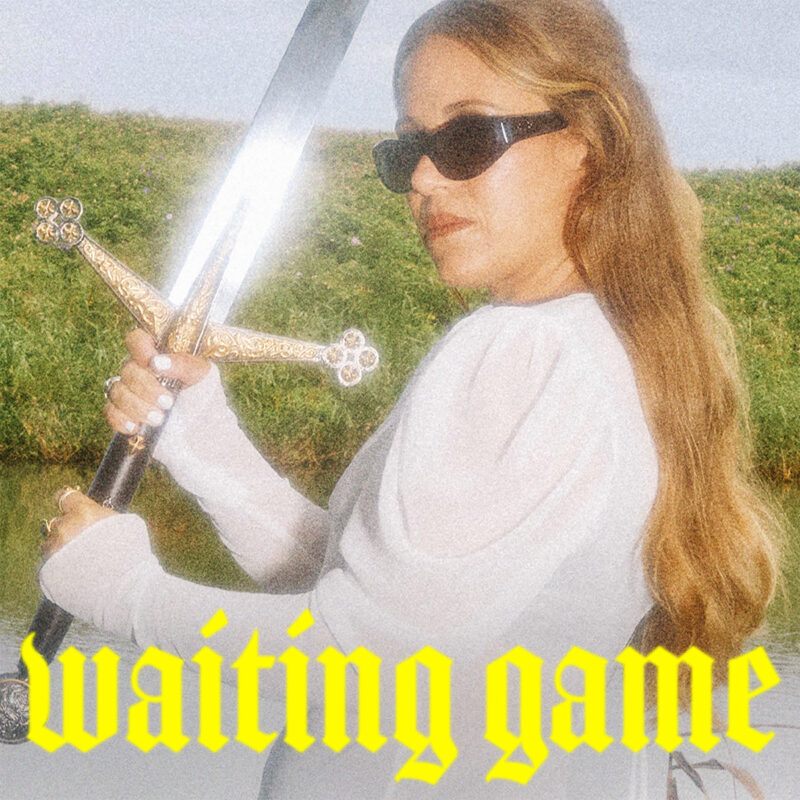
The first single, Waiting Game, sets the tone with unusual patience, taking an existential premise and keeping it close to the body: postponement, delayed consequence, the strange private arithmetic of choosing one door while imagining the life behind another. Dibbs sings as though she is measuring the distance between instinct and action, holding herself in the charged interval before a decision hardens into fate.
The track gathers force by degrees, refusing any cheap revelation; its tension comes from pressure carefully held, from the sense that hesitation can become its own kind of habitat. Around her, the guitars scrape and flare, bringing to mind the slackened bite of Liz Phair, the bruised melodic force of The Breeders, and the serrated pop logic of Pixies. Dibbs bends those references toward her own temperament, allowing the song’s hook to feel less like a slogan than a communal exhale, a chant formed at the edge of recognition.
Waiting Game treats pause as an active state, full of consequence, appetite, and risk. The song understands that waiting can be a form of paralysis, but also a form of preparation: the breath before speech, the hand before the handle, the life one imagines before stepping into the one that remains. That credo could sound inflated in lesser hands. Dibbs makes it lived-in, tensile, and exact. Waiting Game is the sound of an artist ready to step into the limelight.
Listen below, and order the single here.
Across Big Mood, Dibbs writes against emotional compression, against the tidy self one is expected to maintain while screens multiply, attention fragments, and feeling becomes another inconvenience to be managed. The record’s title has a wry bluntness, yet the songs are finely calibrated, turning large states of mind into taut arrangements and charged vocal lines.
Produced, engineered, and mixed over three years by longtime collaborator Tom Crandles, whose credits include Au.Ra, Prudence, and DMA’s, the album carries the mark of careful construction without losing its nerve. The mastering, completed at Black Knoll Studios in New York City, gives the record a clean edge that suits its conflict between control and release.
Dibbs’s own description remains the best key to the album’s ethic: “For the most part, Big Mood is about fighting back,” she says. “It’s about saying, unapologetically, yes to big feelings. It’s about uncovering and embracing self-agency, taking up as much or as little space as you need. And ultimately, it’s about remembering we’re human, submitting to whatever needs to pass through, without guilt and without apology.”
Follow Aleesha Dibbs:
The post Sydney’s Aleesha Dibbs Asks Existential Questions With “Waiting Game,” The First Single From Forthcoming Album “Big Mood” appeared first on Post-Punk.com.