Joy Division’s studio recordings can feel sealed inside negative space: precise, cavernous, and fixed within the severe architecture Martin Hannett built around them. Onstage, that architecture sweated and buckled. Stephen Morris’s drums surged forward with machine-like force; Peter Hook’s high bass carried melody like an alarm; Bernard Sumner’s guitar cut cold through the open air; and Ian Curtis danced at its centre, pulling each song toward the unstable border between discipline and collapse. For decades, that other Joy Division has survived in fragments—radio broadcasts, soundboard tapes, audience cassettes, bootlegs, grainy film, and the memories of rooms long gone.
That scattered history is now being gathered on an unprecedented scale. Joy Division have announced Eternal (Live), a monumental 14CD/2DVD archival collection arriving on September 25 via Warner Music. Its audio discs contain 192 tracks drawn from 16 performances recorded between March 1979 and May 1980, all mastered at Abbey Road Studios, while the two DVDs collect more than two and a half hours of concert film.
Warner describes Eternal as the band’s first official collection of live concert recordings. That wording speaks to its scale and organizing principle rather than the absence of officially released live material. The posthumous 1981 double album Still paired studio outtakes, non-album recordings, and rarities—including “Exercise One,” “Ice Age,” “The Sound of Music,” “The Only Mistake,” “Something Must Break,” “Dead Souls,” and “Glass”—with Joy Division’s final concert at Birmingham University’s High Hall on May 2, 1980. The complete eleven-song set included the only known live performances of “Ceremony” and “Decades” before ending with “Digital.” Still also preserved the band’s cover of The Velvet Underground’s “Sister Ray,” recorded at London’s Moonlight Club on April 2, 1980. Later releases such as Preston 28 February 1980 and Les Bains Douches 18 December 1979 documented further portions of the band’s stage history.
Eternal also follows Joy Division’s previous major archival box set, Heart and Soul, released in 1997. That four-CD collection gathered nearly all of the band’s studio output—including Unknown Pleasures, Closer, singles, and compilation appearances—across its first two discs. The third assembled demos, rough mixes, radio sessions, and rehearsal recordings, while the fourth presented selected live performances, including ten songs from the Factory concert of July 13, 1979, and five from the Lyceum on February 29, 1980. Eternal returns to those nights with fuller presentations and newly heard sources. Rather than replacing Heart and Soul, the new collection functions as its live counterpart: where the earlier box mapped Joy Division’s recorded canon, Eternal traces the songs changing from room to room and night to night.
The collection begins at London’s Hope and Anchor on March 1, 1979, more than three months before the release of Unknown Pleasures, and ends with Joy Division’s final performance at High Hall in Birmingham on May 2, 1980. Between those points, it moves through youth clubs, Factory nights, festivals, European radio broadcasts, London venues, and provincial halls, following the group across the final fourteen months of its existence.
Two performances are presented from previously unreleased recordings. The Hope and Anchor set has been assembled from two unheard audience tapes—one made by Jonathan Crabb and another by an unidentified taper—while the seven surviving songs from Acklam Hall on May 17, 1979 also come from a Crabb audience recording.
Three further performances contain newly heard sources. The band’s July 13, 1979, appearance at Manchester’s Factory arrives from a previously unheard soundboard recording. The first nine songs from the Lyceum in London on February 29, 1980, are newly available, followed on the disc by two additional performance tracks and five soundcheck recordings. At the Moonlight Club on April 2, 1980, “The Sound of Music” comes from an audience tape, while six songs—from “Wilderness” through “Dead Souls”—are drawn from a mostly unheard desk recording. They join the already familiar Still-issued cover of “Sister Ray” to complete the surviving eight-song document of that night.
Eternal does not attempt to disguise the uneven physical history of these recordings. Its sources range from direct soundboard tapes and broadcasts by France Inter and the Dutch broadcaster VARA to audience cassettes made by Crabb, Malcolm Whitehead, Duncan Haysom, Andy Hooper, and Tim Bayes. Some performances are matrices combining multiple tapes; others retain the distance, room noise, and rough edges of a single audience source. The result is less a conventionally polished live album than a documentary map of Joy Division moving through different rooms, crowds, and stages of its rapid evolution.
The chronological sequence also reveals how quickly the repertoire changed. The early 1979 sets place “Exercise One,” “Leaders of Men,” “Glass,” “Ice Age,” and “The Only Mistake” beside material that would define Unknown Pleasures. By the summer, “Dead Souls,” “Wilderness,” “Atrocity Exhibition,” and “Autosuggestion” have entered the performances. As the collection crosses into 1980, songs destined for Closer—“Passover,” “Twenty Four Hours,” “Heart and Soul,” “Isolation,” “The Eternal,” and “Decades”—begin occupying more of the stage.
Some nights emphasize clipped economy; others allow the songs to stretch and scrape against their own structures. Setlists shift continually, sometimes from one evening to the next. “Love Will Tear Us Apart” moves from an emerging song into a recurring centerpiece, while “Atmosphere” appears amid sets that still close with the blunt force of “Interzone,” “Warsaw,” or “Digital.”
The final audio disc returns to the band’s last concert at Birmingham University’s High Hall, performed sixteen days before Curtis’s death and previously issued in full on Still. The concert opened with Joy Division’s only known live performance of “Ceremony.” For Eternal, the first minute of the song is taken from an audience recording by an unidentified taper, after which the sound-desk source takes over. The set then moves through “Shadowplay,” “Passover,” “New Dawn Fades,” “Isolation,” and the only known Joy Division performance of “Decades,” before ending with “Digital.”
The first preview from the collection is “Transmission,” recorded at Les Bains Douches in Paris on December 18, 1979, for a France Inter broadcast. Morris’s drums keep the song locked in constant forward motion, while Hook’s bass cuts a severe melodic path beneath Sumner’s guitar and Curtis’s repeated command to dance.
The familiar 2001 live album bearing the Les Bains Douches name combined nine Paris performances with material from the Paradiso in Amsterdam and the Effenaar in Eindhoven. Eternal separates those dates, presenting the sixteen-song Paris broadcast, the seventeen-song Paradiso set, and the sixteen-song Effenaar recording as three distinct documents.
Listen to “Transmission (Live Les Bains Douches, Paris, December 18, 1979)” below:
The visual archive is comparably extensive. The first DVD includes a new 2026 edit of Joy Division — A Malcolm Whitehead Film, incorporating 1979 rehearsal material and three songs filmed at Bowdon Vale Youth Club. It also contains the band’s two performances from the BBC programme Something Else—“Transmission” and “She’s Lost Control”—broadcast in September 1979.
Its centrepiece is the previously unseen Plan K concert in Brussels from October 16, 1979. The footage is presented first with its original 1979 audio and then as an eleven-song reconstruction made in 2026. That second version uses recordings from Les Bains Douches for most of the set, with “Twenty Four Hours,” “Atrocity Exhibition,” and “Interzone” sourced from the Paradiso performance. “Love Will Tear Us Apart” appears only in the original-audio presentation.
The second DVD gathers two concerts from Manchester’s Apollo Theatre, recorded on October 27 and 28, 1979, along with soundcheck footage from the same period. Portions of those performances were used for Factory Records’ Here Are The Young Men, released on VHS and Betamax in 1982; Eternal returns to the surviving reels to present considerably more of both nights.
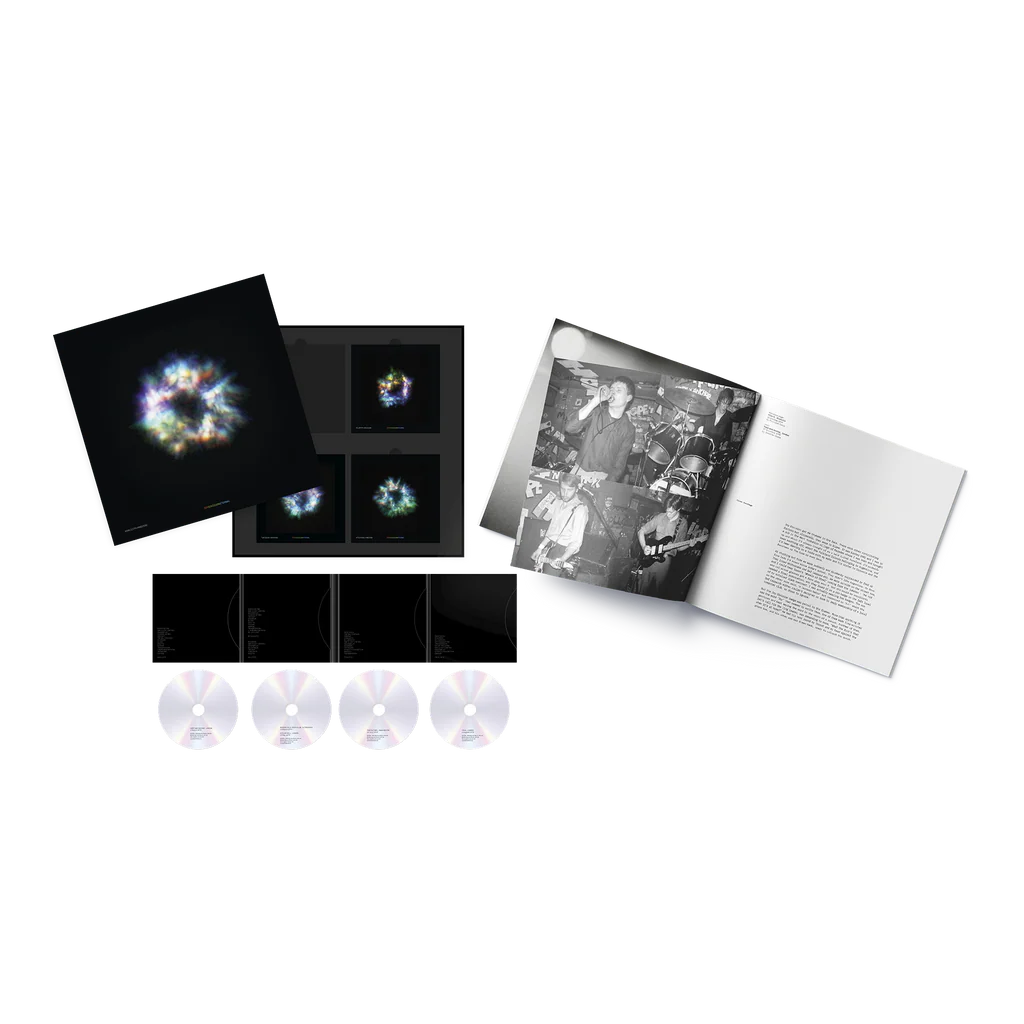
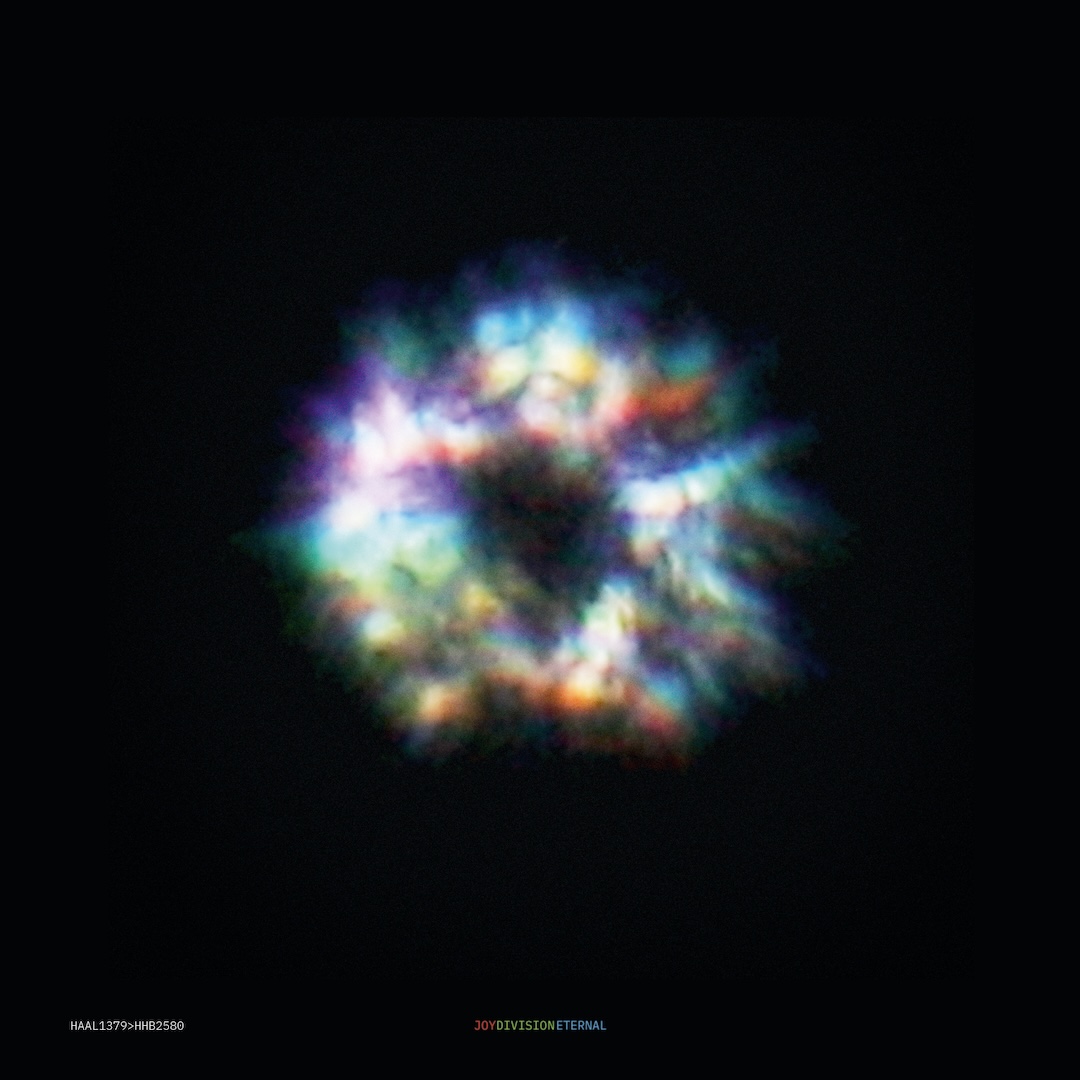
The physical collection is housed in a 12-by-12-inch lift-off-lid box with artwork by Warren Jackson, Peter Saville, Howard Wakefield, and Brett Wickens. Its cover uses Wolfgang Tillmans’s photograph Sirius Through a Defocused Telescope, 2023, in which the brightest star in the night sky becomes a blurred, prismatic bloom suspended against black.
A 16-page booklet includes personal notes by poet Simon Armitage and photography by, among others, Anton Corbijn and Kevin Cummins. The complete 192-track audio edition will also be available digitally.
The announcement arrives alongside a renewed examination of the band’s archive. Ian Curtis: Insight, an exhibition of handwritten lyrics, photographs, personal letters, ephemera, and objects from the Ian Curtis archive at the John Rylands Library, runs at New York’s Voltz Clarke Gallery through July 22. Joy Division and New Order will also be inducted together into the Rock & Roll Hall of Fame in November.
Eternal (Live) is out September 25 via Warner Music. Pre-order or pre-save the collection here.
Previously unreleased. Mixed from two previously unheard audience recordings: one by Jonathan Crabb and one by an unidentified taper.
“Exercise One” comes from a soundboard recording; the remainder is a soundboard-and-audience matrix incorporating Malcolm Whitehead’s tape.
Previously unreleased audience recording by Jonathan Crabb.
Previously unheard soundboard recording.
Soundboard recording.
Audience recording by Duncan Haysom.
France Inter radio-broadcast recording.
VARA radio-broadcast recording.
Audience recording.
Soundboard recording.
The first nine performance tracks are previously unheard. Tracks 1–10 come from a soundboard tape; “Atrocity Exhibition” is a soundboard-and-audience matrix incorporating Duncan Haysom’s recording. The five soundcheck tracks come from an audience source.
Soundcheck:
“The Sound of Music” comes from an audience recording by Andy Hooper. Tracks 2–8 come from a mostly unheard desk tape; “Sister Ray” was previously released on Still.
Audience recording by Andy Hooper.
Audience recording by Tim Bayes.
Audience recording by Tim Bayes.
Sound-desk recording. The first minute of “Ceremony” is taken from an audience recording by an unidentified recordist.
Comprising 1979 rehearsal footage and material filmed at Bowdon Vale Youth Club in Altrincham on March 14, 1979:
Uses Les Bains Douches audio except “Twenty Four Hours,” “Atrocity Exhibition,” and “Interzone,” which use the Paradiso recordings. “Love Will Tear Us Apart” is not included in the reconstructed version.
DVD 2 also includes Apollo Theatre soundcheck footage recorded in October 1979.
The post Joy Division’s “Eternal (Live)” Announced — A 14CD/2DVD Box Set Featuring 16 Performances and Previously Unseen Footage appeared first on Post-Punk.com.