
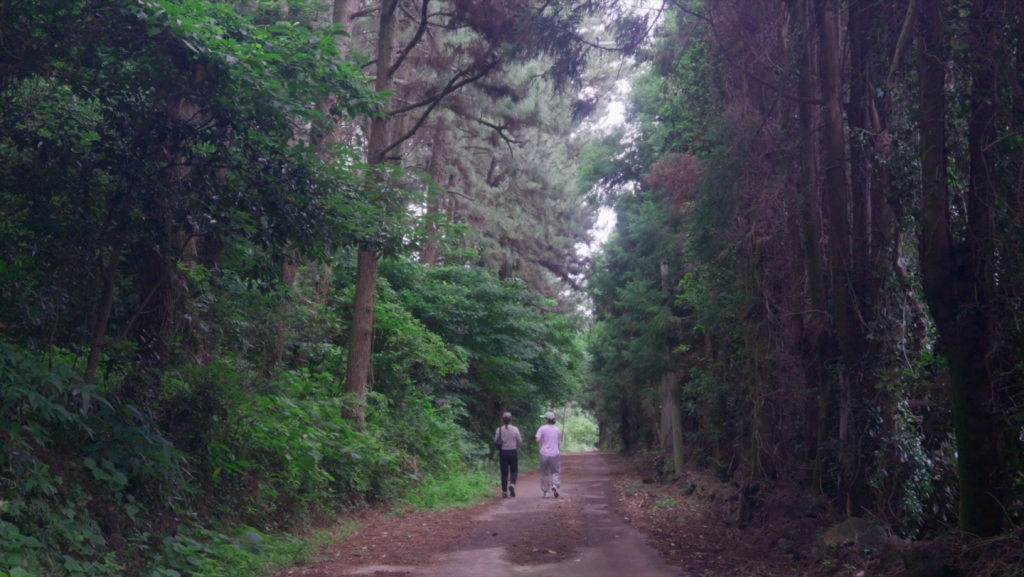
Filled with passion and righteous indignation at the destruction 900 towering cedar trees and acres of natural forest habitat along the Bijiram-ro highway by the Jeju government, filmmaker and community advocate Kim Da-un was inspired to make her sophomore documentary The Time of Jeju, shine a light on the actions taken by five women and their community to fight back.
Premiering at the 27th Jeonju International Film Festival (JIFF), The Time of Jeju opens up a perspective of life on Jeju unknown to those on the mainland and the world; the fire burning in the hearts of locals and dedicated transplants to protect the home from the looming threat of development of a proposed second major airport.
First publicly announced in 2015, the second airport was proposed as a necessary development project to boost the economy and visibility of Jeju as a major tourist destination for South Korea. But rather than being accepted wholeheartedly by the local populace, the project has always faced push back and skepticism for the harm it has and will cause, rather than believed benefits it could bring to Jeju.
The initial construction of the airport and necessary infrastructure would call for 5.51 million square meters of land to be destroyed, and with it the displacement of thousands of people in four of the closet villages; Shinyang-ri, Onpyeong-ri, Susan-ri, and Nansan-ri. That’s decades of community building, and history bulldozed. Should the airport be completed comes additional inconveniences that are in no way mild and easily dismissed. There’s the noise and air pollution from dozens of passenger jets landing daily, the threat to migratory birds (some of which are rare and endangered), increased traffic along the expanded Bijiram-ro highway, which means additional noise and air pollution putting the lives and safety of the forests and the hundreds of species of animals, insects, and amphibians keeping the ecosystem functioning.
The Time of Jeju raises many questions about what development really means for Jeju and South Korea as a whole. The developers and companies hoping to profit from the construction of this new airport only see dollar signs, and so do the politicians backing them up, using tourism as justification for pushing against the will of the people. But as a person who grew up on an island and worked in the tourist industry there, I’d like to ask these people why catering for the convenience of short term visitors takes precedence over the long term protection of the island and the people who call it home?
I’d like to ask why don’t they see protecting and preserving the beauty of Jeju as something they could use to the island’s benefit ecologically, financially, socially, and even politically considering how global warming and climate change are an ever present concern for everyone around the planet. There’s a distinct shortsightedness that always comes into play when capitalism is mixed with the perception that a country, community, environment as it is—specific issues such as stigmatisation and such not withstanding—isn’t good enough for those from the outside to be charmed and impressed by.
People travel because they want to visit new places, meet new people, and have new experiences and learn new things about the world, and Jeju with its complex history, unique topography and habitats, and cultural practices such as the Haenyeo, offer all of this and so much more.
In the film, Kim Da-un shows how dedicated Koreans are to taking action to demand accountability of officials who are seen as failing at their duties to act on behalf of the people who elected them. This culture of protest born from rebellions against occupation by the Japanese empire, and fighting against the brutal military dictatorships and imperial interference that followed are one of the most well known attributes of South Korean identity, and inThe Time of Jeju, this culture comes to the fore loudly in town hall meetings, banner protests standing amongst the uprooted remains of what were once majestic 50 ft cedars, and quietly over meals where the hopes and dreams of five women and the people who inspire them, are shared.
In my email interview with Da-un, she shares what seeing the events unfold over the last several years has been like for her personally as a transplant from Seoul who’s grown to love the people and land of Jeju, and as a filmmaker dedicated to interrogating the identity of South Korea through the camera lens.
Carolyn Hinds: The Time of Jeju is your second feature documentary, your first being the 2023’s This is The Forest Where We Live. Can you share what it’s about?
Kim Da-un: My first feature documentary, This is The Forest Where We Live, is about the Bijarim-ro Citizens Choir, which was formed in response to the expansion project of Bijarim-ro in Jeju.
Rather than being simply a documentary about environmental protection or forest conservation, the film explores how ordinary citizens became emotionally connected to one another while witnessing the sudden return of tree cutting and road construction. The Bijarim-ro Citizens Group emerged out of the desperation people felt after construction, which had been suspended for two and a half years, resumed without warning. The idea began when someone suggested, “What if we sang together in the forest?”
Many different people joined the choir. There were ordinary citizens who were not used to singing in front of others, an alternative school teacher who remembered singing with children while walking through forests, a 69-year-old participant who joined after feeling overwhelmed by the destruction of the forest, and artists and activists who had long searched for a way to participate in civic action. They did not gather simply to perform, but to share their grief, anger, and helplessness in the face of a disappearing forest.
At times, the construction site felt like a battlefield to the people in the film. Yet through the experience of gathering and singing together with the same purpose, they also discovered a deep sense of solidarity and healing. To me, they resembled trees in a forest, connected to one another through roots beneath the ground.
So while the film is certainly about the forest itself, it is ultimately also a story about people trying to remain connected to one another.
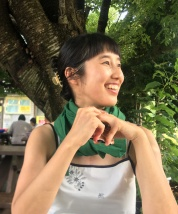
CH: What led to you becoming a documentary filmmaker, and why films about the connection communities have with their surrounding natural environment and conversation?
KDU: In my 20s, I lived in the heart of Seoul’s capitalist society, dreaming of a career at a major conglomerate. However, both my mind and body became exhausted, leading me to migrate to Jeju in 2014. Like many, I was initially drawn to the island by the breathtaking sky and seas I had experienced as a traveler. Yet, once I settled in, the reality was starkly different. I witnessed the onset of so-called “over-development”—groundwater depletion, escalating waste issues, and reckless land speculation—driven by the migration boom and a surge in tourism. Seeing the landscapes I loved being systematically destroyed left me feeling both devastated and indignant.
The definitive turning point occurred while I was working as a gallery curator in Georo Village. This village bears the deep scars of the Jeju April 3rd Incident, a history where the memories and artifacts of residents were once forcibly erased. While interviewing locals to document these vanishing stories, I met an elderly woman who had once tried to film her daily life with a camcorder, only to be forced to stop by those around her. That was the moment I truly realized how easily records can be silenced and wiped away.
Later, while working with documentary directors who were in residency at the gallery, I had the opportunity to appear in and serve as an assistant director for Director Min Hwan-ki’s film, Jeju Note. This documentary explored the realities of Jeju caught in a development frenzy and the complex web of lives and conflicts hidden behind the migration trend. Through that experience, I realized that the lives of ordinary people could be powerful cinema in their own right, which eventually led me to begin my own journey in video documentation.
CH: You began filming In The Time of Jeju, in 2017 at a time when local people began to take the first steps to publicly calling into question the accuracy of Environmental Impact Assessments done prior to the destruction and removal of just under 1000 trees along Bijiram-ro’s main highway, in preparation of expanding it for the proposed airport.
What inspired you to take up your camera to begin documenting what would become an environmental activist movement in Jeju?
KDU: At that time, I was primarily an activist fighting against over-development. I didn’t major in film; I simply started recording because I believed video documentation would be helpful to the Bijarim-ro cause. Eventually, I began thinking of ways to share these long-term records with the public, which led me to filmmaking. My 2023 documentary, The Forest where We Live, was born from the desperate hope that if people learned about the situation at Bijarim-ro through film, the construction might actually be stopped.
While my documentaries are told through the lens of an activist, I wanted to show more than just “environmentalists.” I wanted to capture people striving to create a better society. Whether they are for or against the Bijarim-ro construction or the second airport, their activities—whether individual or social—are driven by perceived interests, and I believe those actions are inherently political. While my previous work was a plea to stop the construction, The Time of Jeju is a more profound expression of my own philosophy and thoughts through the medium of documentary.
CH: In the opening sequence is set during a townhall meeting where residents are crowded into the audience section, while local officials stand on the stage elevated above them, trying to placate them with calls for civilised behavior. Noting this, one of the women in the crowd makes the very astute observation that it should be them the citizens on the stage, and the officials in the audience, and another female resident made a reference to the “Gangjeong Naval Base situation.”
This was to point out the distinction between the social and political position whereby their physical placements within the room and by extension during campaigns and other events, creates the perception and belief that politicians are above rather than equal to the very people who elect them to their positions as representatives.
Because of this, politicians don’t feel as though they’re one with the communities whose best interests they should prioritise, but instead work more on the behalf of corporations and conglomerates.
It was just one sequence, but it’s stayed with me because this has long been an area of contention amongst humans from the time systems of governance and social class were created.
From your perspective as a filmmaker and resident of Jeju-do, can you talk about this scene and the events that took place in that townhall meeting, and the comparison to the Gangjeong Naval Base?
KDU: Capturing that scene was a moment of intense anger and sorrow for me. At that time, I was at the site not just as a filmmaker with a camera, but as an activist myself. As you noted, the physical contrast—officials striving to occupy the high stage while residents tried to block them from below—was a powerful symbol of the flawed power dynamics and perception gaps in our society.
The atmosphere was, in a word, “chilling.” There were only about 20 to 30 residents and activists from Seongsan-eup who opposed the Second Airport, while the government had mobilized over 150 officials. They attempted to seize the stage through sheer numbers, and the scene quickly devolved into complete chaos. When a resident screamed, “If the officials get on that stage, the briefing is considered ‘conducted.’ That’s exactly how they did it during the Naval Base incident!” She was expressing a deep-seated trauma shared by many Jeju islanders.
In Jeju, large-scale national projects like the Gangjeong Naval Base, the Seongsan Second Airport, and the Mt. Songak development has consistently suffered from a lack of procedural legitimacy. The administration doesn’t seem to care how many people gather or how fair the process is; their only goal is to “start” the briefing so they can claim the event was officially held and the procedural requirements were met. This mirrors the painful history of Gangjeong in 2007, where the decision to host the naval base was made in an extraordinary meeting attended by only 87 out of approximately 1,900 residents.
What infuriated me most at the scene was the attitude of the civil servants. It was devastating to see that the representatives and organizations elected by the people do not actually represent the people, but instead serve only the decisions of higher authorities. They didn’t seem to pause and reflect on what was right or wrong. Witnessing that chaos, I was reminded of Hannah Arendt’s concept of the “Banality of Evil.” It hit me hard—the realization that great evil does not only come from “monstrous villains” but can be generated by ordinary people who conform to a system and perform their duties ‘without thinking’ about the consequences of their actions.
This scene is more than just a record of a protest; it is a fundamental question posed by our film: Who does power truly serve, and how can ‘thoughtless conformity’ destroy a community?
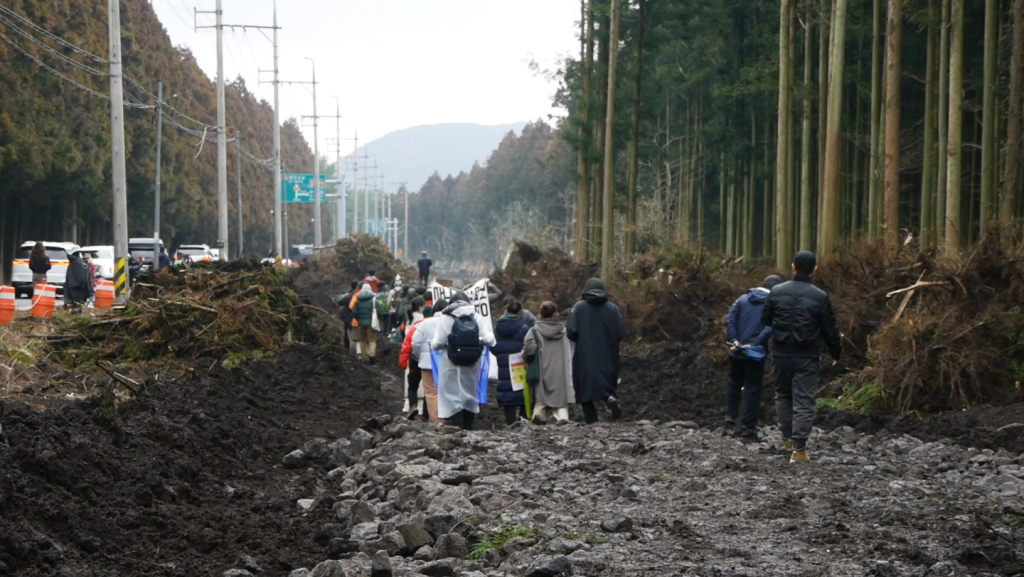
CH: From here the film jumps forward to 2024 where a group of people are walking through a forest late at night to record the activity of the Narrow Mouth Toad, to provide evidence of the prevalence of it and other vulnerable species in danger of being wiped out should the highway expansion and construction of the airport progresses.
Talk about the choice to make this 8 year leap from the townhall meeting. Had the meeting succeeded in putting a halt on the development of the project or were there other factors such as a change in local government?
KDU: The decision to leap across eight years was not a mere omission of time; it was a deliberate choice to encapsulate the “ten years of struggle” that citizens have silently endured. Through this jump, I wanted the audience to confront two conflicting gazes directed at Jeju.
The opening scenes, showcasing Jeju’s pristine seas and valleys, represent the outsider’s gaze, which perceives Jeju merely as a “tourist product”. While many are enchanted by this beauty, they often remain indifferent to the destruction occurring behind the scenes. In contrast, the desperate faces of residents at the 2017 public hearing reveal the “fierce reality” of those who call Jeju their home.
Over these eight years, citizen movements have sparked monumental changes. With Bijarim-ro, construction was halted three times, thanks to the relentless monitoring by citizen groups. Citizens personally discovered endangered species, such as the Fairy Pitta and the gold-spotted pond frog, and reported them to the Ministry of Environment. This exposed the reality of the flawed Environmental Impact Assessments and became a powerful force in stopping the work.
And regarding the second airport, persistent opposition and challenges regarding environmental damage led the Ministry of Environment under the Moon Jae-in administration to “reject” the Strategic Environmental Impact Assessment, effectively halting the project at the time.
With the transition to the Yoon Suk-yeol administration, Jeju once again faced a fierce wave of forced construction for the Second Airport. Despite specific allegations that bird-strike risk data had been manipulated and downplayed, the government pushed forward with the basic plan, exacerbating the situation. However, this unjust power ultimately faced the judgment of history through impeachment following various missteps. The crucial point is that the actual driving force behind this massive change was the unwavering struggle of citizens—the Second Airport Opposition Committee and those who never stopped raising their voices on the streets.
The reason I included the scene of citizens searching for narrow-mouthed toads (Maengkkongi) in the dark is clear. I wanted to pique the audience’s curiosity while simultaneously showcasing the nobility of people who silently walk the path they believe is right, no matter how difficult it becomes.
Searching through the night forest for tiny traces of life is the most honest form of resistance—a commitment to remember and prove the existence of those whom state power tries to erase. Through this record of time, I wanted to convey that what truly protects Jeju’s forests is not administrative goodwill, but the “surveillance of awakened citizens.”
CH: The film has five central figures whom you follow at periodic intervals for a year; Kim Heyon-ji a university student who I believe is studying the connection between geological and cultural history of Jeju Island, Eun-young who ran for governor of Jeju in the 2018 elections, Hyun Sung-mi who operates a guesthouse, and Kang Da-mi who moved from the high pressure environment of Seoul to be an independent artist, and Lee Yu-jin.
KDU: These five cast members are more than just protagonists to me; they are my colleagues and dear friends who have contemplated and practiced an ‘alternative way of life’ in the land of Jeju. Beyond that, they are all incredibly charming individuals in their own right.
The decisive reason I chose to capture them on camera was that their lives resonated deeply with the reason I moved to Jeju in the first place. Like them, I was a migrant seeking a new path away from the competitive life in Seoul, and the activities they engaged in—protecting the forest and building a community—were precisely the things I most wanted to do myself. By staying by their side as a friend, I was able to capture not only their passion for the changes they dreamed of but also the hidden moments of anxiety and anguish beneath the surface.
In this film, I wanted to minimize artificial intervention and capture the raw reality of the protagonists without any filtration. The most important aspect of a documentary is bringing out the true heart of the participants. Had we not been so close, it would have been difficult for them to reveal themselves so honestly and comfortably before the lens. To them, my camera was not a watchful eye of surveillance, but a familiar and comfortable conversation partner. This allowed me to fully capture their truths, which were at times unrefined and at other times desperate.
Ultimately, what I wanted to show through these five women was not a grand heroic narrative. Instead, it is the daily lives of ordinary individuals struggling to create a land where people and life breathe, even in a world dominated by the logic of capital and development. The process of recording their lives was a journey to discover why we must protect Jeju and what the ‘living forest’ we dream of truly looks like.
While Eun-young, Da-mi, and Yu-jin represent the lives of migrants who left Seoul to build a new community in Jeju, Seong-mi and Hyeon-ji represent the voices of “Jeju youth” who stayed or returned to witness the crisis of their hometown.In particular, Kim Hyeon-ji is a young woman who returned to Jeju to protect her roots after hearing that her hometown had been designated as the site for the Second Airport while she was preparing to become an announcer in Seoul.
Despite being a talented individual with a master’s degree from Jeju National University, Hyeon Seong-mi chose the path of an ordinary member, helping with promotion and organizing to establish the Jeju Green Party.
When there are no guests at the guesthouse she operates, she takes on various part-time jobs to earn a living, yet she is someone who finds great joy in the process itself.
Especially when helping with broccoli or tangerine harvests during busy farming seasons, she is so well-loved by the farm owners that she is highly popular, even called the “idol of the labor world.”
Seong-mi never hesitates to take on tasks others might avoid, such as cleaning public toilets or working as a traffic controller at construction sites; she gives her best and approaches every job with genuine joy.
In the scene where she works as a traffic controller, she shares the authentic voice of a realistic resident, saying “necessary construction must be done” even while she opposes the Bijarim-ro project. Whether she was dancing confidently at a Queer Culture Festival or pouring out her heart behind a mask during a mock trial, she was the person who brought the most brilliant joy through her unique humor and unrivaled presence.
Ultimately, these five women demonstrate the beautiful solidarity of ordinary individuals struggling in their own ways to stop development and protect life in Jeju.
CH: One of the most interesting narrative choices you make is the selection of the discussions the women have amongst themselves and community circles. Through the curated scenes and your editing, you cleverly use them to show how the women make the connection between their activism to protect Jeju’s wildlife and geology, to their own personal growth.
There’re discussions about the realisation many had to protect and nurture their mental and physical health, becoming more empathic and sympathetic towards others, embracing queer identity in a conservative country, and humans having a responsibility to be political because our lives are inherently political in capitalist patriarchal societies.
What was it like for you to sit with these women and talk with and observe them having all of these wonderful conversations filled with empathy, humor, and honesty and realising how it all tied into life, human, natural, and cultural in South Korea?
KDU: To be honest, because they are my friends, I often felt a strong urge to stop filming and just join in their conversations.
Korean society has become so individualized that communities are disappearing, and many people are just chasing money. I think this environment, especially in cities like Seoul, is making people feel increasingly desolate.
The people in my documentary who moved to Jeju are seeking a new alternative rather than just focusing on making money. For instance, Eun-young tried to change Jeju society through politics but eventually realized that good people are the foundation of a better society ..
She established Sinsulmok School, a settlement school based on hospitality, where students experiment with eating together and becoming friends.
There is a saying in Korea, “It takes a whole village to raise a child,” and she applied this same philosophy to helping new settlers. The principal created a group where students and local youth share life’s joys and sorrows, as well as practical skills like farming and “appropriate technology.”
Students from Seoul are amazed to see the moon and stars at night, a stark contrast to the artificial lights of the city.
In rural Sinsan-ri, village communities are still vibrant; locals share their harvests and cook together with the students using local ingredients. They also engage in activities like cleaning up beach trash and birdwatching, fostering a deeper connection with nature.
Unlike life in Seoul, where people lack the time to even know their neighbors, Sinsulmok School offers time to greet and connect with others.
This environment provides students with the precious time to look inward and discover what they truly like or dislike. By sharing their anxieties with neighbors, they find a sense of peace and comfort that was missing in their busy lives.
I believe that in a society with room to breathe, people gain the courage to express their true desires and the capacity to understand others.
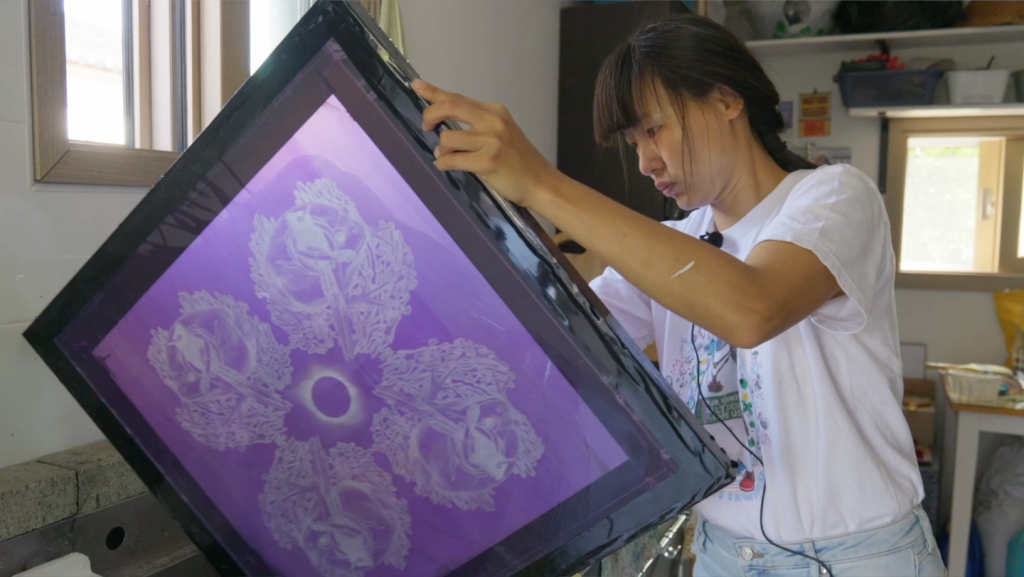
CH: Can you explain what you mean by the students learning skills using “appropriate technology?”
KDU: The “appropriate technology” spoken of at Sinsulmok School is not a grand or complex high technology. It refers to the “most basic skills for self-reliance” that allow young women or single-person households in rural areas to take care of their own lives without depending on others.
These days, single-person households in cities like Seoul often rely on delivery food or convenience store lunchboxes instead of cooking. However, at Sinsulmok School, they learn how to solve the most fundamental aspect of life—the issue of food—on their own.
They first learn how to farm in a small garden, starting not just with sowing seeds, but with making high-quality compost by fermenting food waste or fallen leaves. After learning how to create healthy soil, the process of cooking together with crops they harvested themselves is the most precious survival activity among food, clothing, and shelter.
They make kimchi, gochujang, and doenjang together, and as they share the aged sauces later, they experience how “technology becomes a connection of life.” Furthermore, settling and living alone in an unfamiliar land like Jeju makes home maintenance a significant challenge.
Therefore, they learn practical skills there, ranging from replacing light switches or outlets to using various tools necessary for home repair.
Ultimately, the appropriate technology classes at Sinsulmok School are a process of instilling the confidence that one can solve the necessities of life with their own hands. When supported by such skills, young people finally gain the courage to take firm root in Jeju without relying solely on capital or the help of others.
CH: Close to the end of the film, there are discussions about Jeju’s identity as an island, people, and its place and purpose in the global climate crisis. Please share your thoughts on this.
KDU: The question you’ve asked is, in fact, almost too vast and heavy for any one person to answer. I must honestly confess that I don’t know exactly what grand meaning or decisive role Jeju can play within the context of the global climate crisis. However, there is one thing I know for certain: we must stop the actions that accelerate this crisis right here in Jeju, the very place where we stand.
To me, Jeju’s identity is not a “tourist product” for display, but the “living time” of the forests that have endured for tens of thousands of years, the hidden lives within them, and the people who have coexisted with them. However, large-scale development projects like the Second Airport are fundamentally shaking this identity. Constructing the Second Airport goes beyond just widening a road; it involves emitting massive amounts of carbon and destroying Jeju’s “lungs,” such as its forests and its sumgol (volcanic breathing holes). This is akin to pouring fuel onto the global climate disaster.
Therefore, rather than designing a grand future, I intend to continue my honest efforts to reduce carbon emissions and preserve the ecosystem specifically within Jeju. I will continue to stand at protest sites with fellow citizens to ensure that destructive projects like the Second Airport do not proceed. And as a recorder, I will continue to inform people of the truth about Jeju through my videos, just as I am doing now.
Ultimately, I believe the greatest role Jeju can play in this era of climate crisis is to become a site that proves the value of life must come before the logic of capital. Just as the small songs started at Bijarim-ro became a massive resonance to protect the forest, I believe that when the efforts of each person who records and acts come together, Jeju can finally remain a sustainable forest for all of us.
CH: We’re now almost midway through 2026, and much has changed politically in South Korea since you would’ve officially wrapped filming, including having the documentary successfully submitted and shown at Jeonju IFF. Can you share some updates on where things stand with Bijiram-ro Citizens Group and plans for the airport?
KDU: The struggle against the Second Airport has now lasted for 10 years, and we believe this year is the critical moment to finally stop this destructive plan.
Governor-elect Wi Seong-gon has emphasized “the residents’ right to self-determination,” promising a referendum or public deliberation if social consensus is not reached. In this election, the Jeju Green Party, Justice Party, and Labor Party formed a “Progressive Politics Election Alliance” and stood in strong solidarity to cancel the airport and realize climate politics.
Although candidate Kim Soon-ae was not elected, the 10,000 votes from residents served as a vital catalyst to inform citizens about the risks of the Second Airport and shift public perception.
Recent discoveries of large rook flocks near Udo, which were not reported at all in the Strategic EIA, are reigniting the controversy over the flawed environmental assessment. This reminds us of the tragic 2024 bird strike disaster at Jeju Airport and highlights how the government continues to ignore safety and environmental risks.
Ultimately, what protects the forests and skies of Jeju is not administrative goodwill, but the honest power of awakened citizens who record and monitor the site.
Carolyn Hinds
Freelance Film Critic, Journalist, Podcaster & YouTuber
African American Film Critics Association Member, Tomatometer-Approved Critic
Host & Producer Carolyn Talks…, and So Here’s What Happened! Podcast
Bylines at Authory.com/CarolynHinds
Twitter & Instagram: @CarrieCnh12
#TheTimeofJejuDocumentary #KimDaunFilmmaker #kcrush #JeonjuIFF2026 #kcrushinterview #filminterview #SinsulmokSchool #Bijiram-roCitizensGroup #kcrushamerica #kcrushmagazine #internationalfilmfestival #filmfestival2026 #newJejuAirport #changeswithintheenvironment #featuredinterviews
The post Jeonju IFF 2026 Interview with ‘The Time of Jeju’ Documentary Filmmaker Kim Da-un appeared first on K Crush America Magazine.