
 |
| Photo by Sam Kang |
One of the things that I personally love most when it comes to Korean food and culture is soju. At the heart of any good dinner with friends is that it bonds and adds that little bit of comfort. Popular variety show games and K-dramas will usually involve a bottle or two of soju. Now we all have our favourite brands and flavours, and one writer in particular has provided everyone with the best way to enjoy it, in all forms.
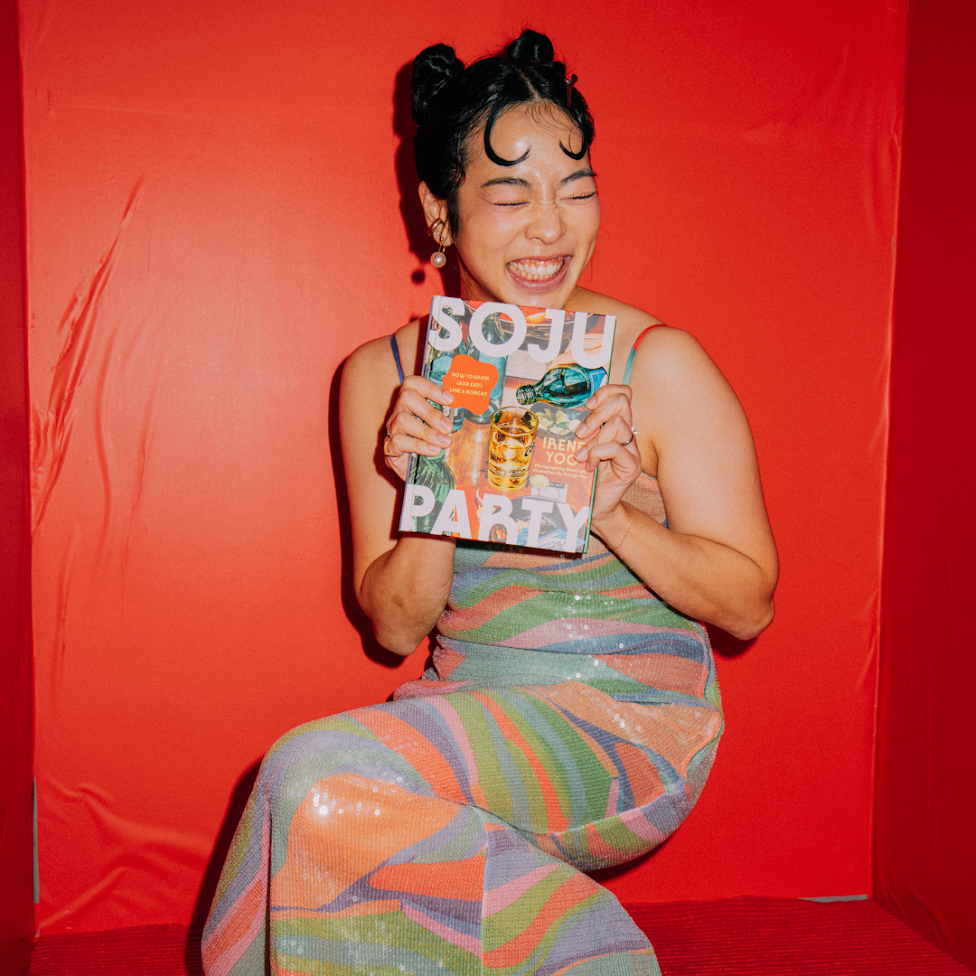
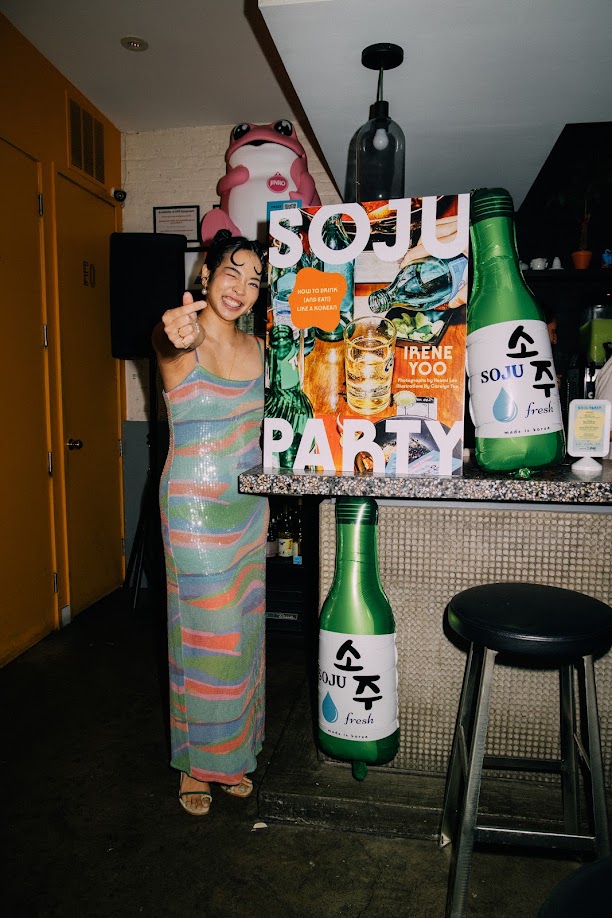
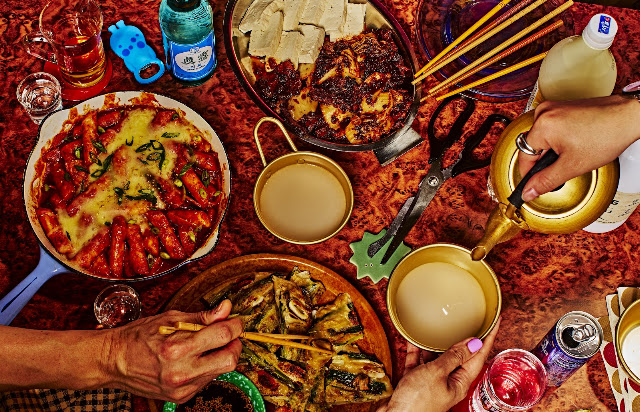
Irene Yoo, author and chef, captures that spirit perfectly in SOJU PARTY: How to Drink (and Eat!) Like a Korean. Creating a book that not only provides recipes for the best drinks to make at home but also features wonderful illustrations from her sister that bring those recipes to life. It’s also recently gained critical acclaim, recently winning best author and book at the James Beard Awards in June.
Speaking with Irene, her passion about her craft and sharing Korean food culture is clear. Warm and effortlessly engaging, she’s definitely someone you’d want to go and enjoy the traditional games with. Her bar in New York, The Orion Bar, is a place for people to relax and enjoy the love of soju. For Seoul Stories we discussed her love for food pairings, the inspiration behind SOJU PARTY, and the perfect after-drinking comfort food.
SOJU PARTY: How to Drink (and Eat!) Like a Korean is refreshingly different from traditional cookbooks. What made you centre it around soju culture, food pairings, and storytelling rather than just recipes?
Irene Yoo: I was originally approached to write a cookbook about Korean cocktails by infusing Korean flavours into different drinks. I was like, 'That sounds like a great idea, but also, I feel like there haven't been any books in English dedicated to Korean drinking culture or soju. It's such a rich ecosystem, with its own history, traditions, and rituals. So I really wanted to introduce that first and set the foundation before I built on top of that. One of the things that I learned as I grew up and started drinking was just how short the history of Korean modern drinking is. The green bottles of soju we see K-pop idols drinking or in K-dramas – are actually a modern thing that's really happened in, sort of, the post-Korean War era.
I also wanted to explore the lore and rituals surrounding Korean drinking, because there are so many fun drinking games. Once I began conceptualising the book, it really crystallised so quickly. At its heart, though, it is still a cookbook. There are an equal number of cocktail and drink recipes as there are food recipes, because in Korean culture, you can't have one without the other. You don't just go out to just drink. You always have to eat as well. I definitely wanted to emphasise that and give equal weight to both.
It’s definitely an experience, isn't it? For those who have never tried soju before – and there are so many different brands and flavours to choose from. Is there one you particularly enjoy or recommend to someone who's never had it before?
Irene Yoo: Well, I feel like I want to preface this by saying that all soju tastes very similar if you're talking about the unflavoured, or original, versions. From there, it really comes down to personal preference and marketing-driven, to be honest.
I personally really like Jinro, which is from the company HiteJinro, but I encourage others to try a few different ones and see what they like. I've done taste tests and still prefer Jinro, but I also know I'm probably responding to the beautiful blue bottle. It's a little different from the green bottles, but I know there are plenty of people who are loyal to the classic green bottle with the red cap. I think that's a good place to start. But yeah, in a pinch, I'm not too fussy. It’s not like a Coke versus Pepsi thing. (Laughs.)
You're happy to just take whatever (laughs).
Irene Yoo: Exactly. Whatever gets the job done. (laughs)
I always think unflavoured soju is much stronger than the flavoured ones, like peach or strawberry. It always feels much stronger, like it burns your throat, but then as the night progresses, you're fine, but with a fruit, it just goes down easier.
Irene Yoo: Oh, absolutely. I also feel like there's definitely a bit of a bell curve. The first time you have it, that first sip is so strong, and then it gets easier, and then that's where it starts to get dangerous. (laughs)
 |
| Photo by Sam Kang |
And then you're like, 'How have we drunk so many bottles?’
Irene Yoo: Exactly. And then the bad part is when it starts to not taste good anymore, and you think maybe I should just stop drinking it. (laughs).
So when you created the recipes in the book, how did you go about creating the drink recipes? Did you go with what you knew worked really well, or was it just a particular memory that you've collated over the years?
Irene Yoo: A little bit of both. I started with what in the book I call 'easy drinks'. These are very, like, kind of one-plus-one type of cocktails. The classic ones in Korean drinking culture are somaek, soju, and Milkis. And then there are a lot of other variations on those. There's something called a milky shot, which is Chilsung Cider (or Sprite) mixed with beer. In Korea, people don’t tend to make elaborate cocktails. They often do really simple one-to-one mixes. So that's one chapter.
The second chapter is cocktails that are based on classic American cocktails but infused with more Korean flavours. That reflects the drinks menu we have at our Orion Bar.
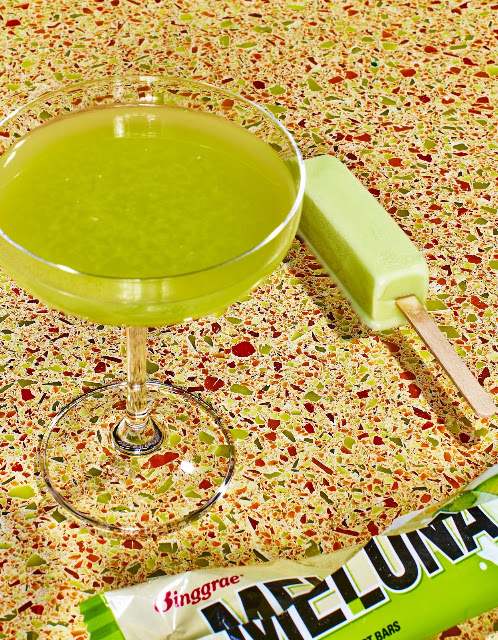
And then the third tier of cocktails is what I call "taste memories". These are cocktails all inspired by nostalgia and flavours that I loved as a kid. Whether that was Melona, naengmyeon, or Spam. I thought, "I really want to try and make this into a drink. "That's what's so fun about cocktails and drinks you can really have fun being playful and infusing different flavours. That was probably the chapter that I had the most fun with.
Growing up, had you always enjoyed learning about the different varieties that Korean food had to offer? Was there a particular food memory that made you realise it was something you wanted to pursue as a career?
Irene Yoo: My family was always very into food, my mom immigrated from Korea to America, and she was a very prolific home cook. She couldn't find a lot of the foods that she grew up with in Korea, so she would make a lot of it and spend a lot of time and energy sort of recreating her own taste memories. I think I really responded to that, and then we also went back to Korea every summer for 3 months at a time. So I became really immersed in different parts of Korean food culture. In my family, every meal revolved around the next one. We would be eating lunch and planning on where or what we're going to do for dinner. We would often take one- or two-hour road trips out of the city to go get the specific barbecue or the specific seafood noodles.
As a kid, good food came to me so easily. That, as a grown-up, I really missed that, and I was like, oh, it's just really hard to find. And then I also think, as adults, you're often just really responding to the flavours that you loved as kids and always trying to revisit those. That's why we spend our time chasing the good we loved growing up. Whether that’s Kraft Mac & Cheese, Shin Ramyun, or even Pop-Tarts, those flavours just stay with you for your whole life.
Your sister illustrated the book, adding another personal layer and touch to the book. Growing up, had you both been incredibly creative growing and influencing each other in a way?
Irene Yoo: Yes, she was the illustrator for the whole book. I commissioned her to create the artwork for the drinking games chapter because I felt like it would translate the most through illustration versus, say, photos. She illustrated all those different rituals and traditions around Korean drinks, and she added the whimsy that I just wanted to bring.
Because we shared the same childhood, I knew that she would really understand the memories and be able to visualise and bring that to life. She did bring that party vibe to the illustrations in a very informative way. She's incredibly talented.
Outside of entertaining and cooking for others, what are your own personal comfort meals? The ones that you enjoy after you've been drinking or when you just need something warm and comforting?
Irene Yoo: My favourite is always instant ramen. I always crave it after I've been travelling and drinking and sometimes even while I'm drinking. It's the perfect comfort food.
When we were creating the menu for the Orion Bar, that was one of the things I really wanted to do. I was like, we have to have instant ramen. It seems really counterintuitive, because it's something you can go home and make yourself, but who wants to do that? (laughs)
In Korean society, it's very common to be able to go somewhere and have someone make it for you, and that's the best ramen. Because they cook it on a high-powered stove and put a lot of delicious things in it, it just feels a little bit more special than just going home and eating it by yourself in your sad kitchen. (laughs)
For our readers planning a trip to South Korea, where would you recommend for first-timers or those who have been many times and maybe need somewhere new to go? Do you have any hidden gems that you enjoy?
Irene Yoo: I feel like, honestly, the areas surrounding Myeongdong are such hidden gems. Because there is sort of a revitalisation of the heart of the city, so on recent trips I’ve been staying in the adjoined areas like City Hall, Jongno, and even Insadong.
They’re ideal because you still get access to all of the resources that one would want as a tourist, you know, like museums or shopping. But one of my favourite places to go out drinking is the Jongno area. At night, the street tents always have the vibe that I'm looking for. And it's literally a 10-minute walking distance from places like Jongno, and the street food is so good.
Korean BBQ has become incredibly popular over recent years with Westerners. Why do you think so many people gravitate towards that particular type of food? Is it, like, a community thing, do you think?
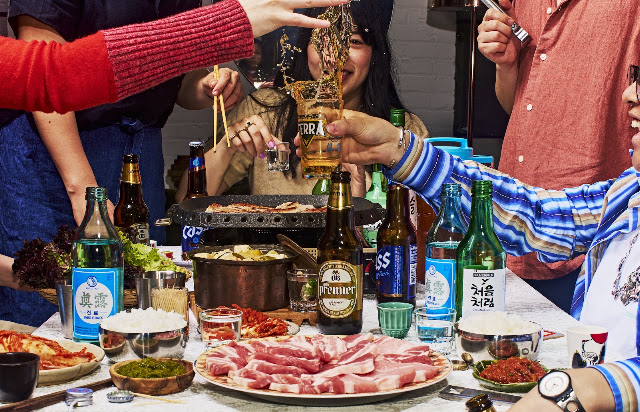
Irene Yoo: I think the Korean barbecue obviously has always been in Korea and has always been an opportunity for people to gather in large families, so whenever I would go visit Korea and I would see my whole extended family, we would always go out to Korean barbecue. It's just easy, you don't have to be like, 'What is everyone going to order?' You just order meat on meat and share it around, so it's always been a very communal thing.
But it really rose in popularity during the 90s, especially in LA's Koreatown, and part of that is because meat was so much cheaper and accessible in California. That led to the rise of all-you-can-eat barbecue restaurants, which introduced Westerners or non-Korean people to the cuisine. The same thing has happened here in New York, too.
I think now there is a wave of different styles of restaurants, it’s like, 'Oh, we can go really fancy or lowbrow.' It goes back to the concept of it being very much a communal gathering. Similar to Korean drinking, there are so many little things like how everyone makes their own wrap. Like, how do I order this? What's the best pairing of that? So there's always some discovery there, in addition to just being able to share with your friends.
How much do you think K-dramas and K-pop have played in people wanting to try the cuisine and drinks? They see the variety shows, and they're like, 'What is this? Why are my favourite idols eating it?
Irene Yoo: Absolutely. For me, I know I’ve always loved going out for food and drinks, but I'm also a big SEVENTEEN fan. Watching their TTT show introduced me to drinking games I’d never seen before. The dedication too – it's hard to play drinking games with 4 people, but having to do that with 13 people and the chemistry they have, so that I learned. And one of the games is featured in the book it's called Bunny Money, and that's actually one I learned from their variety shows. The same goes for K-dramas. I loved Work Later, Drink Now. It's these three single women who love to drink, and so the first couple episodes, they’re using their heels to pop open bottles of soju (laughs).
It makes you want to try it yourself (laughs).
Irene Yoo: Exactly, it’s crazy tricks, and I was like, Oh my god, there's so much to learn. (Laughs) I think it's really inspiring to be like, 'Oh, that looks really fun, I want to try it,' or 'I want to eat that, I want to gather my friends and go try that out.'
You also own the Orion Bar, in Brooklyn. What made you want to take on a big project like that and centre it around Korean drinking?
Irene Yoo: Yeah, it is! (laughs) We wanted to have Korean-style drinking be more accessible out here in Brooklyn. For a long time, if you wanted soju in New York, you could really only get it, up until recently, in New York's Koreatown. It was great to go and make a pilgrimage and do that, but sometimes it’s nicer to just have a bottle closer to home.
So the idea we had was to sort of marry that with the American-style bars that we really love to go to. Sometimes you want a beer and a shot, others want a glass of wine or a bottle of soju, and sometimes you're going out with people doing multiple things, and we want to eat good food while doing it. So that was the genesis of the idea of Orion Bar, a neighbourhood bar that blends Korean and American drinking.
One thing I feel we’re still missing in the UK is dedicated Korean bars. We have plenty of Korean barbecues, but if you want to enjoy soju, you usually have to go to the Korean supermarket or order it with dinner. I like that idea of having that here.
Irene Yoo: Actually, we visited London in January, and first off, I was amazed by all the Oseyos stores you have there. I was like, 'Wow, that was awesome. 'And then I was also surprised by all the Korean food places and how much variety that has popped up. Because in New York, it's really centralised to one location. I do agree though. The next stage is then bringing that style of drinking into those spaces. London already has such a strong pub culture and in many ways is similar to Korea.
I think that could be one of many reasons British people love Korea. There's no stigma for drinking in the middle of the day it’s very normal to start at lunchtime (laughs).
Irene Yoo: Exactly. We have a toddler, and so in London we could go to the pub at lunch to eat and have a pint. In Korea it’s the same thing, and you can enjoy a drink, and nobody thinks twice about it.
When visiting America, there’s that feeling of, 'We should wait until 5 o'clock' (laughing).
Irene Yoo: Right? For some reason that's, like, the magical time for alcohol. (laughs)
Do you hope, when you're teaching people these recipes, that people come with a deeper understanding of the social traditions and the customs that come with drinking?
Irene Yoo: Yeah, absolutely. One thing I always say in my book and in general is there are all these rules and rituals, and I think anytime you're appreciating a new culture, it's good to know and understand that, just so you have a better awareness. But that said, we're drinking, we're having fun. Like, learn the customs, but don't worry about making a faux pas.
As the whole point of the rules and rituals, too, is, like, that's how we start, and then as the evening goes on and the more we drink, the more we bond, and the closer we get, those walls come down. I think the goal with Korean drinking is to overcome the boundaries that are being created by these rituals, so it's a starting point of understanding, here's where we're coming from.
It's just good to know someone's age or what they do or, you know, finding common ground. And then, ultimately, the whole 'we're pouring for each other' thing, too, is coming from a place of wanting to feed and take care of each other. So again, I think it's such a communal and sharing thing, so I think it's something that helps us sort of bond together and create really fun memories and then do it again the next time.
So, let's talk about your Milkis shot, the video that went viral. It’s gone on to reach, I think, over a million people across social media.
Irene Yoo: That was actually a drink that my friend, who's also a chef, Chef Tian, showed me. He was like, 'Oh, you haven't heard of this? 'It's from the 90s. It's so old, and it's not really a thing anymore. It just goes down so easily that I have a funny story. My friend was showing it to his mom, and she loved it, and she went on to have ten, and then she was, like, on the floor. So maybe don't do that. (laughs) I think it's just the performance of it, which is really fun. It's also very simple and easy to recreate at home.
But then I saw last year Lisa from BLACKPINK making it on a YouTube variety show, and I was like, see, it's still going on strong (laughs).
Having grown up between Seoul and America, how did those cultural environments shape how you've understood your own Korean food identity and how you’ve brought the two together between the East and the West?
Irene Yoo: That's a great question. I think that's a huge reason as to why I got into what I'm doing in the first place. Growing up Korean in LA meant I was surrounded by one of the largest Korean communities outside of Korea. So staying connected to my Korean heritage and food was something I really took for granted.
When I moved to the East Coast and started living in New York, I think that really opened me up to other cultures. As I found myself almost like a bit of an anthropologist, trying Vietnamese, Cuban, and other cuisines and then relating it back to my food and culture. At that time Korean food really wasn't what it is today, and I still had to do so much education and explaining what kimchi and gochujang are to people.
But by exploring other cultural cuisines, I think it helped me find the language and connection points to share Korean food with a wider audience. That’s why I think around 12 or 13 years ago, I had started hosting a pop-up that pairs Korean food with other culinary traditions.
Whether that was Korean and Vietnamese food or Korean and Cuban. It was really the impetus for me wanting to share Korean food, especially in this industry, as there are a lot of male chefs or male voices that are sharing about Korean food, but it's really something that's passed down through different matriarchal lines, like, moms are often cooking for their families and then teaching their daughters. So, it's really been a way for me to also stay connected with my family and learn my mom's recipes and then share that with my own family. Looking back, it’s been really interesting to see the evolution of it over the past 10 or 15 years that I've been doing it, it’s just been so cool.
I imagine when you first started the pop-ups, the knowledge of Korean food for many people was very much 'What is this?' Whereas now it’s become part of the mainstream. Are you surprised?
Irene Yoo: I think it's definitely surprising to me how much it's taken off and how much there is of this huge ongoing trend of Korean fine dining, especially here in New York. There are so many Michelin-starred restaurants now that I don't even know the names of all of them anymore. Which is very interesting, because Korean food at its heart is very much home food.
More people are exploring their third culture, especially for people like me, who are Asian Korean-Americans who grew up between both cultures. But at the same time there’s a wave of cooks and makers in Korea wanting to share their food or culture with other parts of the world and vice versa. So I think just the globalification of the industry is sort of helping to continue to evolve what Korean food is.
What advice would you give to someone hoping to create their own cookbook in what I imagine is a very saturated market at the moment?
Irene Yoo: Yeah, that's a great question. I think there are still so many subcultures of Korean food to explore. It’s not just one homogenous cuisine. So one thing I'm seeing a little bit more of lately is just more regional cooking. I think that is great, but also hard, because regional cooking is so reliant on regional Korean ingredients. I don't know if it's adapting that ethos to cooking with, you know, regional ingredients in, let's say, England or New York. Korean food history, as I mentioned earlier, is still very young.
Fine dining is taking a lot of cues and inspiration from very old-school, like Joseon Dynasty, historical food places, but I think that's also because the food history is so young. That’s what’s exciting, as it gives people a lot of opportunity to continue to evolve it and create something new that will then eventually become part of Korean food culture itself.
Having done a cookbook, and then launching your own bar, and having achieved so much in a short amount of time. Are you now like, 'What now?' Do you have to keep thinking of new dreams and more goals?
Irene Yoo: Oh my god, you're hitting the nail on the head so hard. (laughs) How did you know? I feel like there was so much happening for the past couple of years, and I was just trying to get over the finish line with these things, so this year, especially at the beginning of the year, it has been really nice to be like, 'Oh my god, I'm just chilling for a little while.'
But I am conceptualising what's next, and what does that mean? As I want to keep growing. At the same time I’m still promoting this book, which hasn't even really been a year yet since it came out. So, I think it's easy to be like, oh, I did this thing, what's next? I remind myself that these are the books I created for a reason so they can live on for a really long time. So, I want to make sure to continue to promote and talk about that while I begin to think about what is next. Besides, books also take a really long time, so if I had an idea now, it would take maybe over 3 years for it to come to life.
Follow Irene Yoo
Instagram | YouTube | Book| Website