Turin has historically provided heavy music characterized by a sense of architecture, drama, and subterranean grandeur, while Ponte del Diavolo has constructed its own imposing structure using those same elements. Formed during the winter of 2020 through a jam involving members of Feralia, Inchiuvatu, Abjura, and Askesis, the group developed a concentrated fusion of doom, black metal, post-punk, and wave that they describe as “blackened post-punk.” Its force comes from an arrangement as unusual as it is imposing: two bass guitars form the low, dense foundation, while Nerium’s guitar cuts across the rhythm with sharp economy and Segale Cornuta’s drums keep the music tense, physical, and unpredictable.
At the center stands vocalist Erba del Diavolo, whose wave-informed delivery gives the band’s esoteric language its commanding presence. Alongside bassists Krhura Abro and Kratom, she helps turn the group’s old-school metal roots toward colder, stranger terrain, where doom’s mass meets post-punk’s disciplined motion and black metal’s feral edge. The contrast between these elements produces music that feels ceremonial without losing momentum, vast without surrendering detail.
After issuing three EPs, Ponte del Diavolo signed with Season of Mist and released their debut album, Fire Blades from the Tomb. Two years of touring followed, including appearances at major European festivals such as Roadburn and Inferno, where the band’s uncommon instrumentation and theatrical intensity found a wider audience.
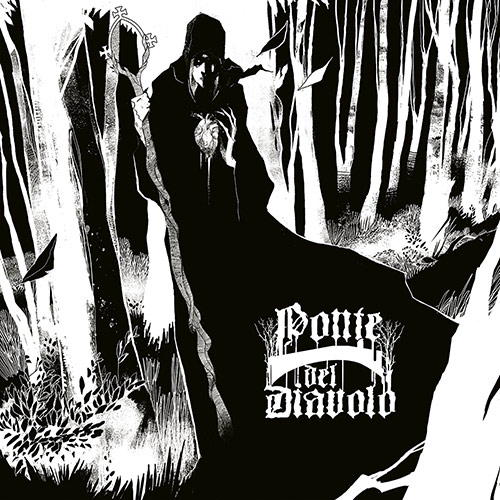
They now return with De Venom Natura, an album that pushes their established language into more expansive and intricate forms. The record sharpens the interplay between voice, bass, guitar, and drums while deepening the ominous atmosphere that has defined the group from the beginning. Ponte del Diavolo enter this next chapter with greater control, broader reach, and a clear sense of their singular place between metal’s ancient foundations and post-punk’s austere pulse in the European underground and far beyond.
Ponte del Diavolo spoke with Post-Punk.com about the album:
Ponte Del Diavolo draws from doom and black metal as well as post-punk, deathrock, and gothic rock. Which post-punk artists first made a lasting impression on each of you, and what elements of their work eventually entered the band’s music?
KRATOM: The first artists that come to my mind are Bauhaus, early Christian Death, Virgin Prunes, Burning Image, and Killing Joke. The most obvious thing they brought to our music is, of course, the pulsating, driving bass lines, but also the melodies that are creepy, unsettling, and romantic at the same time. Most of the recordings by the artists I mentioned are also raw in terms of sound quality, which is something I find very appealing too. You can feel a visceral passion, in a similar fashion to old black metal recordings.
Kratom, the band’s dual-bass configuration gives Ponte Del Diavolo an unusual foundation. How do the two bass parts divide their roles, and how has post-punk’s emphasis on the bass guitar shaped your approach to rhythm, melody, and atmosphere?
KRATOM: Having two basses in the mix is both a big challenge and a big creative outlet. As you said, the post-punk genre is famous for having the bass as the driving force of the compositions, and this is in stark contrast with the black metal approach, where the bass is most of the time completely buried in the background or almost non-existent. It was certainly a bold move on our part to double down and mix these very different approaches with an additional bass, but I have to say we really love the end result.
That being said, managing two basses in the mix is no easy task, and with each record we try to improve the chemistry between them and get a better overall blend.
Erba, gothic rock frequently treats the voice as both a storytelling instrument and a physical presence. Which vocalists or performers helped shape your delivery, and how do you adapt that theatrical tradition to Ponte Del Diavolo’s own identity?
Erba: That’s a tough question for me, mostly because it’s never a deliberate choice. Instead, it’s the result of a lifelong alchemy, a mix of every concert I’ve ever witnessed, the bands I’ve listened to until exhaustion, and the gothic musical aesthetic, which is simply what resonates most naturally within me.
I’m certain that the towering, luciferian presence of Diamanda Galás, the elegant, punk vampire prince movements of Peter Murphy, and the melancholic sweetness of Robert Smith have all shaped me. So too have the liminality of silent cinema (Cinema Strange embody this perfectly), the esoteric and magical depth of The Mission and Fields of the Nephilim, the ethereal spirit of Dead Can Dance, the unsettling sensuality of Rozz Williams, and the ritualistic commanding presence of Siouxsie.
All of these elements have filled my own personal Pandora’s box, and it is a box I gladly empty in front of everyone, every time I step onto the stage.
Il Veleno della Natura, from Ponte del Diavolo’s latest album, De Venom Natura, brings the band’s melodic post-punk and gothic-rock qualities particularly close to the surface. Could you take us through how the song developed, including its basslines, guitar melody, vocals, and lyrics? What does “the poison of nature” signify within the song, and how did the video’s alchemical laboratory setting extend those ideas?
KRATOM: The song particularly stands out in terms of the dual basslines accompanying the groovy verses. The main bass riff comes from Abro (the other bassist), who is a big fan of The Cure, and I think you can hear the influence in the melody. I also think the synths (played by our dear friend Lucynine) play a major role in giving the song its “electro-wave”, eerie feel.
Erba: The poison of nature’ speaks of transformation of nature’s movement as a perpetual cycle of life, death, and rebirth. That poison can carry various meanings, depending entirely on the listener. I don’t really like to dissect or over-explain my lyrics because it strips away the poetry; it almost robs the audience of their right to give the song their own personal meaning. I believe art should be exactly like that: taking shape and living a different life inside whoever experiences it. Once it is fed to the public, it must have a life of its own.
In any case, that poison acts differently depending on the eyes of the beholder, or how it manifests in the lives of those who endure it, whether actively or passively. It is a fermenting agent that can either become your personal creative spark or the very cause of your death. And we aren’t necessarily talking about drugs here, in this case, I might be referring to the magical power of humankind. Or perhaps not. Who knows?
Lunga vita alla necrosi, another song from De Venom Natura, takes the album’s post-punk current into heavier territory more closely aligned with deathrock. What inspired the song’s central rhythm and escalating intensity? Please also discuss the meaning of its title and lyrics, and how the video’s changing procession of occult and psychedelic images reflects the music.
Erba: Lunga Vita alla Necrosi is the flip side of the coin to Demone, a track from our previous album Fire Blades From The Tomb. It represents what happens to the human soul when, paralyzed by the fear of change or the desperate need to cling to a fragile illusion of security, one fails to follow their own inspiration, their true nature, their inner demon.
As for the video? It’s a relentless procession of decay and putrefaction. It mirrors the state of a soul that refuses to be honest with itself.
KRATOM: You’re right, this is the song on De Venom Natura that definitely has the most deathrock vibes. It’s an upbeat song, but dark and heavy as well. I channeled my punk influences for the main bassline, and when Nerium added his black metal guitar riff on top of that, it really clicked for us.
Covenant, from Ponte del Diavolo’s 2024 debut album, Fire Blades from the Tomb, moves at a slower, more ominous pace, allowing tension to accumulate gradually. How did you construct that sense of weight and expectation? What kind of covenant is invoked in the lyrics, and why did you choose Turin’s ancient, monastery-like monuments and a cemetery as settings for the video?
Erba: We didn’t want any religious undertones. In fact, I think I can speak for the whole band when I say that religions disgust us, every single one of them.
What we actually wanted was to use the ancient monuments of the city we grew up in. To us, they don’t feel religious; they feel imposing, ancient, weathered by time, filthy, and deathly. And because of that, they are incredibly beautiful, just like the cemetery where the entire second half of the video was filmed.
As for Covenant, it represents a gathering of natural elements. While I was writing the lyrics, I fantasized about them organizing themselves to break free and sweep humanity away completely.
Your cover of Bauhaus’s In the Flat Field appears on De Venom Natura. Why did you choose this particular song, and what does it mean to you personally? Your interpretation feels icier and more theatrical than the original. How did you decide which recognizable features to preserve and which elements to reshape in Ponte del Diavolo’s image?
Erba: Choosing In the Flat Field came from pure love for Bauhaus; I’ve always dreamed of singing one of their tracks, though I’m deeply aware of the sheer greatness of the artists I’m covering.
The song’s core resonates with me on a deeply personal level. I suffer terribly from boredom, and I completely reject the suffocating routine of everyday life; that sense of existential frustration is practically a reflection of my own personality.
When it came to the music, we didn’t overthink it. The truth is, when we play together, that heavy theatrical sound is just what comes out of us completely naturally. It’s still Bauhaus, but dragged through our own darkness.
Looking across these four recordings—Covenant from Fire Blades from the Tomb, followed by Il Veleno della Natura, Lunga vita alla necrosi, and your cover of In the Flat Field from De Venom Natura—how has Ponte del Diavolo’s relationship with post-punk changed between the two albums? Has that influence become more pronounced, or have you found new ways of integrating it with the band’s heavier foundations?
KRATOM: I would say both. The influences were always there, but throughout these years of live shows and records we have grown as musicians and as a band, and we have become more aware and conscious of our sound, which we have decided to label “blackened post-punk”. It’s a term that could really mean everything and nothing, but I feel it’s the most correct way to define our music. We have definitely learned how to integrate different elements better, and as a band we find it very appealing to push our sonic boundaries. We would love to expand them further in the future.
Ponte del Diavolo’s latest album De Venom Natura is out now. Listen below, and order it here.
Follow Ponte del Diavolo:
The post “Fire Blades from the Tomb” and “De Venom Natura” — Italian Outfit Ponte del Diavolo Discusses Their Signature Post-Punk Doom appeared first on Post-Punk.com.