
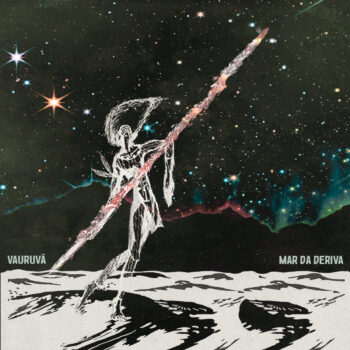
 Folky black metal enjoyed much success in 2025. February alone held an embarrassment of riches, offering delicacies from Scotland (Saor), Siberia (Grima), and Finland (Havukruunu). In August, Sgah’gahsowáh dropped the much-hyped Blackbraid III, continuing his evocation of Adirondack landscapes. And on Halloween, New York’s Yellow Eyes jumpscared many a year-end list with the haunting medievalisms of Confusion Gate. Amidst these cold-climate albums, Vauruvā released a ray of sunshine in the month of May. Mar da Deriva is the third full-length from Caio Lemos (instrumentalist) and Bruno Augusto Ribeiro (vocalist/lyricist), a duo infusing black metal with indigenous music from their native Brazil.1 Loosely translated as ‘Drift Sea,’ Mar da Deriva drifts between iciness and vaporousness in a way that should excite folkened black enthusiasts.
Vauruvã has been described as ‘tropical blackened trance.’2 This characterization is appropriately evocative, if a bit misleading. For starters, Vauruvã don’t blacken trance metal or some other subgenre. They play black metal of a progressive variety, recalling the aforementioned Yellow Eyes and Saor in their flair for expansive compositions. Mar da Deriva unfolds as a flowing stream of three epics, encompassing dreamy tremolos, majestic riffing, and d-beat fury (“As Selvas Vermelhas no Planeta dos Eminentes”). Vocally, Ribeiro emits a serviceable blackened screech, with occasional, low-register cleans. Sonically, the album hovers between atmospheric and melodic black metal à la Yellow Eyes; memorable riffs regularly drift into a sea of ambience. But more like Saor, Vauruvã generally eschews dissonance in favor of neo-classical melodicism. Vauruvã occasionally surprises, though, with Eastern-tinged themes, supplementing their icy core with much-welcomed warmth (“Os Caçadores”). These temperature fluctuations make Mar da Deriva stand out amidst similar black metal acts.
Mar da Deriva truly shines, however, for its ‘tropical’ aesthetic. Like patches of rainforest abutting a frozen Amazon river, Brazilian folk instruments enliven Vauruvã’s fierce black metal foundation.3 Opener “Legado” best exemplifies this musical biome. The song begins with a simple pipe melody overlaying slow-building acoustic strums and foreboding chugs. After forays into blasty and riffy black metal sections, the pipe returns with a more mournful melody, rising in prominence. And then any semblance of metal drops away for a stunning conclusion: the pipe whistles atop an infectious rhythm driven by shakers and tribal drumming. Like “Legado,” Mar da Deriva wends it way through hypnotizing indigeneity and blackened hooks. Each of its three tracks constitutes an exotic journey, and the journey as a whole subtly ebbs and flows between placidity and ferocity.
 In lieu of calling Vauruvã ’tropical blackened trance,’ I submit that Mar da Deriva is black metal to enjoy while sipping a Caipirinha. Like Brazil’s signature cocktail, Vauruvā’s third album mixes bitter and luscious notes to create a refreshing experience. In a year replete with high-quality folk-infused black metal, Lemos and Ribeiro somehow fill a void with their steamier take on the subgenre. Metal in general (and black metal in particular) needs more voices from the Global South (and South America in particular). In this spirit, Vauruvã offers a unique libation that—at a meager 36 minutes—will have you immediately demanding another round.
Tracks to Check Out: All of them, in order, in one sitting.
The post Vauruvã – Mar da Deriva [Things You Might Have Missed 2025] appeared first on Angry Metal Guy.