Across the vast American sprawl, post-punk and darkwave have taken root in cities throughout the country, with each local scene giving the music its own character. Among the rising bands within that wider movement, Casket Cassette and Stare Away represent two distant geographic poles: Los Angeles and New York City, the City of Angels and Gotham, relentless sunshine and after-dark intensity. This summer, the bands have closed nearly 3,000 miles of continental distance on Casket Cassette’s Reducer Tour, the Los Angeles project’s first headlining run. Constant Laval Williams and Ben Nelson first became friends when Stare Away joined a Casket Cassette bill at Sip Studios in Jersey City, where they discovered common ground in Joy Division’s rhythmic force and Ian Curtis’s songwriting, as well as recovery, poetry, and the desire to exorcise personal damage through catharsis of a crowd.
Both artists entered the tour with their most substantial releases to date. Casket Cassette’s third album, Reducer, released June 12, turns experiences of erasure, constriction, recovery, and the aftermath of the Los Angeles fires into a ten-song study of what survives when a life and community have been pared back. Post-Punk.com followed the record’s development through Kiss Me Awake and Show Me a Sign, songs that brought Williams’s doomed romanticism into sharper electronic relief. On July 31, Stare Away released its seven-song debut, In Absence, via à La Carte Records, drawing on Nelson’s seclusion after sobriety, the depths of addiction, and relationships that continued to exert their pull. Its closing track, Familiar, gave those concerns one of the album’s most immediate expressions.
Onstage, their geographical and musical differences sharpen the pairing. Casket Cassette channels the strange darkness that flourishes beneath Los Angeles sunshine through electronic pressure and doomed pop melody, while Stare Away draws on Gotham’s nocturnal velocity with tensile bass, urgent guitar, and the close physical charge of an early post-punk club. As the tour enters its final stretch, Post-Punk.com spoke with Williams and Nelson about the records that guided Reducer and In Absence, the friendship behind the tour, the cultures of their respective cities, and the collaboration already waiting beyond the final date:
Ben, in absence, feels like a reference to the terms “In Memoriam” or “To Absent Friends”. What kind of absence does the title refer to, and what emotional or thematic thread holds the album together?
The record is a massive reflection on the past couple years of my life. I definitely secluded myself from a lot of aspects of living in New York City so I could just focus and make progress on better finding myself after getting sober. I just disappeared for a while from going out and was working full-time at a job I absolutely hated. I looked at myself & how insane the state of the world currently is, and put everything into my craft to reflect my own mysteries, questions & realizations of isolation, depths of addiction, and relationships I’ve had that were very important to me. I think when you put your heart into something physical and artistic, people will truly relate rather than follow like a cheap social media posting scheme and will feel much more fruitful and fulfilling in the end. I feel like I discovered more about myself throughout the process of writing this record than I ever would if I hadn’t. The title track sums up the entire record and each following track dissects it in its own way musically and lyrically. Sitting with Mike Morello in the studio and putting so much time and emotion into each song really tied it all up with a bow.
Ben, which artists, records, or musical periods were foremost in your mind while making In Absence? Or writers and filmmakers perhaps?
To really narrow it down, New Order’s “Movement” demos and writing sessions, The Cure’s “Faith” home demos, and The Sound’s “Jeopardy” record are in my everyday rotation. When it came down to pure influence, I really wanted to write from a direction as a band involved in the first wave with a maturing mid-80s attitude. The sculpting behind what defined an emerging underground genre is what I’ll always strive for when writing. Experimental films and beatnik writers of the late 50s and 60s called me to think more of vulnerability in expression when it came down to writing the lyrics.
Ben, was there one song that unlocked the direction of In Absence and helped you understand what the rest of the record needed to become?
“I Can’t Escape Myself” by the Sound. Truly a masterpiece of a track in my opinion. The daily hysteria of living life on life’s terms regardless of situation or control over one’s ability to have an answer for everything that shapes our identities and emotions is kind of a beauty in a sense, which makes us all unique in our own ways. The album art shot by Julie Lodhy really captured that reflection literally.
Constant, what first set Reducer in motion, and how did the album develop from that initial idea into the finished record?
I’d been spending most of my time focusing on crafting standout singles (Bouquet, Broken Tomorrow, etc.), and I wanted to return to another cohesive project. Specifically, for album #3, I wanted to respond to the erasure, reduction, and alienation I’d been feeling after returning home to LA from graduate school at the Iowa Writers’ Workshop, and in the wake of the LA fires. In a short period of time, my community of friends and my childhood home had both burned, shrunk, or vanished. It was a period of interpersonal, mental, and physical loss.
I first explored these themes in the context of inward reflection, and then expanded into an examination of my past and my relationship to others. I also chose to incorporate increasingly poetic elements (such as references to Robert Lowell’s Skunk Hour in Kiss Me Awake, a poem in the interlude, and various lyrics that leaned more deeply into nuanced metaphor). The instruments ended up expressing rage, loss, and existential claustrophobia via the use of heavy basslines and aggressive drums, coupled with ethereal anthemic synths and the occasional heartfelt guitar line.
What made me fall in love with the darkwave and post-punk genres to begin with was their ability to honestly express pain and darkness while also transfiguring that same pain into something beautiful and danceable. I can only hope this new album achieved that same duality.
Constant, the word “reducer” suggests compression, subtraction, or stripping something to its essential form. What does the title mean to you, and how does it relate to the album’s songs?
I think that you summed it up nicely. Like the choke-chain collar in the cover art, the title reflects a feeling of constriction (a minimization of self, community and environment). If you have the kind of brain that I have, life can sometimes feel like a series of “reductions” almost like pruning a bonsai tree to try to stay “right sized.” This has always been the case for me (especially as someone in recovery), but to have those reductions unwillingly extend into the world around me was intense.
I think the songs all mirror this differently. I tried to let them be eclectic; sometimes disparate elements in conversation with one another are more comprehensive than similar elements. On songs like Kiss Me Awake and Melting Angels, there’s a wide-open purgatorial feeling that’s at odds with poignant, pared-down lyrics. A song like Pacific Coast Highway (PTSD) is a bittersweet memory, a bleeding echo of a whole. Show Me a Sign and Becoming burst past constriction into raw expressions of existential energy (etc.).
Harmoniously, the album was mixed by Matia Simovich at Infinite Power Studios, who works almost exclusively with analog equipment. The process of mixing with analog machines is also a reduction of the nebulous revisions and additions of modern DAWs; when effects were baked into the stems, they were made singular and permanent. The same is true for Matia’s raw, minimalistic approach to tracking vocals on songs I recorded in-studio such as Becoming. The stems of some songs like Elegy were compressed together onto tape, and then re-digitized.
Constant, which artists and records exerted the strongest influence on Reducer, and where can you hear those influences entering the album?
There is always a plethora of artists within (and outside of) the genre influencing me. These, of course, include the giants whose footsteps we walk in (ie. Joy Division, The Cure, Bauhaus, Siouxsie, etc.) as well as the peers I have walking beside me (check out my Spotify playlist for reference).
If I had to narrow it down for this specific album, I’d say: Charlotte Sometimes by The Cure, But Not Tonight by Depeche Mode (specifically the intro), the body of work by Sad Madona (who I’ve done two collaborations with (including on Reducer), and who I’ve been hanging out with when I visit the EU), the music of my buddy Jamison (aka Gossip Cult), indie and indie-adjacent bands I used to listen to when I was a kid (like Beach Fossils, Surf Curse, The Drums, etc,), The Smiths, Atmosphere by Joy Division, Crystal Castles, experimental acid/trance/house music I used to dance to at illegal warehouse raves downtown, Nitzer Ebb, Pagliacci by Leoncavallo, and various movie soundtracks.
As a result, songs like Pacific Coast Highway (PTSD) blend post-punk and indie/alternative, while songs like Show Me a Sign or Apathy are darkwave with elements of electronica and EBM. All of these influences have allowed me to move in a new direction while staying true to my voice.
Constant, you are also a poet, photographer, and filmmaker. How did those other disciplines shape the lyrics, imagery, or structure of Reducer?
For me, all these disciplines come from the same source but are expressed in different ways, each appropriate for different moments/needs. They all allow us as human beings to try to source meaning from existence and our universe; a meaning we will never fully reach, but a beautiful process regardless.
Photography and film rely on choice of subject and composition to craft visual narrative or provoke thought, while music relies on a similar, auditory gut-instinct. These instincts are also involved in poetry, but the act of writing and editing a poem requires a more microscopic cartography; everything must belong, every word must connect, every image must work against or for the conceit of the poem.
Poetry is my first love. I’m obsessed with it. There’s a beautiful anarchy to it, yet an intentionality that I don’t find to be fully true in music or photography. Sometimes my lyrics are hyper poetic, and sometimes I want a break from the intense scrutiny required of poetry. Sometimes I just want to write an immediately understandable or quasi-cliché lyric for the catharsis of that immediacy; just want to say “I love you” or “I miss you” and not “your shadow lingers in the wake of my delinquent dreams.”
Coming out of the Writers’ Workshop and being in the process of finishing my debut collection of poetry, poetry played a much larger role in this album than in the past. As I previously mentioned, there is a full poem in the Interlude; songs like Elegy and Kiss Me Awake both use rhyme schemes (or non-rhyming free-verse) in their lyrics and poetic imagery that is a new frontier for the fusion of poetry and music for me.
I have a very vivid imagination; it can be very cinematic at times. I daydream a lot. When I was writing Reducer, photography and cinematography also informed the songs for sure—if I can’t imagine a visual narrative in my head while listening back to a song, then it’s probably not a good song. Structurally, I always want my albums to have a narrative arc as well. In the case of Reducer, I wanted to start with a feeling of stasis and constriction that then erupted into defiant forward movement.
Constant and Ben, how did the two of you first meet, and what were your initial impressions of one another, both personally and as musicians?
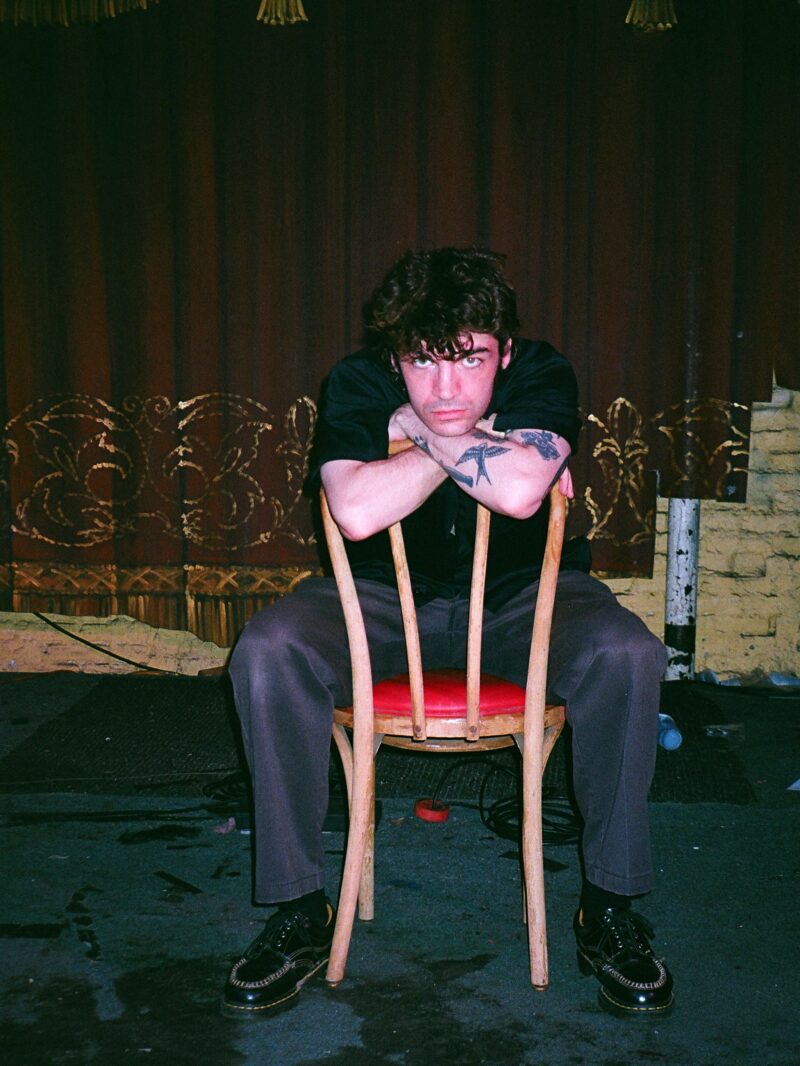
Ben: We met at the Jersey City date of his first US tour with Blood Club and dustbowlchampion at Sip Studios, it was so cool to be able to meet from being on complete opposite sides of the country, everyone was so inviting and kind and it was awesome being able to appreciate each others music. It was like going to a new school and kicking it off with another kid in class with similar interests.
Constant: Ben and I met a few years ago on my first-ever national tour with Blood Club and Dustbowlchampion. I had already been aware of Ben’s music after finding it online and would religiously listen to “My Cathedral” and “Something Strange” in my car on the way to work, so I was psyched when Ben was booked to play with all of us in Jersey City. I think we hit it off immediately; I could tell Ben just got it, it being the reason we all do what we do as artists. It’s really cool when you meet someone and are on the same wavelength.
Constant and Ben, did you initially connect through any shared bands, records, or influences, and what helped that first connection develop?
Ben: Definitely comparing our distinguished sounds to similar bands we both enjoy, I think Joy Division would be a top example because we both love Ian Curtis’ writing from a poetic standpoint, we did hit the exhibit in New York City together which was an awesome experience. I always learn of new books and readings to pick up from him. I also think it’s because I am a bassist and he came from a background of being a drummer, so I think a lot of bands that have that heavy foundation of rhythm sections drove a lot of our similar musical interests.
Constant: For sure, I think most people who make music similar to us can connect over a shared love of many of the same bands (like the ones I mentioned before). I think it also helped that we both come to music at a poetic and existential angle, and we both could relate in terms of recovery from substances and the perspective shift that is required.
Constant and Ben, what first made you want to collaborate musically, and when did the idea of touring together enter the conversation?
We haven’t collaborated yet but we definitely have a song in the works. I think every time we’ve seen each other, we’ve thrown around the idea of touring together because we love each other’s music, and it especially made sense now that both of us are with BLCKJEANS.
Ben, what appeals to you most about Reducer, and which song from the record do you find yourself returning to most often?
I think Constants approach on the arrangements were genius. The drum breaks feel lyrical, the combination of synth selections and vocal melodies reached a part of this genre that hasn’t been touched upon yet, and classic Casket Cassette elements cultivated into his best work. My favorite part of all this is watching and listening as an artist grows musically. It’s hard to put my finger on a single song because each song has its own unique skeleton, but I have to go with “Apathy” as the track that’s always running through my head on this record.
Constant, what do you enjoy most about In Absence, and which song on the album has become your personal favorite?
Beyond how catchy and danceable its songs are, I love how authentic and genuine the album is. I also really enjoy the combination of quintessential 80’s New Wave sounds with dark Post-Punk melodies. The title track and Faithless Hum are my top favorites.
Constant and Ben, your music shares certain post-punk and darkwave foundations while retaining two distinct identities. What do you think makes the bands complement each other so well on the same bill?
Ben: I think our high-energy performances are what make this tour so special; the riffs throughout the night keep the atmosphere intense with movement and bring a great amount of nostalgia you feel at a goth club or punk show that you can’t capture at other shows. Our deep connection with the fans is what’s most important to me, hearing how the music can move through the audience and watching kids get lost in their dancing with their eyes closed while we’re playing on stage is so cool being able to resonate that from the stage.
Constant: I think we complement each other because we both bring a similar energetic performance style, matching high energy with a candid sincerity. Ben’s music leans more towards post-punk with moments of darkwave, while my music leans more towards darkwave with moments of post-punk. I think that also creates a “yin and yang” effect for our live shows; two sides of the same coin.
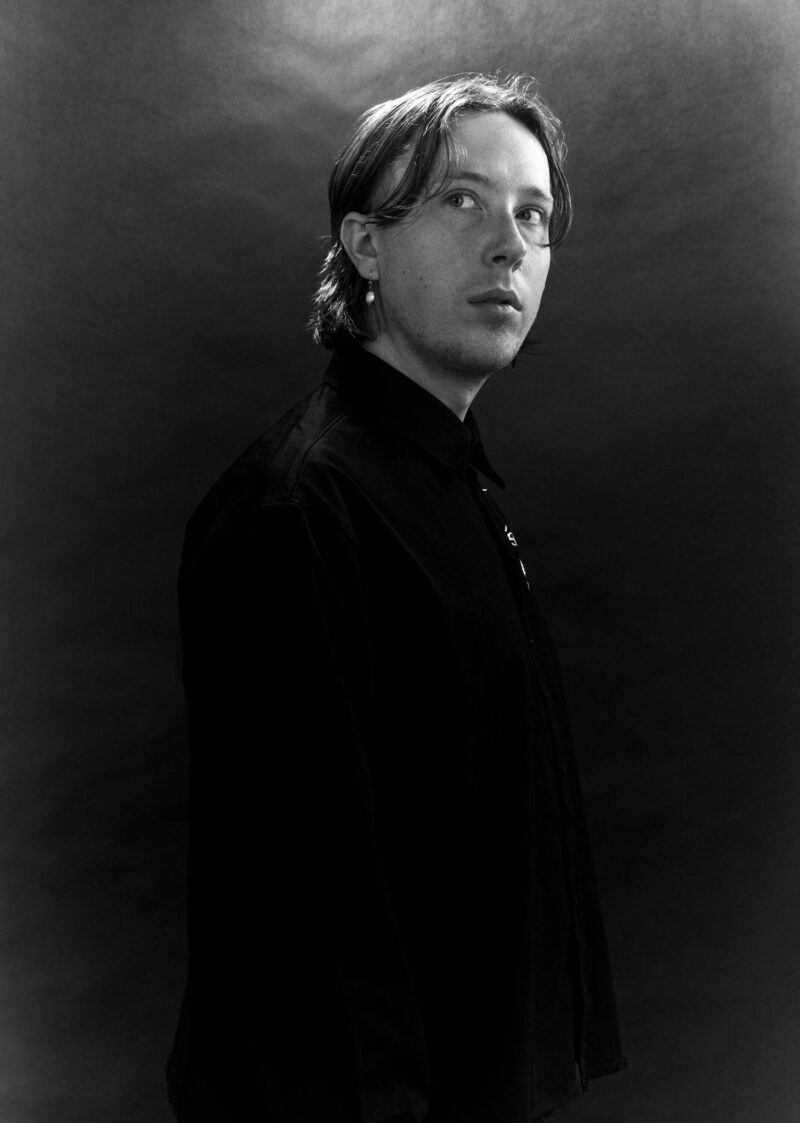
Constant, you come from Los Angeles, while Ben is based in New York City. How have the music scenes and cultures of those cities shaped your respective projects, and what similarities do you recognize between them? And what do you think is different?
Ben: I think New York City’s music scene is so diverse, which makes it such a beautiful and thriving location for musicians and showgoers. You can hit a punk show, an electronic show, hardcore show, or jazz club in the same borough in the same night. It’s wicked, I love it. I think LA is quite the same besides the traffic haha, but I think the diversity of people and genres is the best and most important similarity of both cities, keeping live music thriving. New York City in general has a million places to find and take inspiration from. Taking late night subway rides can create a huge narrative story in its own way, walking in the parks and seeing all different types of fashion and taking everyone’s unique sense of expression and sensing love and unfortunate disparities throughout the air can present all kinds of thoughts and ideas to put down on paper, it becomes its own dimension and reality that spews inspiration for lyrics and especially beat and rhythm. The nightlife through dive bars and street festivities is an overwhelming resource of artistic relation. You can simply sit in a moment, look around, and take in so much that you can’t find anywhere else. I try to take the mood and energy of wherever I was that night or night before to the writing process to resemble the city’s grit and hardstyle energy that keeps it alive.
Constant: I think growing up in Los Angeles has informed my music a lot. There’s a strange duality to the shiny movie stars, warm beaches, and perpetual sunshine that is surrounded by industrial decay, violence, and broken dreams. I think my music has a similar duality, being both deeply sad and deeply danceable. That’s a strange combo that (I hope) works. It definitely reflects how I grew up and who I am; I never truly fit into any one box.
On the contrary, despite being visually more gothic and less “shiny” than LA, I feel as though the scene might be a bit less substantial in size in New York City, but I only know a little from my limited experience. It has always made me laugh that the places with the most goths are often the ones that punish us with bright sunlight (ie. Los Angeles, Mexico City, San Antonio, etc., with the exception of Chicago). I love New York, and I do think there is a kinship between the two cities, and certainly they are two of the most important musical hubs in the world.
Constant and Ben, what are you each most excited about on this run, and what kind of experience do you hope audiences take away from seeing both projects in the same room?
Ben: I’m really stoked to finally play these new songs live and also give the fans a chance to sing the songs that got us here with us. My absolute favorite part is inspiring younger showgoers to keep pushing their craft; the young musicians are the main reason I do this 100%. I started going to shows around 12-13 years old at VFWs and want to relive how I felt when people rushed to the stage to snag the mic from the vocalist to scream the lyrics. We want to go against the grain as much as possible so we get sweaty with everyone on stage with us during ‘Parting Ways’. It just started out of a last-minute call-up on our first show in San Diego so I just wanted to try and accomplish that every single night regardless of the size of the audience. I was pretty nervous at first, but I know the fans have such a fun time being able to dance underneath the lights with us, and that’s what matters the most. I hope the audience can take away a fresh new ear for Post-Punk music and can feel like they’re at a Factory or CBGB show. I just want people to feel free in a safe space and take home an amazing show experience.
Constant: I’m excited to play shows with Stare Away and all our awesome local openers because I know the audience is going to have a great experience! As my first headliner tour, I’m also really excited to get to play a longer set for fans; I’m always bummed when someone comes up to say hi and is sad that I didn’t play a specific song; hopefully having a fuller set mitigates some of that disappointment. Another favorite part of tour for me is meeting the amazing people who listen to my music; none of this would be possible without them, and they mean everything to me. All I want is for them to have a night where they can let go and enjoy themselves during these crazy times.
Constant and Ben, once the tour is over and both albums have had time to settle into the world, what does each of you have planned for 2027, and do you envision further collaborations?
Ben: As soon as we get back, I plan on just getting right back to constructing the direction of the next record. I want to find the perfect hybrid kit to add to our live shows and just make something different. I feel like a lot of bands just get trapped in the same sound, playing the same riffs. I definitely want to get my head into a new book and maybe pick up some weird new hobby, but I think I just want to challenge myself towards a new direction to take Stare Away.
Constant: I recently won a literary award, and as a result I will be releasing a book of poetry in 2027 called Elegy with Beautiful Child, available for preorder from Milkweed Editions. My lifelong dream (even before music) has always been to publish a book of poetry, so this is a really important moment in my life!
There is also a Stare Away x Casket Cassette song in the works, and Ben and I are good friends, so it’s definitely not the last you’ll be hearing from both of us.§
Casket Cassette’s Reducer is out now. Listen below, and Order Here.
Stare Away’s In Absence is out now. Listen below and Order Here.
The end of the Reducer tour leaves both artists with fresh work already taking shape. Nelson plans to begin developing the next Stare Away record as soon as he returns to New York, introducing a hybrid drum kit while pushing the project toward unfamiliar methods. Williams will turn toward the January 2027 publication of Elegy with Beautiful Child, his debut poetry collection and winner of the 2025–26 Jake Adam York Prize. A Stare Away and Casket Cassette song is also underway, extending a friendship that began on a shared bill into the studio.
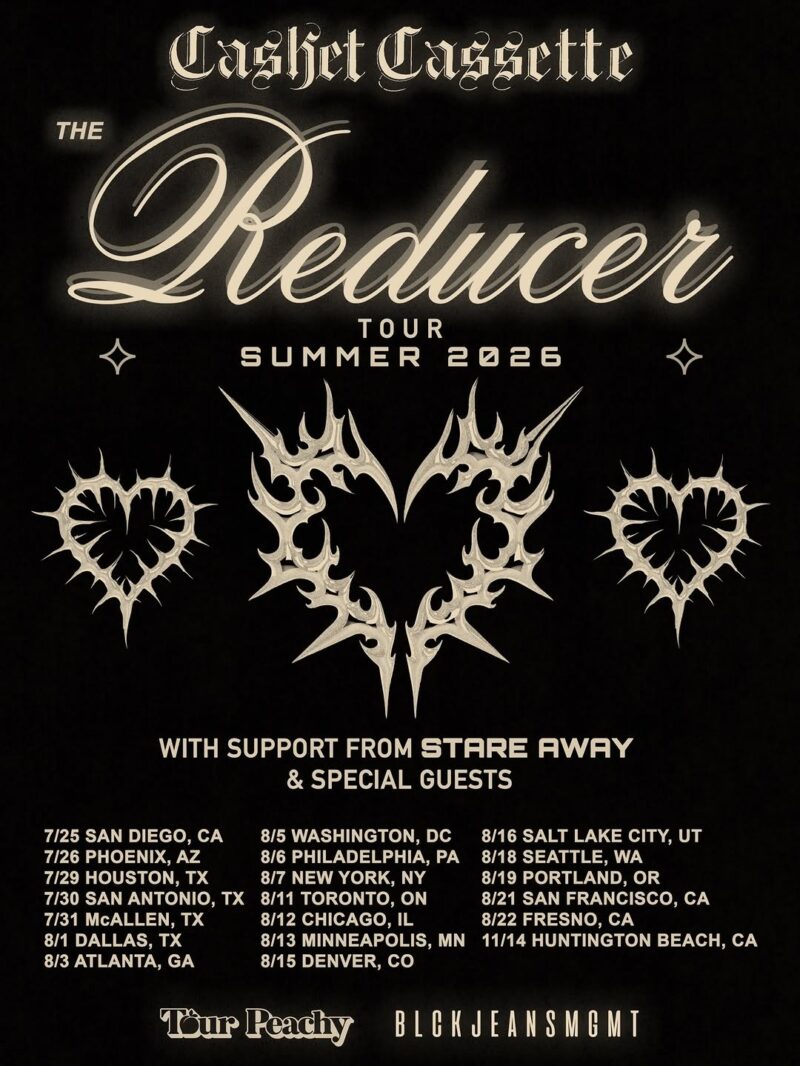
Before those plans take over, Casket Cassette and Stare Away have eight dates remaining together on Casket Cassette’s Reducer Tour. The itinerary continues August 12 at Beat Kitchen in Chicago, followed by Minneapolis, Denver, Salt Lake City, Seattle, Portland, and San Francisco before their shared run closes August 22 at Summer Fox Brewing – Tower in Fresno.
Casket Cassette and Stare Away Reducer Tour Dates:
Follow Casket Cassette:
Follow Stare Away:
The post Between Fallen Angels and Gotham Nights — An Interview With Casket Cassette and Stare Away on the “Reducer” Tour appeared first on Post-Punk.com.