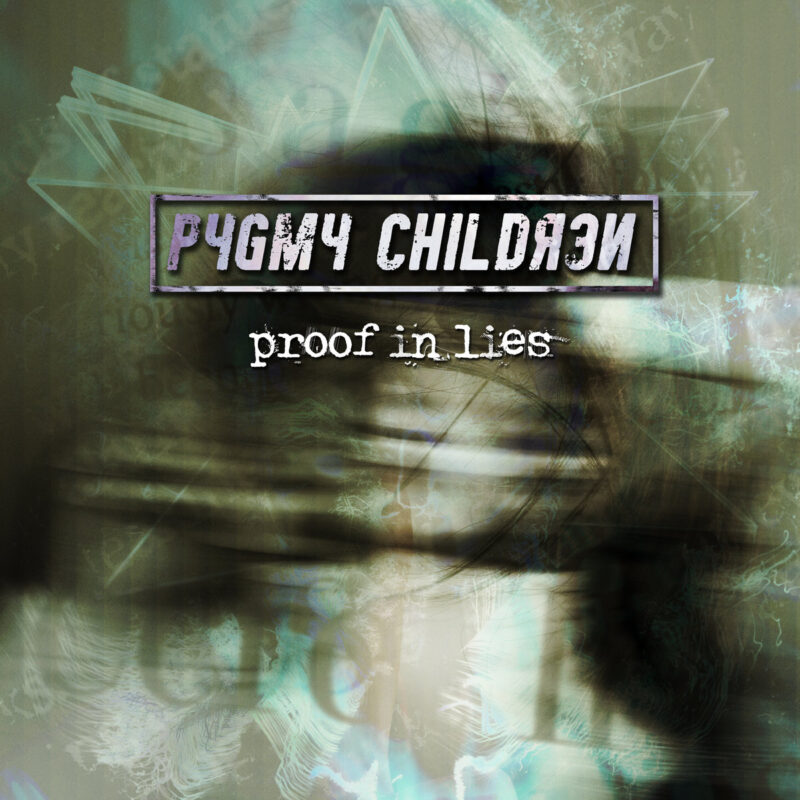
There comes a point, after enough headlines, alerts, feeds, clips, corrections, denials, cropped videos, expert panels, anonymous sources, and professional faces staring gravely into cameras, when information begins to resemble an industrial solvent poured directly onto the brain. Reality remains somewhere underneath, presumably, but reaching it requires digging through so many layers of interpretation that certainty starts feeling less like knowledge than another product somebody is trying to sell. Baltimore electro-industrial duo Pygmy Children, brothers Pete and Brian Roper, plant Proof in Lies directly inside that psychic mess.
The track leads their forthcoming fifth studio album, Into The Silence. The music carries the physical force of industrial rock without turning itself into machinery: drums strike with hard, deliberate weight, guitars grind against serrated electronics, and Pete Roper delivers his vocals from somewhere between accusation, exhaustion, and the suspicion that everyone in the room has already agreed upon the wrong version of events. Nine Inch Nails, Ministry, Christian Death, and the severe electronic rock of later Gary Numan all come to mind, although Pygmy Children funnel those affinities through their own Baltimore-bred sense of unease.
“I rediscovered some old lyrics in a notebook for a track that had never fully materialized,” says Pete Roper. “I still remembered the original chord progression, so I rewrote the lyrics, recorded the initial drum tracks, and the project began to take shape.”
That resurrection feels appropriate for a song preoccupied with evidence, memory, and the slippery authority of whatever appears before our eyes. Proof in Lies examines a culture in which perception competes continuously with experience, while repetition can make the grotesque seem ordinary and the ridiculous seem plausible. Once violence becomes entertainment, catastrophe becomes content, and human suffering becomes another image between advertisements, the ability to distinguish participation from spectatorship begins to rot.
Roper ultimately locates his remaining point of orientation in music, describing it as a place of clarity, peace, and honest expression. That conviction gives the track an emotional center beneath its metal-edged pressure: somewhere behind all the competing signals remains the stubborn belief that expression can still communicate something uncorrupted.
The accompanying video pushes the idea further through live performance footage, original visual effects, and public-domain animation produced during the 1940s, recombined into an uneasy collision of obedience, fantasy, violence, and entertainment.
“The imagery in the video challenges our blurred perception of the boundary between reality and fantasy as we move through life increasingly disconnected from one another, following established paths without question and becoming desensitized to experiences beyond ourselves. The social acceptance of violence as a form of entertainment also emerges as a recurring theme. Finally, the unanswered question of what the recurring mysterious character possesses invites deeper interpretation.”
Watch below:
By the end, Proof in Lies leaves certainty battered beyond recognition, which may be the most accurate portrait possible of an age where everybody has access to everything and somehow nobody can agree on what they have seen.
Listen to Proof In Lies below and order the single here, out now via Re:Mission Entertainment.
Follow Pygmy Children:
The post Baltimore Electro-Industrial Duo Pygmy Children Blur the Lines Between Reality and Fantasy in Video for “Proof in Lies” appeared first on Post-Punk.com.