Hier und da
verbrannten zwei Welten.
Hier und da:
die Brücke.
Martin Falkenstein has spent years making music that stares into old forests, old legends, and old wounds. As the force behind Thuringian black metal folklorists MOSAIC, founder of the House of Inkantation label, and a live musician with Sun of the Sleepless and Empyrium, he has built a body of work steeped in history and myth. With HEILSTATT, Falkenstein turns the telescope around, planting the monster squarely in the room with us.
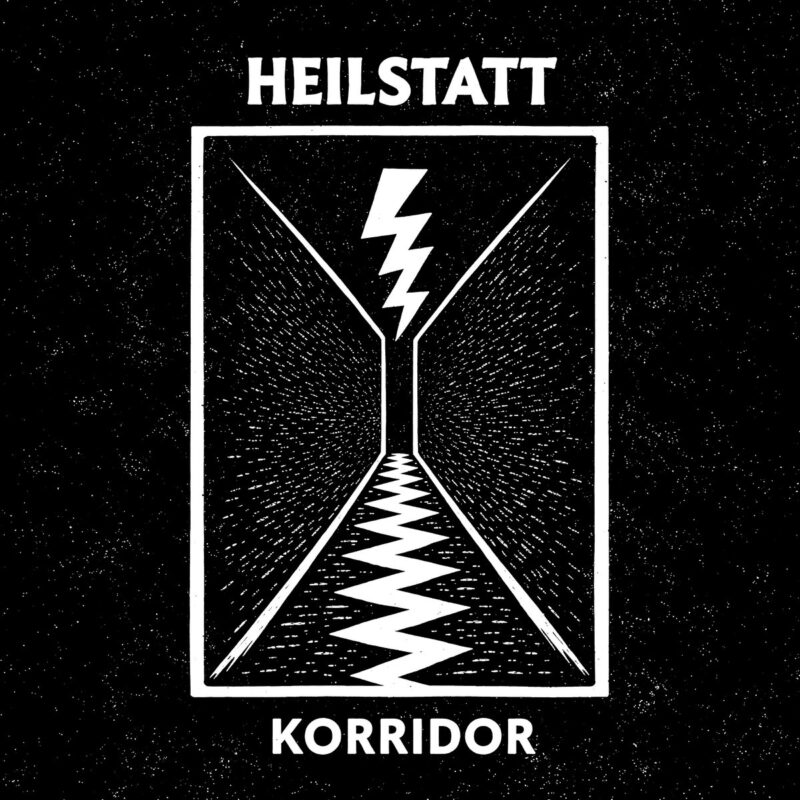
Korridor strips everything to bare architecture: early post-punk basslines, rigid drum patterns, skeletal gothic textures, operatic, growling vocals; brittle trip-hop, and depressive punk. Falkenstein wrote, performed, and produced every piece himself, keeping the arrangements severe enough that each drum hit and bass figure lands with bureaucratic force. EA80, Fliehende Stürme, Merciful Nuns, Molchat Doma, and Verrottet Minimal hover somewhere in the bloodline.
The name HEILSTATT comes from an old German word suggesting sanctuary, refuge, or salvation. On Korridor, those ideas feel more like coordinates scratched onto a damaged map, with repetition applying pressure as cold surfaces meet fragile melodies. Falkenstein examines disillusionment, longing, resistance, and the increasingly absurd spectacle of modern life eating itself in public.
“With the debut album, I wanted to capture the spirit of our time: a world moving ever closer to the edge, turning against itself in the digital realm, surrendering its privacy, its individuality and, ultimately, its humanity. A world that is driving itself towards its own destruction…Nothing about this world seems rational anymore. It has become a vast stage populated by people consumed by their own importance and their pursuit of absolute power. That is what the music represents: the end of the world. Cold, stripped back and uncompromising — repetitive and grinding, much like everyday life itself.”
That fracture reaches its sharpest point in Die Brücke, a song built around a broken crossing between two worlds. Fog, separation, historical memory, and political division gather around one damaged piece of infrastructure.
“Die Brücke is based on the idea of an old leaflet that was dropped over Gotha in the 1960s, calling on people to flee the GDR in what was known as Republikflucht,” says Falkenstein. “This historical reference is intertwined with a personal perspective: I grew up in Lehesten, a town located directly on the former inner-German border, in close proximity to what was then the restricted and death strip between East and West Germany. The video for the song was filmed on an old bridge in the former border region. Geographically, the bridge led from the GDR side towards the West German side. During the years of German division, however, this area lay within the so-called no-man’s-land. Against the backdrop of today’s social and political tensions, the lyrics take on an additional layer of meaning. The bridge refers not only to a concrete historical border, but also to contemporary forms of division: to entrenched camps, black-and-white thinking, and the growing difficulty of allowing for nuance.”
Watch the video for Die Brücke below:
HEILSTATT’s Korridor takes that broken bridge as a fitting emblem for the age, pressing private experience against historical wreckage while salvation remains visible somewhere across the gap.
Listen to Korridor below and order the album here.
Follow HEILSTATT:
The post German Post-Punk Project HEILSTATT Bridges History and Modern Division on Debut Album “Korridor” — Watch Video for “Die Brücke” appeared first on Post-Punk.com.