
The mind protects itself by hiding what it cannot yet bear to see. Trauma may become a locked room whose very door triggers fear. Denial, dissociation, and avoidance are not proof of hidden programming, but ways consciousness narrows around pain until, with safety, the forbidden room can be approached again.
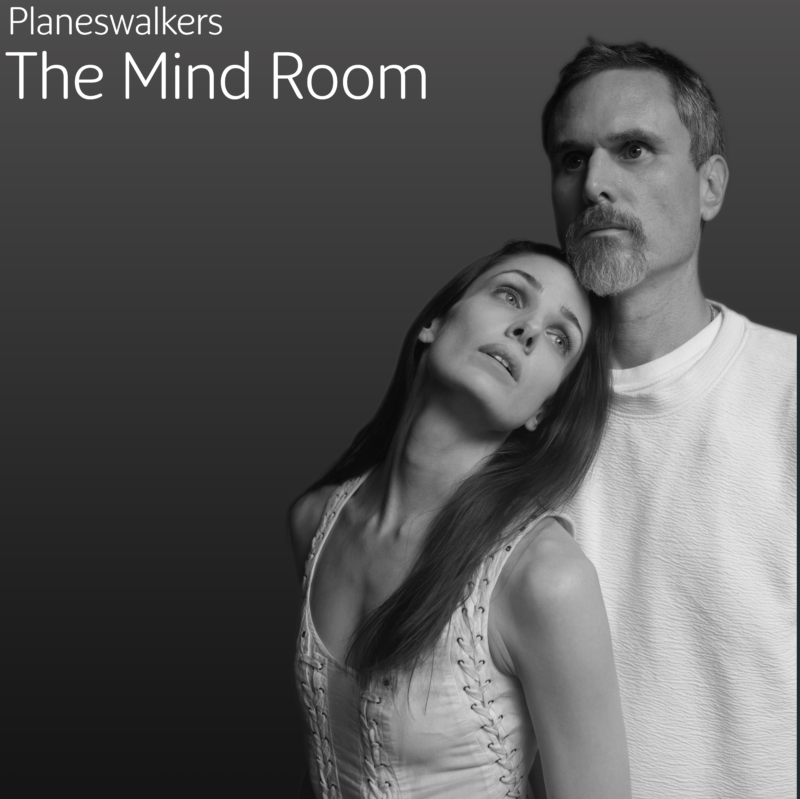
Planeswalkers begin their odyssey with an unusually literal name. The collaboration between gothic songstress Arden Leigh and electronic composer Andrew Means takes its title from the occult idea of moving consciousness between planes through dreams, trance, meditation, astral projection, or other altered states. Their debut EP, The Mind Room, turns that metaphysical vocabulary toward trauma, dissociation, memory, and recovery, imagining the psyche as a series of sealed chambers approached indirectly when direct confrontation feels overwhelming.
The record’s premise draws on Leigh’s belief that extreme trauma can create psychological “tripwires,” while denial and avoidance may become forms of protection. Such language carries obvious clinical and spiritual complications, yet The Mind Room is most persuasive when it translates those ideas into texture and movement rather than explanation.
Leigh describes the partnership in explicitly occult terms:
“Andrew is a really skilled psychic, one of the best I’ve ever met, and he predicted that we’d have more success with it this way. I got a third-party divination just to be sure, and sure enough, it said he was right. We decided to name ourselves Planeswalkers after our shared occult hobbies…I’d say Andrew is a lot better at planeswalking than I am, but I get the job done when needed, or I compensate for it with other aspects of my practice. There were times when we’d finish working on music and then lie down on my floor and astral project together. It’s a really amazing gift to have met someone who shares my two main interests of music and magick like that, and I’m really looking forward to seeing how we continue to explore both of them as we keep working together.”
Across four tracks, The Mind Room treats psychic exploration as both subject and compositional principle. The rooms keep changing shape, and the record’s deepest question remains simple: how does someone approach what the mind has placed behind a locked door?
Horizons opens amid static, distant electronics, and gentle cymbals. Leigh’s voice floats high above the arrangement with an Enya-like purity, making the track resemble a guided meditation intercepted by an unstable transmission. Its spacious trip-hop architecture recalls Massive Attack, though ruptures of noise repeatedly disturb the calm. Clockwork gives the EP firmer physical dimensions. Leigh’s commanding register suggests Zola Jesus, while Means bends electronic tones into an uncanny interior where corridors seem to extend past their logical endpoints. Repetition becomes claustrophobic, and the title begins to feel mechanical in the psychological sense: a mind caught inside patterns that continue moving after conscious control has weakened.
Body makes the sharpest turn. Trip-hop drums support a leering chant, voices push toward shouting, and the earlier inward drift acquires force. The lyric about “walking the planes” supplies the duo with their name, but the song remains intensely corporeal, concerned with breath, rhythm, threat, and will.
The closing Alive returns to open space and echo, with Leigh’s voice receding and reappearing as though consciousness were adjusting to gravity after an excursion elsewhere.
Order The Mind Room here and listen below:
“For resources on plurality, including traumagenic DID, or to make a donation, we recommend supporting The Plural Association here,” suggest the band.
Follow Planeswalkers:
The post Gothic Electronic Duo Planeswalkers Unlock the Psyche on Debut EP “The Mind Room” appeared first on Post-Punk.com.