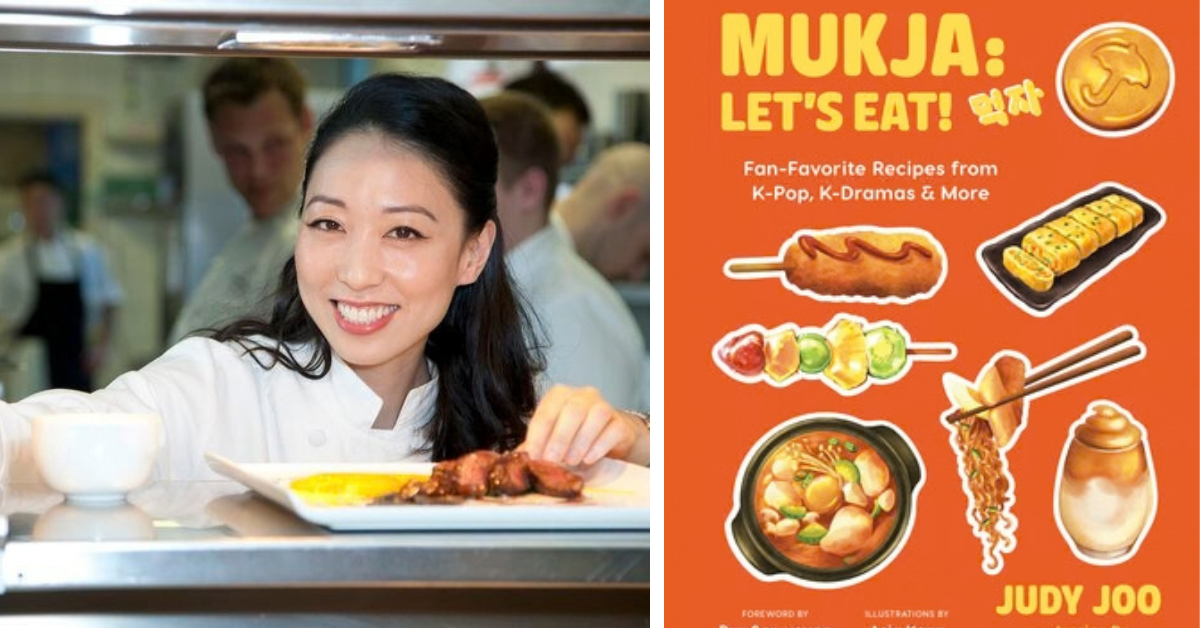
As Korean food, K-pop, and K-dramas continue to find new fans around the world, Judy Joo’s MUKJA: Let’s Eat! brings those worlds together through recipes inspired by some of the moments fans know and love.
KpopWise recently sat down with Ms. Joo to talk about her upcoming book, set for release on November 10. During the conversation, she shared more about her unexpected journey from engineering and Wall Street to the kitchen, as well as the memories, music, and Korean culture that inspired the recipes and stories behind her new collection.
You went from engineering and Wall Street to becoming a chef—what made you realize cooking was the path you really wanted to follow, and was there a moment when you knew you had made the right choice?
Judy Joo: Food was always my creative outlet. Engineering taught me how to solve problems, and Wall Street taught me finance and business, but cooking was the first career where I could use both sides of my brain—the analytical and the creative—and actually create memories at the end of it. I’ve always loved feeding people. Eventually, I realized I was spending considerably more time thinking about what I was going to eat than what was happening in the markets. That was probably a clue.
Leaving a secure career to start again at the very bottom of a kitchen hierarchy was terrifying, humbling, and incredibly liberating. I went to pastry school and then worked in some brutally demanding kitchens, but I loved it. I knew I’d made the right choice when, after a sixteen-hour day on my feet, exhausted and smelling vaguely of garlic, fish, and fryer oil, I still wanted to go back the next morning. That’s either love or madness. In restaurants, it’s usually both.
K-dramas and K-pop have made foods like tteokbokki, Korean fried chicken, and dalgona coffee recognizable around the world. Why do you think food has become such a powerful part of the K-Wave?
Judy Joo: Korean food is practically another character in every K-drama. People aren’t simply eating—they’re flirting over ramyeon, drowning their sorrows in soju, sharing fried chicken after work, or gathering around a bubbling pot of jjigae. Food tells you so much about the characters: who they are, where they come from, and, most importantly, how they care for one another.
And food needs no subtitles. You don’t have to speak Korean to understand the appeal of something crispy, spicy, bubbling, or gloriously cheesy. You watch someone inhale a plate of tteokbokki, and suddenly you need a bite too. It’s contagious. K-pop and K-dramas opened this enormous door to Korean culture, and food has become one of the most delicious ways to walk through it.
For someone who has never cooked Korean food before, which recipe in Mukja: Let’s Eat! would you recommend trying first, and what makes it a good introduction to Korean cooking?
Judy Joo: Kimchi fried rice, without question. It’s fast, forgiving, and ridiculously satisfying—and you don’t need seventeen mysterious jars lined up on your counter before you begin. It also teaches you something fundamental about Korean cooking: a handful of bold ingredients can create extraordinary depth of flavor.
It’s the ultimate fridge-cleaner too. Leftover rice, some beautifully funky kimchi, whatever vegetables or protein happen to be lurking about, and a crispy-edged fried egg on top. Suddenly, leftovers look very intentional. Korean food can be wonderfully complex, but cooking it at home doesn’t have to be.
A lot of young people discover Korean food through a favorite K-drama or K-pop artist. Did you have a particular scene, song, show, or food memory in mind while creating the recipes for this book?
Judy Joo: Absolutely—that’s really the heartbeat of Mukja. I wanted to capture that moment when you’re watching a K-drama, completely invested in the plot, and then suddenly you’re distracted because you desperately need to know what they’re eating. I love shows like Business Proposal, Vincenzo, Reply 1988, and Itaewon Class. Food is rarely just set dressing in Korean storytelling—it carries memory, creates intimacy, and tells you so much about the people sitting around the table.
K-pop is every bit as delicious. Idols are constantly sharing what they’re eating, craving, and cooking, and naturally, I went straight down that rabbit hole. I created recipes inspired by everything from BTS’ hit Butter—hello, honey butter chips—to Jennie’s go-to rice bowl and Jay Park’s favorite tacos. It’s pop culture you can actually eat, which is very much my kind of research.
But underneath all that pop culture is something much more personal for me. I grew up Korean-American, and these foods take me straight back to my mother’s kitchen. So Mukja became this wonderful collision of my two worlds: the food I grew up eating and the Korean culture a new generation is discovering through K-dramas and K-pop. Different route, same destination. Everybody ends up hungry.
You’ve cooked everywhere from Michelin-starred restaurants to street-food-inspired restaurants like Seoul Bird. How did those very different experiences influence the way you approach Korean food today?
Judy Joo: Michelin-level kitchens taught me discipline, precision, technique, and an almost obsessive respect for ingredients. Seoul Bird reminds me of something equally important: food should be joyful, comforting, craveable, and generous. Sometimes you want food plated with tweezers; sometimes you just want extra sauce and a stack of napkins.
I bring both sides of that experience to Korean food. I have enormous respect for the traditions and complexity of the cuisine, but I don’t believe it belongs preserved under glass. Korean food has always evolved, travelled, and adapted. As a Korean-American chef who has made London home, my cooking inevitably carries all of those identities with it. Sometimes that becomes an exquisitely composed plate; sometimes it’s Korean fried chicken dripping with sauce. Both can tell a story. And frankly, I’m very happy eating either.
Your career has taken some unexpected turns—from engineering to pastry school, Iron Chef UK, television, restaurants, and now your fourth cookbook. What advice would you give young people who are unsure about leaving their original career plans to pursue something they love?
Judy Joo: Never think of changing direction as throwing away everything that came before. You take it all with you. Engineering taught me science, structure, and problem-solving. Finance taught me business, discipline, and resilience. Pastry taught me precision and patience. Television taught me the gift of gab. I use all of it.
I also reject this idea that we’re supposed to discover our one true calling at 22 and dutifully follow it for the next forty years. Careers have chapters. Mine certainly has.
Be brave enough to turn the page when something no longer feels right, but do your homework first. Passion is wonderful; passion plus preparation is much more useful. And never be afraid to start at the bottom. I did—more than once. A successful path doesn’t have to be straight, and it’s full of failure. Mine has looked considerably more like a bowl of ramyeon, twists and turns, and I wouldn’t change it.
If you could invite three K-pop idols or K-drama characters to a table and cook them anything from Mukja: Let’s Eat!, who would you choose, and what would you serve them?
Judy Joo: Only three? That’s terribly unfair. I’d invite Jennie from BLACKPINK because I love her style and confidence, and I suspect she appreciates a beautifully laid table. Then Park Sae-ro-yi from Itaewon Class—anyone willing to stake his future on a restaurant has my respect and definitely deserves a proper feed. And Moon Dong-eun from The Glory, because she is so quietly badass that I’m simultaneously enthralled by her and slightly terrified of her. I’d be checking very carefully that she liked the food.
Although, can I sneak in a fourth? Ryu Soo-young. I love how genuinely excited he gets about cooking and making good food approachable. Plus, he can help me in the kitchen while the other three have a drink. Every dinner party needs a little free labor.
I wouldn’t cook individual dishes—I’d cover the table. Crispy Korean fried chicken, tteokbokki, kimchi fried rice, loads of banchan, and something bubbling, spicy, and communal in the middle. Ryu Soo-young can make his delectable sesame soy noodles—the recipe is in the book!—and obviously, there would be soju. For dessert, Dubai chocolate hotteok, because it’s so damn good.
That, to me, is the spirit of Mukja: completely different people brought together around one table. Mukja literally means “let’s eat”—and I still think that might be one of the loveliest invitations in the Korean language.
Pre-Order MUKJA: Let's Eat: Amazon
Follow Judy Joo: Instagram | TikTok | Facebook