“It is about hiding nothing”
German grammar gives death a masculine identity, an administrative decision Die Tödin has taken the liberty of correcting. With an arresting voice, a fine ear for melody, and a sharp sense of the absurd, she has become one of darkwave’s most distinctive personalities. A microphone, a MIDI controller, and Ableton provide the tools; she supplies the morbid wit and conviction. There is an elegance to that economy, particularly in the way she makes the bleakest observation sound like a perfectly reasonable complaint. Her dark electronic beats keep the flesh moving, even when the lyrics have reservations about the whole business of being alive.
Die Tödin initially took shape in the West German city of Gelsenkirchen, where industrial surroundings, limited prospects, and the useful luxury of being left alone provided room to work. Although she has recently moved away from that bleak environment, her songs retain the resolve of someone carving out her own space when society has failed to offer any. Musically, the basslines and beats come first, followed by the words and vocals. Likewise, German and English share the microphone, sometimes for comic effect and sometimes to establish distance. That instinct extends across yet another language in the Spanish refrain of La Bruja / Die Geister, die ich rief. Even the designation “trve darkwave” borrows black metal’s spelling habits with a straight face, and whether anyone catches the joke is someone else’s problem.
Her wit is matched by equally formidable candor. For instance, her song “Angepasste Spießerschweine” takes aim at status-conscious conformity, while “Dissonanz des Lebens” speaks openly about mental illness and the pressure to keep it hidden. Meanwhile, “Die Tödin” distinguishes the project’s focus on lyrics and performance from the immediate emotional expression of her other work as Strobo.Lolita. Although both draw on deeply personal psychological states, she gives each experience a clear musical identity. Just as impressive is the self-possession with which she protects that identity when choosing collaborators.
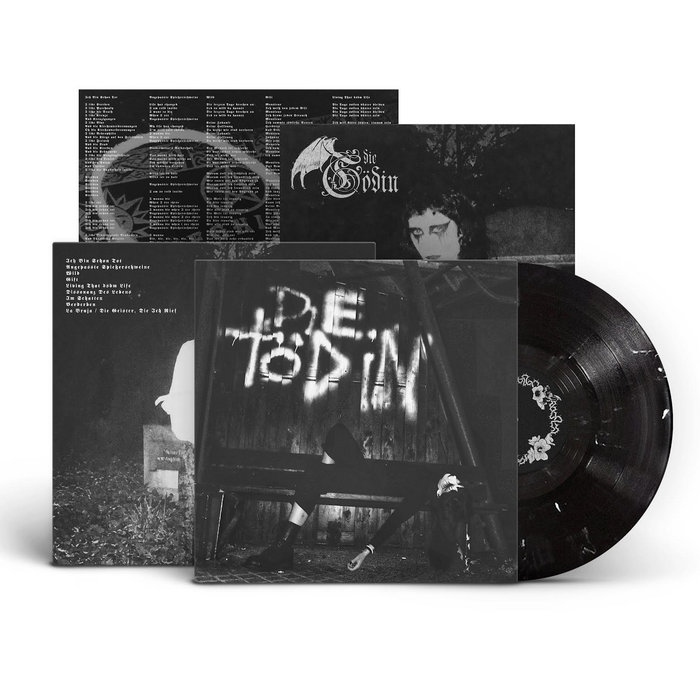
Her forthcoming self-titled collection brings nine recordings from 2022–2025 to Heartworm Press, the label founded by Cold Cave’s Wesley Eisold. Due October 30, 2026, Die Tödin expands upon the earlier Selected Singles release on Minimalkombinat. She regards the collection as a way to bring closure to a difficult period in her life, and the recordings remain unchanged for this edition.
We spoke with Die Tödin about the mysterious woman behind the name, the usefulness of being left alone, her relationship with Heartworm Press, and the pleasure of leaving an audience uncertain whether she is joking. Listen to Angepasste Spießerschweine below, then read our conversation with Die Tödin.
Your very first song as Die Tödin, “Ich bin schon tot,” name-checks Einstürzende Neubauten, Throbbing Gristle, Peter Murphy, Nosferatu, and Dracula. Which records, books, and films first gave Die Tödin her identity, and which of your formative influences would surprise listeners?
There aren’t really any surprises.
Die Tödin’s identity didn’t evolve so much through the influence of records, books, and films, rather, it is rooted in a personal history of mental suffering. Themes like suicidality and depression have played a major role in shaping the persona.
But to name someone anyway, I really adore artists like Beta Evers. Also, the track “Frustration” by Soft Cell from the Mutant Moments EP was kind of an influence on Die Tödin.
You have also worked as Strobo Lolita, drawing more directly from industrial music, no wave, noise, and performance art. What required Die Tödin to become a separate project, and do techniques or ideas ever pass between those two identities?
Strobo.Lolita prioritizes raw, immediate emotions, whereas Die Tödin focuses on lyrical content and performance.
The only thing the two projects actually have in common is that they represent profound expressions of a psychological state.
You describe the city you are from, Gelsenkirchen, through its lack of prospects, industrial nature, cemeteries, physical roughness, and sense of chosen isolation. Can you tell us more about your experience there, and if we can hear the city within the music itself, whether in the rhythms, synthesizer tones, repetition, lyrics, or empty space?
You can definitely hear that in the lyrics!
Gelsenkirchen is anti-social, and so is Die Tödin. What I liked most about the place was that people left me alone and I had my own space to make music. There are so many poor and unemployed people there, too. So no one noticed that I was in a similar situation, and it didn’t matter that I was just another person who didn’t fit into society.
By the way, I moved away recently, so no more Gelsenkirchen.
German ordinarily gives death a masculine form, der Tod, while Die Tödin turns that figure female. Why was that particular name important, and what can Die Tödin express that you might be unable or unwilling to express under your own name?
As I mentioned before, Die Tödin deals with suicide, death, and transience. Therefore, it makes the most sense to choose a name that embodies these themes. And since I am a woman and express my innermost self through music, Die Tödin had to be female as well.
“Trve Darkwave from Gelsenkirchen” began partly as a joke about “trve Norwegian black metal,” although you have also connected it to genuine pessimism and misanthropy. As the project reaches listeners outside the German underground, are you concerned that some of its self-irony may be lost in translation?
Sure, but I don’t think that’s a problem.
The music itself can create enough atmosphere to carry the emotions, even if people don’t understand the lyrics. That’s exactly the beauty of music.
By the way, even Germans sometimes don’t catch the irony. They find themselves asking, “Is she serious?”
How did your relationship with Heartworm Press begin? Who approached whom, which recording first caught the label’s attention, and what convinced you that Heartworm understood Die Tödin?
Wes reached out to me completely out of the blue, and it didn’t take long until I was convinced that Heartworm Press and Die Tödin were a perfect match.
They act in my best interests as a musician, are artists themselves, and I really like the work they have published.
I don’t know which song caught their attention first, but the first one they asked me about was “Ich bin schon tot.” We also didn’t know whether it was supposed to be just a single or a longer release.
Heartworm Press was founded by Cold Cave’s Wesley Eisold to release his own recordings and writing before expanding into an international home for singular underground voices. Why does it feel like the right label for Die Tödin, and what do you hope the partnership will make possible without compromising the project’s independence?
I have a very specific vision for what I create as Die Tödin, and I am very selective when it comes to collaborations. They worked closely with me, and it was important to them that everything was done in my best interest. They made me feel that they wanted to support me and truly valued the fact that I was working with them – and not the other way around.
The self-titled Heartworm Press release gathers nine recordings made between 2022 and 2025. Why did this particular moment call for a definitive collection, and why was Die Tödin the right title rather than something that identified it as an anthology or retrospective?
The last two years have been very difficult for me, so I want to draw a symbolic line under that period with this release.
It isn’t an album, but rather almost everything Die Tödin has released to date. For me, this collection marks the conclusion of this chapter. The original release on Minimalkombinat was titled Selected Singles, now a few more tracks have been added, and a self-titled release seemed the obvious choice for the international market.
How did you determine the sequence and final selection? Was there a reason the nine-minute “Nacht” remained outside the collection, and were any of the chosen tracks remastered, remixed, or otherwise altered for this edition?
The two songs that didn’t make it onto the record have no recognisable lyrics and aren’t played live. Consequently, they have something of a hidden track quality and aren’t quite typically tödish. The other songs remained unchanged.
Earlier editions became extraordinary physical objects, including a one-sided clear record with screen-printed henbane artwork and a special version involving black candles, roses, and petals pressed into the vinyl. The Heartworm pressing comes on Black Static or White vinyl with an 11-by-17-inch newsprint poster. How closely were you involved in shaping this edition, and what role does your continuing visual collaboration with Schwarze.Leere play in the identity of Die Tödin?
Schwarze.leere is closely connected with Die Tödin and understands the visual aesthetic.
The extras for the special editions were primarily ideas from Minimalkombinat.
For the current release, after we had discussed the visual concept together, Amy from Heartworm Press showed me her designs, and I was immediately on board.
Listen to Selected Singles below:
“Angepasste Spießerschweine” attacks a mindset governed by status, consumption, narrowness, and hostility toward alternative lives, including versions of that behavior found inside subcultures. As darkwave becomes increasingly fashionable and commercially visible, where do you currently see conformity reproducing itself within the scene?
I don’t really keep up with the scene anymore and prefer to spend my time on my own. That’s why I can’t give you an answer to that.
You have previously stated that your songs generally begin with a bassline and beat, with the words and vocals arriving last, and that the first vocal take is often the strongest. Which song departed most radically from that method, and how has your minimal setup of Ableton, microphone, and MIDI controller changed since the earliest recordings?
To be honest, work on every song begins exactly like that, and the setup hasn’t really changed either.
Your lyrics move freely between German and English, while “La Bruja / Die Geister, die ich rief” introduces a Spanish refrain. Do different languages create different degrees of intimacy, distance, humor, or severity, or are those choices guided primarily by rhythm and the physical sound of the words?
Yes, it has to do with humor and a sense of detachment. Most of it happens intuitively.
In German, many neologisms, especially from English, are already in use, so it felt quite natural.
I think it is still far too early in the story of Die Tödin to speak of anything having developed.
Listen to Verderben below:
“Dissonanz des Lebens” directly names psychiatric medication, therapy waiting lists, exhaustion, self-harm, and suicidal ideation. How do you decide what can be disclosed in a song and what must remain private? Has the response from listeners changed how you think about presenting these subjects without diminishing their severity?
It is about hiding nothing. In their daily lives, people with mental illness already have to hide so much. On stage, Die Tödin has to let everything out unfiltered, because it is the only way to endure that state of being.
People with mental illness are increasingly being pushed into a corner and left to fend for themselves. There are cutbacks everywhere, and help is no longer available. It is important to address this and deal with it openly.
As for the people who think this is sick or inappropriate – they haven’t understood the meaning of the lyrics, and Die Tödin simply isn’t the right artist for them.
Onstage, you use instrumental playback to give yourself complete freedom of voice and movement, surrounding the performance with corpsepaint, candles, incense, altars, and other carefully chosen elements. With the Heartworm release bringing Die Tödin to a larger international audience, how do you imagine the project developing from here through new music, expanded performances, or shows beyond Europe?
I don’t overthink it, nor do I make it my main focus. Making music is definitely the priority. Ultimately, however, Die Tödin should be present wherever she is needed.
Nevertheless, music is what I live for. So it would be great to bring tödish music to the whole world.§
Die Tödin has a knack for keeping interviews honest: a question may arrive dressed in their funeral best and leave with an answer that fits on a postage stamp. Her clarity is part of the appeal. She knows what her work needs, holds the terms of collaboration firmly in her own hands, and gives difficult experiences both musical precision and room to be spoken aloud. These nine recordings from her forthcoming self-titled release offer a fitting introduction to an artist whose melodic instinct is matched by the conviction behind it. She says Die Tödin should be present wherever she is needed. And for anyone tired of being told to put on a happy face, this Lady of Death makes surprisingly good company, especially in that she makes darkwave worth living for.
Die Tödin is due October 30, 2026, via Heartworm Press. The first pressing is offered on White vinyl and Black Static vinyl, with the latter limited to 200 copies. Both editions include an 11-by-17-inch newsprint poster. Preorder through Heartworm Press here, or visit the collection’s Bandcamp page.
Tracklist:
Forthcoming live shows:
Follow Die Tödin:
Heartworm Press:
The post Death Becomes Her — An Interview With Trve Darkwave Artist Die Tödin on Her Self-Titled Compilation via Heartworm Press appeared first on Post-Punk.com.