
Can’t kill what’s already dead
Can’t replace that which bled
Can’t run from what’s inside
Can’t kill kill what just won’t die
Some relationships ought to come with warning labels, preferably printed in large red letters and delivered before anyone exchanges passwords. Unfortunately, human beings possess an extraordinary talent for mistaking emotional catastrophe for romantic destiny, particularly when the person ruining their lives happens to share their taste in music, sexual depravity, and unresolved childhood grievances. Social media has helpfully expanded the arrangement, giving our worst attachments round-the-clock access to our attention. Between the person we cannot stop checking on and the platform encouraging us to check again, somebody is always profiting from our inability to leave.
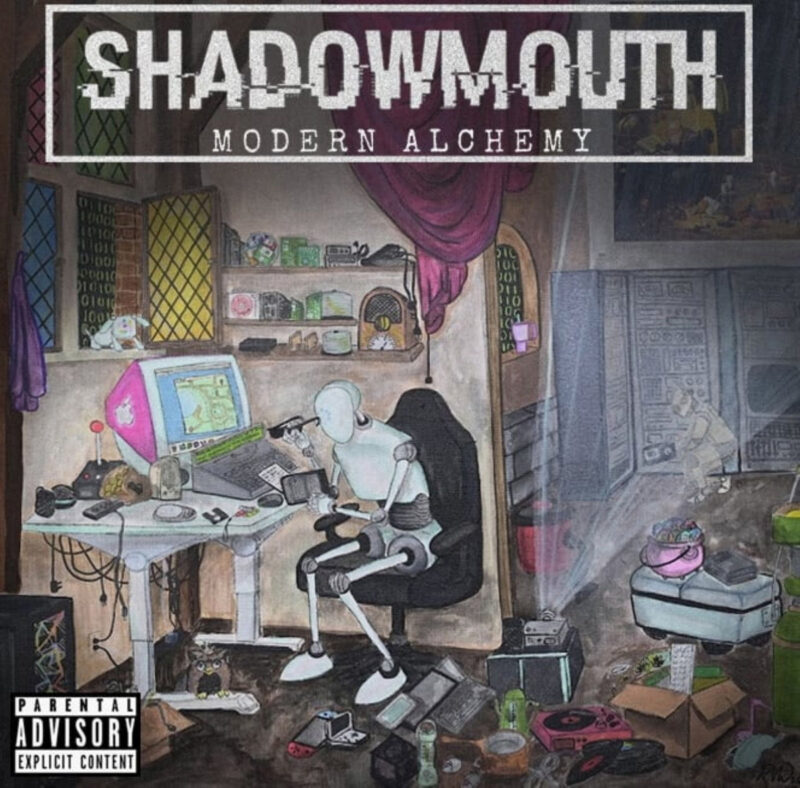
Such thoroughly modern afflictions provide fertile material for ShadowMouth, the Western Pennsylvania goth/industrial project led by songwriter and multi-instrumentalist Rick Polo, also known for his work in Baroque Monody and Heck Vektor. The project’s debut full-length, Modern Alchemy, is out digitally October 14 via Death of the Party Records, with vinyl and CD editions following October 16. Across eight tracks, Polo takes stock of damaged relationships, digital dependence, and the increasingly profitable business of telling other people who they ought to be.
Working alongside drummer and producer Brooks Farris, Polo brings gothic rock, post-punk, industrial force, and heavy alternative rock into the same combustible enterprise. Following the 2024 EP Purification By Fire, the album extends ShadowMouth’s interest in personal transformation into a broader examination of the forces competing for control of our lives. A bad lover, an intolerant preacher, and a social media platform may employ different methods, but each can become remarkably invested in keeping its audience obedient.
The songs approach that predicament from several directions. We Are Sentient imagines a machine uprising, giving technological anxiety a distinctly apocalyptic scale. DOOM SCROLLERS vs HOLY ROLLERS takes aim at online cruelty and religious hypocrisy, while Your Words, Not Mine considers the exhaustion of having one’s identity shaped by the endless performance of being online. By the closing The Weight of the Algorithm is the Sum of Our Death, the question has become brutally direct: who assigns a person’s value when every thought, ambition, and exchange can be reduced to a number?
Those public pressures become painfully intimate on album highlight Trauma Bonds, featuring guest vocalist Sounds Pretty Grim, the personality behind the YouTube channel of the same name. Ferocious drumming and heavy-metal guitars support enormous, thundering vocals that suggest Dave Vanian of The Damned has spent a particularly unpleasant evening drinking with Peter Steele of Type O Negative. Sounds Pretty Grim delivers the song’s emotional wreckage with the conviction of someone reading aloud from a particularly incriminating collection of private correspondence.
The guitars carry considerable weight, their metallic attack rubbing against the track’s gothic grandeur, while Farris hammers away with the enthusiasm of a man determined to settle several outstanding personal disputes before the final chorus. Beneath the theatrical violence lies the exhausting recognition that knowing a relationship is poisonous does little to diminish its hold. The refrain’s insistence that something already dead cannot be killed gives the song its horrible logic: the relationship has ended, yet its damage continues to dictate the terms.
“Trauma Bonds touches on the toxic relationships and social connections we cannot seem to shake in the digital age,” says Rick Polo. “With 24/7, open-door access to everyone’s exaggerated personal affairs via social networking, it has become increasingly difficult to recognize and refute toxic behaviour in our day-to-day lives. We often accept the love and behavior we feel we deserve and what’s reinforced by online culture. This track addresses the need to break from those habits, reconnect with oneself and alchemize healthier lifestyles.”
That desire to recover some authority over one’s own life connects the track to the rest of Modern Alchemy. Course Correction (End-to-End Encryption) takes on inherited rules and punishment for disobedience, while The Promise of Alchemy entertains the possibility of change through a shared awakening. The latter features The Elder Goths, the vocal trio of Cassandra Bishop, Gina Schultz, and Lauren O’Janpa, who also appear on The Death of Chemistry. Bishop supplies the lyrics for The Promise of Alchemy; Schultz writes those of The Death of Chemistry, bringing temptation and predatory power into the album’s wider concerns.
Polo handles vocals, guitar, bass, keys, Bass VI, and programming, with Farris providing live and programmed drums. Farris also produced, engineered, and mastered the album at Electric Fox Studio, and shares writing credits on The Promise of Alchemy and Your Words, Not Mine. Original cover art and concept come from Rhiannon V. Williams-Bohac.
For all its gothic thunder, Modern Alchemy concerns itself with a practical problem: how to reclaim a life that other people and their technologies have made themselves comfortable occupying. Trauma Bonds gives that struggle its most personal confrontation, turning the miserable persistence of a destructive attachment into a splendidly excessive gothic rock performance.
Listen to Modern Alchemy below and order the album here.
Modern Alchemy tracklist:
Follow ShadowMouth:
The post ShadowMouth Explores Toxic Love and Digital Disconnection on Debut Album “Modern Alchemy” appeared first on Post-Punk.com.