
Shaking under spotlight
Melting in a silent fright
Breaking just to do what’s right
We all change into glistening things
Humanity has developed an astonishing capacity for turning its most elementary desires into elaborate forms of psychological torture. We fall in love, become possessive, mistake dependency for devotion, and eventually discover that the person who once seemed capable of saving us has acquired an intimate knowledge of precisely where to insert the knife. Entire industries have been built around these spectacular failures of judgment, from popular music and psychotherapy to greeting cards and divorce litigation. The absurdity would be hilarious if the consequences weren’t so frequently catastrophic.
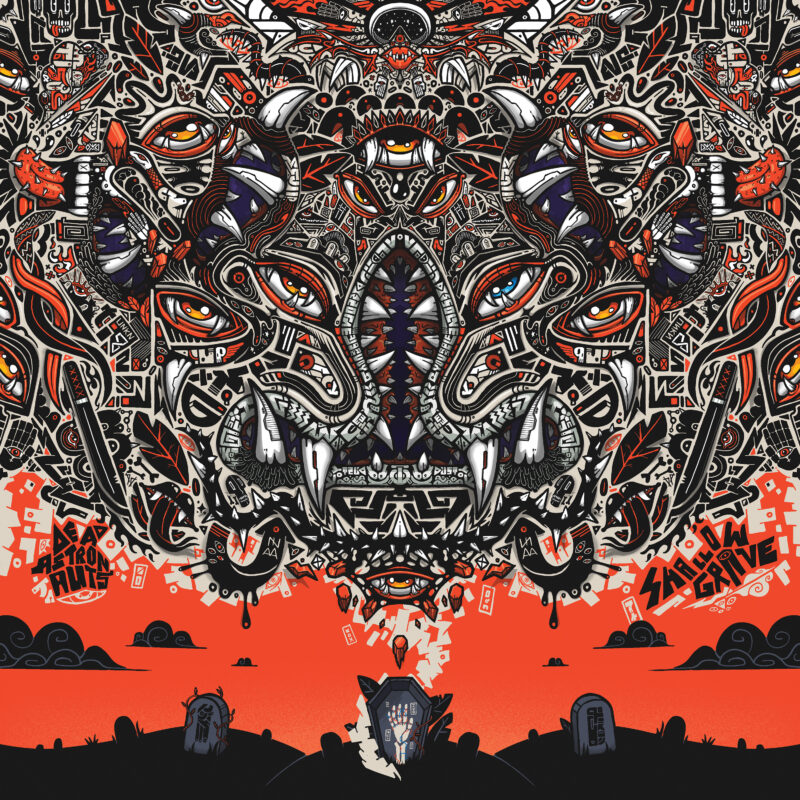
For the past decade, Dead Astronauts have occupied a curious intersection of darkwave, synthwave, gothic rock, and cinematic electronic music, producing records increasingly preoccupied with the psychological debris of modern existence. Now operating as the duo of Jared Kyle and Slade Templeton, the project has developed an international following through releases on Cold Transmission Music and NewRetroWave. Following Ghosts, their fifth studio album, Shallow Grave, takes their longstanding fascination with memory, obsession, and mortality into considerably more uncomfortable territory.
Across Shallow Grave, Kyle and Templeton bring together the romantic fatalism of gothic rock, the propulsive mechanics of post-punk, and the synthetic architecture of darkwave, allowing abrasion and melody to coexist within an increasingly disturbed vision of modern existence. Their subject matter ranges from private emotional catastrophe to collective moral collapse, held together by the uncomfortable recognition that human beings possess an almost supernatural ability to repeat their worst mistakes.
The album opens with An Intro, a whispered poem delivered over atmospheric synthesizer pads and disquieting electronic textures. The words possess the dreadful intimacy of somebody revealing a secret they have kept for far too many years, while the surrounding electronics establish a sense of apprehension that carries into the record’s first proper song. It’s a suitably theatrical beginning, suggesting that whatever follows will involve several questionable decisions and the sort of emotional damage that rarely responds to conventional treatment.
Bodies immediately introduces the album’s central preoccupation with violence and its psychological consequences. Brooding post-punk rhythms accompany images of manipulation, physical suffering, and memories that have acquired an independent existence. Somewhere between the silver screen and the spectacle of suffering, other people’s pain has become entertainment, and the individuals responsible for manufacturing it seem remarkably pleased with themselves. There’s a vicious little observation buried here about our appetite for watching people get torn apart, especially when the spectacle comes equipped with a sufficiently attractive soundtrack.
The title track, Shallow Grave, takes the proceedings into the miserable romantic territory where affection becomes another method of self-destruction. A woman seeks comfort in a relationship whose emotional foundations appear considerably less stable than either participant would care to acknowledge. The repeated assurances of devotion acquire the ghastly sweetness of a poisoned valentine, while the melodic restraint gives the lyrics room to expose the absurdity of loving somebody so completely that annihilation begins to resemble companionship. The prospect of digging a hole for two suggests that romance has officially exhausted its more conventional possibilities.
Get Lost continues this examination of emotional captivity through imagery of mechanical dependence, bodily deterioration, and surrender. Its driving post-punk foundation accompanies a speaker who recognizes the destructive nature of an attachment yet remains prepared to disappear into it. The relationship operates with the efficiency of a machine designed to consume its participants, while the repeated questioning of what remains after someone has finished dismantling your identity gives the song its disturbing emotional weight. There is an awful lot of romantic literature devoted to the idea of losing oneself in love, and very little of it bothers to investigate who is responsible for cleaning up afterward.
With Glistening Things, the album develops a more grotesquely sensual fascination with physical transformation. Skin peels back, bones become objects of strange beauty, and suffering assumes the character of a horrible metamorphosis. The song’s uneasy romantic quality makes these images especially disturbing, suggesting that beauty and decay have been sharing an apartment for centuries without anybody bothering to introduce them. Beneath the delicate exterior lies a fascination with the biological machinery that allows us to experience love, desire, terror, and the bewildering spectacle of consciousness itself.
Who Kills Who expands the album’s concerns beyond individual suffering into the miserable business of organized oppression. Invisible authorities govern through dependency and fear, while the people struggling beneath them dream of freedom. Unfortunately, liberation carries its own terrible possibilities. The oppressed eventually acquire the weapons of their persecutors, and the cycle begins again with a fresh collection of enthusiastic participants. The song’s confrontational electronic attack gives this observation a bitter urgency, presenting human civilization as an endlessly recurring exercise in learning absolutely nothing from catastrophe.
That suspicion becomes considerably more personal on Stuck (In a Modern Day Cult), where psychological manipulation reduces the individual to a frightened collection of borrowed thoughts and impulses. Estrangement from one’s own body, invasive voices, and the desperate desire for human connection suggest a consciousness attempting to escape an elaborate system of coercion. The surrounding instability introduces the possibility that even one’s own perceptions can become unreliable, while the forces responsible for maintaining control appear reluctant to surrender their investment. Beneath the track’s sinister atmosphere lies a familiar modern predicament: the astonishing ease with which people can be persuaded to surrender their autonomy to anybody sufficiently skilled at exploiting their loneliness.
Make It Right introduces a domestic tragedy, following a woman who responds to an abusive man’s cruelty by arranging his permanent removal from the premises. Revenge, survival, and justice become hopelessly entangled as the lyrics describe a midnight confrontation and the secrecy surrounding its aftermath. The song possesses the uncomfortable moral energy of a crime committed after every reasonable alternative has apparently been exhausted. Here, violence becomes an instrument of deliverance, although the distinction between liberation and vengeance remains sufficiently murky to trouble even the most enthusiastic advocate of frontier justice.
By the time From Dust arrives, the album has exhausted most of humanity’s more intimate methods of destruction and turns its attention toward the collective predicament. A world in flames, the certainty of impermanence, and the possibility of companionship beyond physical existence form the basis of an existential meditation on our astonishing inability to learn from our mistakes. The line, “We all die young, with the light of the sun. We don’t think it through, just a thing we do,” captures the record’s fatalistic humour with almost embarrassing precision. We arrive without instructions, spend our allotted time enthusiastically damaging the furniture, and depart before anybody can explain what the hell was supposed to happen. Yet the invitation to face an uncertain future together introduces a curious tenderness into the proceedings. After an album occupied with manipulation, emotional deterioration, and the machinery of oppression, companionship survives as one of the few remaining consolations.
And because no respectable excursion through the darker corners of the human psyche should conclude without somebody turning up the drum machines, Dead Astronauts finish with Bodies (Dark Club Edition), an EBM-flavoured reconstruction of the earlier track. Its dancefloor emphasis transforms the original’s catalogue of violence and psychological wreckage into a muscular electronic stomper, giving the record a final burst of physical energy. One imagines the accumulated anxieties of the preceding songs being processed through a particularly unforgiving nightclub sound system, where existential dread becomes considerably easier to tolerate once the bass starts rearranging your internal organs.
Shallow Grave is out now via Cold Transmission Music. Listen to the album below, and order it here.
Perhaps the great cosmic joke is that we spend so much time worrying about our limited existence while behaving as though we have an unlimited supply of second chances. Shallow Grave finds Dead Astronauts examining that contradiction with morbidity, affection, and a distinctly unhealthy interest in the ways people manipulate, consume, and occasionally rescue one another. The human condition remains a spectacularly disorganized enterprise, although at least somebody has had the good sense to provide it with a decent bassline.
Follow Dead Astronauts:
The post Dead Astronauts Dig Into Romantic Ruin on New Album “Shallow Grave” appeared first on Post-Punk.com.