Rock and roll has maintained a long and thoroughly unhealthy relationship with the graveyard, from the teenage death fantasies of the 1950s to the black-clad miscreants who turned existential dread into a perfectly reasonable excuse to buy another guitar pedal. Romantic despair remains excellent business, particularly when enough distortion can make a broken heart sound like a structural emergency. Atlanta’s Psychic Death have secured a plot where deathrock’s theatrical excess meets anarcho-punk’s abrasive economy, and even the funeral procession has difficulty keeping to a steady pace.
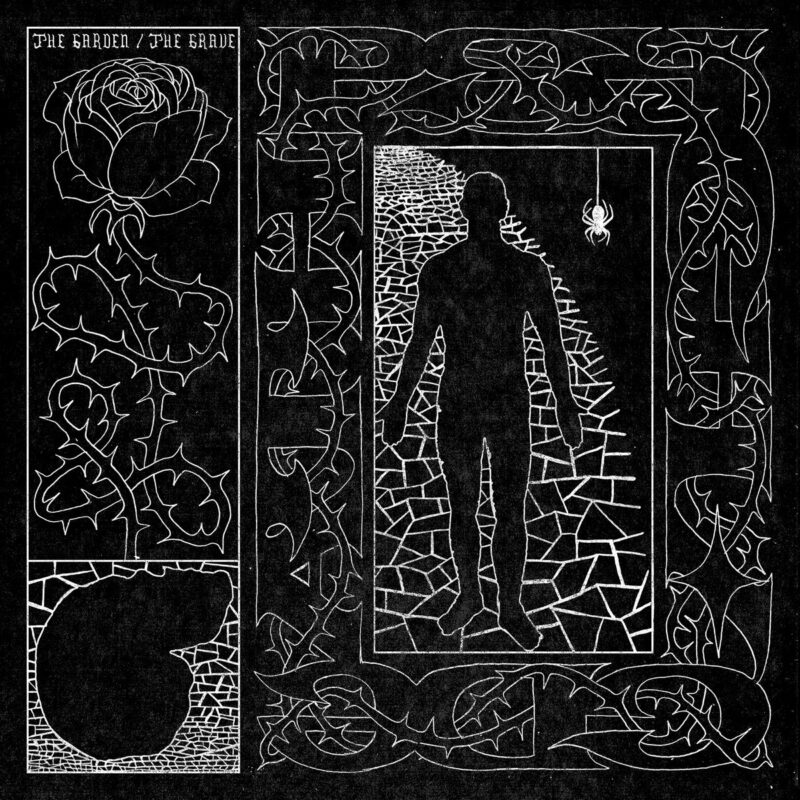
Released October 23 through A Certain Fate, their debut full-length, The Garden / The Grave, brings post-punk, deathrock, darkwave, and noise into close, frequently uncomfortable contact. Guitars scrape against synthesizers, basslines push through the distortion, and rhythms repeatedly change direction beneath songs that initially seem intent on charging straight ahead. Those adjustments give the record much of its character, making its aggression feel restless and deliberate.
Blake Lumry handles guitar and vocals, his acidic delivery stretching from punk accusation to a fuller gothic register. Ryan Stark supplies synthesizers that move between organ-like tones, metallic repetitions, and stranger atmospheric details, while bassist Zach Estess and drummer James Cramer provide both the weight and the instability. The rhythm section does considerably more than hold everything together; it keeps changing the terms under which the guitars and vocals operate.
Buzzing, organ-like synthesizers open the album’s introductory track Debt before sizzling hi-hats, drums, and deep bass begin to lock together. Heavy guitars enter with intermittent screeches, giving the deliberate deathrock groove a sense of resistance: the parts take a moment to catch, then start driving one another. Lumry’s vocals are acidic and biting, recalling the hostility of Christian Death’s Deathwish, although Psychic Death move at a slower, more measured pace. When the chorus opens into a broad, echoing hook, the melody becomes as forceful as the noise surrounding it.
An opening guitar screech and a piston-like drumbeat give way to a thick, Cure-like bass tone on Self Immolate. Estess repeatedly clips the notes short, interrupting their sustain and making the bassline jolt against the drums. Guitars descend in heavy cascades as Lumry adopts a growl that brings Jaz Coleman and Killing Joke to mind. The rhythm acquires the repetition of a production line, then changes shape several times, making the song’s industrialized deathrock feel physically unsettled. Each adjustment puts fresh pressure on an arrangement already packed with distortion.
On Blame, cold guitar notes tremble above an unsettled rhythm section, their fine melodic pattern suggesting a spider’s web stretched across the heavier instruments. There is a faint resemblance to Xmal Deutschland’s Polarlicht, alongside the eerie precision of Barry Galvin’s guitar work in Mephisto Walz. The performance carries an anarcho-punk edge, keeping those delicate upper-register details under constant strain. A late shift in rhythm changes the relationship between the beat and the guitar figure, reinforcing the impression of a band that grows suspicious whenever a groove becomes too comfortable.
Delayed, trembling guitars establish the misty gothic atmosphere of We Have The Night, while Lumry’s clearer vocal delivery allows the song’s melody to take greater prominence. His performance retains its macabre theatricality, now carrying the tune with a bravado that suits the rolling drums and thick bassline. The guitar accents land with purpose, giving the arrangement definition without sacrificing its spaciousness. One of the record’s strongest songs, it finds Psychic Death turning their accumulated tension into a chorus with real reach, particularly well suited to the season of the witch.
A bass figure strummed high on the neck establishes the rhythmic backbone of Pressure, its insistent repetition opening space for sharp bursts of icy guitar. Lumry’s delivery pulls toward punk, while the trembling guitar tones keep the deathrock character firmly in place. The arrangement makes an effective meeting point between the record’s gothic atmosphere and its anarcho-punk attack, with the bass providing a clear melodic line through the abrasion. There is ample darkness for the goths and enough force to satisfy the punks, who may have to negotiate custody of this one.
The album’s lead single, Control, gives Stark’s synthesizers greater authority. A resonant figure rises and falls with the metallic vibration of pipes before deep bass and drums establish a macabre dancefloor drive. Electronic textures hang behind the rhythm section, suggesting the atmospheric use of space associated with Daniel Ash. The guitar holds back until midway through, when its brief appearance introduces an additional note of unease. That restraint makes the entrance effective, while the combination of physical rhythm and gothic spaciousness recalls Play Dead. It is among the album’s most persuasive demonstrations of how much the band can achieve by allowing the instruments room to work.
Repeating electronic textures introduce Picture Me Gone, then propulsive drums and bass begin to carry the song forward as guitars saw across the arrangement. Lumry growls through the competing layers, his voice becoming another abrasive element in a performance that maintains its pressure throughout. Following the comparatively spacious Control, this return to a more congested attack has particular force. The electronics provide the recurring pattern, while the guitar cuts across it, keeping the song’s dense post-punk momentum from settling into routine.
Droning synthesizer notes give Salvation a dirge-like opening before an ominous, rolling drum pattern begins to take shape. A thick bassline anchors the arrangement, gradually taking on a stronger melodic role as the guitars crash around it in a deathrock crescendo. Lumry’s vocals carry the abrasive urgency of anarcho-punk into the song’s gothic setting, while organ-like shrieks surface within the mix. Rapid changes in the beat heighten the unease, making the rhythm feel susceptible to the same panic conveyed by the voice. The accumulating instrumental detail gives the song an increasingly oppressive weight.
A shifting, mechanical drumbeat opens Wait For Me, with a sluggish bassline recalling the oppressive weight of The Cure’s Pornography. Trembling guitars extend that atmosphere while Lumry’s anarcho-punk delivery gives the performance an agitated edge. Around the midpoint, high, organ-like synthesizers introduce a more pronounced sense of gothic dread, widening the space around the instruments. The sustained guitar tremor continues through the remainder of the song, suggesting movement in rooms that ought to be empty. Cramer’s unsettled beat keeps that atmosphere from becoming static, maintaining an uncomfortable tension between the bassline’s drag and the drums’ activity.
An ascending, buzzing synthesizer melody opens Fall Ground before deep bass and streaks of gothic guitar give the closing track a more ornate, almost baroque character. Lumry’s darker vocal register brings Corpus Delicti to mind, while warbling electronics introduce an arcane quality beneath his performance. The arrangement then draws back around the voice, allowing the bass melody and isolated guitar accents to become more prominent. This change in scale makes an effective final turn, revealing how much atmosphere the band can sustain with fewer elements in play. A closing violin supplies the last funereal detail, ending the record with a different kind of instrumental ache.
Recorded at Studio 1 Zero with producer Josh Monroy and mastered by Dietrich Schoenemann at Complete Mastering, The Garden / The Grave keeps its bass and drums tangible beneath considerable guitar noise. There are moments when that density threatens to crowd Lumry’s voice, but the changes in pace and the openings afforded to melody keep the ten tracks distinct. We Have The Night, Control, and Fall Ground offer especially strong evidence of the range within the racket. Psychic Death have made a debut whose appetite for gothic excess is matched by a useful instinct for when to change the beat, clear some space, or let a tune take over.
Listen to The Garden / The Grave below, and order the album here.
Catch Psychic Death at Atlanta Utility Works in East Point, GA, on November 7.
Follow Psychic Death:
The post Atlanta’s Psychic Death Find Fertile Ground for Deathrock, Goth, and Dark Post-Punk on “The Garden / The Grave” appeared first on Post-Punk.com.