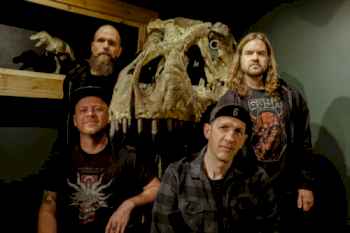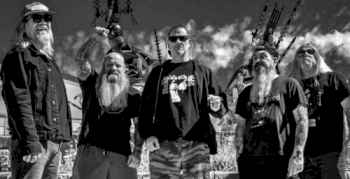
Twenty-five minutes. Five tracks. And an overwhelming urge to start the whole thing again. Blood of the Earth’s Beneath a Sky That Breaks is a thrilling listen, an extraordinary collision of crushing sludge, sprawling post-metal, industrial abrasion, and haunting melody. Each composition flows effortlessly into the next, with unexpected textures and shifting dynamics revealing new details on repeated listens. A gloriously filthy reworking of Ministry’s “Filth Pig” brings the proceedings to a suitably punishing conclusion.
Beneth the considerable weight lies a deeply personal record. For vocalist J Costa, storms have a habit of changing everything. They uproot what once seemed immovable, expose weaknesses in foundations, and leave the survivors to reckon with whatever remains. Loss, grief, fractured relationships, and the increasingly bewildering state of the world inform the EP’s four original compositions, tracing an emotional journey through destruction, defiance, disillusionment, and the ghosts that linger long after the rain. For Costa, whose two-decade tenure fronting Thy Will Be Done includes years of touring alongside some of metal’s most formidable names, the experience has reignited something fundamental. Invited by longtime friend Jeff Golden to contribute guest vocals to music he and Katie Golden had already recorded, Costa soon found himself joining the band permanently, embracing an opportunity to explore unfamiliar territory and rediscover the exhilaration of creating without constraints.
“I wanted to challenge myself and do something different with each song,” he explains. “I didn’t want to be a one-trick pony, just yelling and screaming over things, as much as I love doing that. I wanted to grow.”
That ambition runs throughout Beneath a Sky That Breaks, an intimate, expansive record whose musical complexity serves deeply personal stories. Ahead of its October 23 release, Costa takes Decibel through the songs, the people and experiences behind them, and the creative possibilities that have made Blood of the Earth such an important new chapter in his life.
Beneath a Sky That Breaks
DECIBEL: You’ve chosen to open the record with a song that also lends its name to the entire EP. What does that title represent, and what made this the right piece to establish the record’s identity?
J COSTA: I’m kind of a nerd when it comes to words, wordplay, and poetry. All the music had already been written and tracked when I came into the project, and every song had a working title. I decided to challenge myself by using those titles as inspiration for the lyrics. They were all really solid starting points, but the opening track was the one exception.
The original working title was “Oncoming Storm.” I understood the idea behind it, and it certainly inspired what I was writing, but eventually I felt it was too common an expression for everything I wanted to communicate. By the time I went down to Tampa for mixing, I had something different in mind.
Jeff and I were taking a break from the studio, driving to the store, and I explained why I wanted to call it “Beneath a Sky That Breaks.” I’d been thinking about everything happening in my life and in the world. I’d lost my mother a few years earlier, gone through a divorce, and lost three very close friends within the space of a few years, including one to suicide. There’s also this tremendous weight that comes from looking at the current state of the world.
Through all of that, I’ve tried to carry love and hope with me. We weather so many storms in life, and we never really know what’s going to survive them. Sometimes the foundations we believe are strongest turn out to be much more fragile than we imagined. Sometimes the storm destroys things, and there’s nothing we can do to prevent that.
What matters to me is what we do when things start falling apart. We can’t always stay hunkered down, waiting for the storm to pass. Sometimes we have to find the courage to step outside and start repairing what’s breaking, even while the storm is still happening. We have to be willing to do the work.
That’s where the title came from. It’s my hope that things can remain strong through adversity, and that when something does begin to crumble, we have the resolve to try to rebuild it.
When I explained all of this to Jeff, it immediately resonated with him. He suggested making it the EP title, which was exactly what I’d been thinking. Jeff and Katie have been through their own storms, too, so it felt like something all three of us could stand behind, individually and collectively.
DECIBEL: What do you want that opening composition to communicate about this incarnation of Blood of the Earth?
COSTA: I want people familiar with our previous work to challenge whatever expectations they might have. Jeff, Katie, and I have all had different musical experiences, but we’re not necessarily interested in repeating what we’ve already done. We love music, especially emotive music, and I want people to understand that this chapter of Blood of the Earth is a human force.
I feel like some heavy music has become a little too contrived, almost algorithmic. Everything starts sounding very similar, and sometimes that human element gets lost. I’m not knocking anybody who enjoys that music, but the aggression, grief, vulnerability, and emotional expression are what attracted me to heavy music in the first place. It’s an art form that has always spoken to people who don’t necessarily feel they belong.
There’s a line in the song that means a great deal to me: ‘We crown the void.’ I think about how vapid and fickle things can be, and how often we celebrate the emptiest things in society. We’ve lost sight of substance and what it means to be human. We place so much importance on something appearing perfect or meeting an arbitrary standard, and we forget that making mistakes and being vulnerable are essential parts of who we are.
What about somebody who creates something simply because they need to create? Maybe somebody paints a picture for a friend, and it hangs in their basement for the next 30 years. Maybe one day it ends up in a gallery. Neither outcome changes what happened when that person put paint on the canvas. The act of expression matters. Sharing something of yourself, knowing it might not be accepted or understood, takes courage. I think we’ve forgotten how beautiful that can be. That’s the human element I want Blood of the Earth to preserve.
The Constellation
DECIBEL: We’ve been talking about how the songs relate to one another. Was there a particular musical or emotional progression you wanted to establish between the opening track and “The Constellation”?
COSTA: There was a very specific image I had in my mind, although I don’t know that I ever discussed it with the others.
Have you ever looked up at the sky after a really bad storm? Once the clouds clear, the stars seem so much brighter. You notice things that weren’t visible before, and there’s something beautiful about that.
I imagined the opening song as this angry storm, and then “The Constellation” arriving as the calm afterward. Suddenly, you’re looking up at the sky and seeing everything differently. There’s also something fascinating about how people have admired constellations throughout history, creating myths and stories around them and passing those stories down through generations.
The music has that haunting, melodic quality, and with the lyrics Katie had written, it felt like a natural progression. I could picture the transition in my mind.
DECIBEL: The record moves between crushing heaviness and atmospheric restraint without ever feeling disjointed. How do those dynamics take shape during the writing process?
COSTA: It’s a very conscious decision that the songs need to breathe. They need that give and take. I’ve always loved space in music, and I think dynamics are what really move me.
Jeff and I have talked about this for years through our shared love of bands like Neurosis, ISIS, and Amenra. Those bands create soundscapes that feel alive. It’s not just this monolith of riffs. The music moves, flows, and changes shape. There’s something organic about it.
That’s what we wanted to achieve, both within the individual songs and across the EP. Every section needs to serve a purpose, and when you put the compositions together, they should feel like a complete statement.
I love records that have that quality. You can hear how much thought has gone into the sequencing and how the pieces relate to one another. We wanted to give this EP that same attention.
DECIBEL: Is there anything else about “The Constellation” that we haven’t touched on?
COSTA: The lyrics are especially important because this is the one song Katie wrote the words for. They’re connected to some of her experiences in music and the way people sometimes dismiss others because they’re no longer part of a particular scene or perceived in-crowd.
There’s this idea that somebody who’s been excluded or doesn’t conform to certain expectations is suddenly irrelevant, that they’re never going to amount to anything because they think differently or play music differently.
For Katie, and for us collectively, the song is a statement that we’re still here. We’re still artists. We’re still creating. It isn’t a popularity contest. It’s about expression and the experience of making something.
Barren Oasis
DECIBEL: “Barren Oasis” is an evocative title. There’s an interesting contradiction between those two words. What’s the story behind the name, and how does that imagery relate to the song?
COSTA: That was another working title, and I loved it immediately. The juxtaposition gave me a starting point, especially because this was the first song I recorded for Blood of the Earth. At that point, I was still approaching it as a guest appearance.
The question I kept coming back to was: What are we doing to our environment, and what are we doing to each other? Why do we take something naturally beautiful and find a way to destroy it or deplete it? Why is there this constant need for more?
As I’ve gotten older, I’ve found myself appreciating the idea that less is more. There’s tremendous beauty in a landscape, in something that simply exists naturally. Yet we seem determined to reshape everything in the name of progress. We destroy habitats, cut down trees, burn through resources, and convince ourselves that we’re building something greater.
I don’t understand that arrogance. What is it in the human psyche that makes us believe we can improve upon everything? Why can’t we appreciate something for what it already is? Nature existed before us, and it’ll exist after us. Yet we continually challenge it because we believe we know better.
“Barren Oasis” is about taking something beautiful and completely exhausting it, then looking around and wondering where it went. And rather than examining our own responsibility, we immediately try to find somebody else to blame.
There’s a line Jeff particularly loved: ‘Woe to the kings of decay.’ He actually considered changing the song title to that, although we ultimately agreed that “Barren Oasis” was stronger. That lyric captures the underlying idea. We celebrate what we perceive as our greatness while systematically destroying the things that sustain us.
DECIBEL: One thing I particularly appreciate about the record is that there’s always something happening to hold the listener’s attention. How do you decide when to let an idea breathe and when it’s time to introduce something different musically?
COSTA: I think you develop a sense for that through experience. The three of us approach things similarly. We’ll work on something until we feel it has what it needs, then put it aside for a while and come back to it.
Sometimes you return to a song and there’s still something nagging at you. Maybe a section needs another element, or perhaps there’s an idea you haven’t quite explored. I think it’s important to experiment, even when something initially seems ridiculous.
I’m of the opinion that nonsense can create really profound outcomes. Sometimes you have to throw the clay onto the wheel, punch it, pull it apart, and see what happens. But you also need to recognize when something has already made its statement.
Maybe a section needs to be cut in half. Maybe you’ve added something that doesn’t contribute anything meaningful. You can keep building and building until the song starts exhausting itself, and then you’ve lost what made it effective in the first place.
We’ve all spent enough time making music to recognize that. We’re at a point where we can appreciate letting something exist as it is. We made a conscious effort to trim the proverbial fat and allow the compositions to remain fresh and alive. Sometimes the best decision is to leave something alone.
Petrichor
DECIBEL: “Petrichor” has an interesting history. From what I understand, the song began with riffs Jeff was sending Katie while they were living apart, before she developed the arrangements and additional textures. How did you become involved in shaping the finished composition?
COSTA: This is one of my favorite songs on the record. Katie really shaped the arrangement. She took Jeff’s riffs and developed everything around her piano and keyboards, creating these transitions between the incredible heaviness and the more haunting passages. When I started working on the lyrics, I used the working title as my inspiration. Petrichor happens to be one of my favorite smells—that scent in the air after it rains.
Smell is such a powerful trigger for memory. Something can immediately transport you back to a particular moment or experience, and I wanted to use petrichor as an allegory for memories that linger and haunt us.
There are things we carry that we can’t seem to shake. Sometimes it’s a person or an experience, something that continues to bother us years later. I wanted to explore that feeling because the music itself already sounded haunted to me.
I’d begun writing lyrics around the idea of ghosts and memories when we had a Zoom call one evening. Jeff and Katie were down in Tampa, and I was up here in Massachusetts. As I explained what I was thinking, Katie suddenly remembered something she’d written on a Post-it note on their refrigerator. She’d written this question: Do old ghosts haunt new buildings?
I loved it. There was something about the imagery that fit perfectly with what I was trying to express. I eventually adapted it to ‘Do old ghosts haunt new homes?’ because it worked better lyrically, and Katie really liked how it came together. It was a wonderful opportunity to take something she’d written and integrate it into the story I was developing.
The melody at the end came to me while I was driving around listening to the music. I kept hearing that line, “Why are you still haunting me?” and imagining somebody who couldn’t escape the memories they were carrying.
I recorded the vocals with my friend Matt Marcel near Worcester, including several harmony parts, and sent everything down to Jeff and Katie. When I went to Tampa for mixing, Katie asked if she could sing on that section too. Of course, I immediately said yes.
We ended up replacing some of my harmonies with her voice, and it brought a completely different quality to the song. Her vocals sit underneath mine almost like a ghost beneath the main narrative. It was exactly what the composition needed.
At the very end, I imagined this solitary voice, almost like somebody in a mausoleum, still wondering why something continues to haunt them, even after death. There’s something tragic about that image, and I wanted the ending to communicate that isolation.
DECIBEL: Katie’s vocals provide such a compelling contrast to the harsher elements of the music. Is that interplay something you consciously write toward, or does it emerge organically as the songs develop?
COSTA: It definitely happened organically this time around. But now that we’ve heard what we’re capable of together, it’s inspired us to explore new possibilities. We’re already working on new songs, and sometimes you discover something through the recording process that opens another door creatively.
It doesn’t mean we want to repeat what we did on “Petrichor.” We aren’t interested in simply rinsing and repeating something because it worked. But hearing what our voices can accomplish together gives us more ideas about where we might go next.
DECIBEL: Looking at these four compositions together, you could chart a narrative arc through the record. You begin with the storm, move through its aftermath, and eventually arrive at the lingering memories and hauntings of “Petrichor.” Was that emotional progression something you consciously developed?
COSTA: At first, I didn’t even realize it was happening. It developed organically, and then when we started thinking about the running order, everything began falling into place. Jeff pointed out that the storm comes first, and eventually you arrive at petrichor, which is what remains after the rain. Before we decided to include “Filth Pig,” we were planning to close the EP with “Petrichor.” It felt like the natural conclusion.
After a storm, you’re left with whatever remains. Sometimes those are memories or experiences that continue haunting you. Sometimes you can move beyond them, and sometimes you can’t. And not every haunting is necessarily negative. There’s something about that progression that felt right to all of us, even though we hadn’t consciously planned it from the beginning.
For me, “Petrichor” is also where I experimented most with my voice. I was able to bring in some of my influences and explore melodies and approaches that I hadn’t really attempted before. It allowed me to paint the emotional picture in a way I don’t think I’d managed with my previous projects. It’s a very special song for me.
Filth Pig
DECIBEL: I absolutely love your take on Ministry’s “Filth Pig.” You’ve spoken about recognizing the sludge composition buried inside the original. Was that something you’d always appreciated about the song, or did approaching it as a band reveal aspects you hadn’t previously considered?
COSTA: Jeff and I have always loved Ministry. We’ve been friends for about 16 years, and they’re one of the bands we’ve really bonded over. Jeff’s first European tour with one of his previous bands was supporting Ministry, and he’s such a huge fan that he even has a Ministry tattoo!
We’ve always felt Filth Pig is an incredibly underappreciated record. When it came out, it sounded so different from what people expected from Ministry. It was unbelievably heavy and sludgy. When we started discussing doing a cover, Jeff suggested “Filth Pig,” and it immediately made sense. We could already hear the sludge song inside it.
The question became: What if we made it even dirtier? What if we really broke it down and exaggerated that heaviness?
Jeff started playing around with the riff and found this particular groove. He and Katie then worked together to develop the arrangement. They tried different tempos, but the slower approach captured the feeling we were looking for.
We wanted to reimagine the song, pay homage to Ministry, and make it our own. It also needed to fit naturally alongside the other material.
DECIBEL: You brought Afzaal Nasiruddeen and Glen Ellis into the recording, both of whom have connections to Chicago’s early industrial scene. Beyond the historical significance of their involvement, what did their presence bring to the performance?
COSTA: Working with those guys was incredible. Afzaal was an original member of Crisis, a band Jeff and I have loved forever. He and Jeff have become close friends, and they’re also involved together in Masters Ashes. Afzaal contributed guitar, feedback, and atmospheric elements to “Filth Pig,” along with some guitar work on the opening track.
When we were down in Tampa mixing, Afzaal and Glen came by the studio to hang out and listen to what we were doing. Ryan Boesch suggested recording some gang vocals for “Filth Pig,” which was something I’d actually been thinking about but hadn’t mentioned. Suddenly, everybody was there, Ryan set up a microphone, and we all went into the room to record these vocals together.
It brought a completely new element to the song. Afzaal started coming up with additional guitar parts and production ideas, and the whole thing became this spontaneous collaboration. He really came alive during that process.
But just as meaningful was spending time with them and hearing their stories. They were sharing experiences from Chicago in the 1980s, talking about Al Jourgensen, Ministry, My Life with the Thrill Kill Kult, and the people who helped build that scene. Some of those stories I’ll probably never repeat!
What struck me was hearing about a time when people were creating an actual musical culture together. It wasn’t about social media, influencers, or fitting into some perfectly curated image. These were outsiders experimenting, doing things differently, and building something that nobody could have predicted.
To be in the studio recording a Ministry song while hearing those stories from people who’d experienced that world firsthand was extraordinary. It felt like this almost sacred connection to the past. That energy was still rippling outward, and suddenly we were part of it. I’ll always be grateful for that experience.
DECIBEL: Given the influences running through the preceding four songs, “Filth Pig” feels like revealing a piece of the band’s musical DNA. Was that part of the thinking behind including it as the closing track?
COSTA: I think that was more subconscious than anything. We originally recorded the cover without knowing whether we’d release it at all. We thought it might be something we’d share online as a little extra for people who were interested, but it wasn’t necessarily going to be part of the EP. Then some friends heard it and encouraged us to release it properly. One good friend told me it was far too good to leave sitting around as a throwaway track. I’m glad we listened.
I love the tradition of including a cover as something extra at the end of a record. I remember hearing records when I was younger where that was part of the experience, and there was something exciting about discovering a band’s interpretation of music that had influenced them. In that sense, “Filth Pig” does reveal something about who we are.
It’s also personally meaningful. Jeff and I have been friends for all these years, and we’ve talked about doing a sludge project together. Now we’re finally making that music, and we’ve recorded a song that helped shape both of us as musicians. I listen to our version and feel genuinely proud of what we accomplished.
The Record as a Whole
DECIBEL: Having worked through the songs individually, I want to return to something that struck me about the record as a whole. Despite the weight and aggression, there’s an extraordinary amount of space and texture in these compositions. How important was Ryan Boesch in helping you achieve that balance?
COSTA: Ryan was integral to the sound of this record. His understanding of frequencies and how to balance them is extraordinary. He knows how to make everything work together so the songs have the impact they’re supposed to have.
Jeff and Katie had already written and tracked the music, so Ryan wasn’t heavily involved in rearranging everything. There were moments when he’d suggest shortening a section or making an adjustment, but his real contribution came through production, mixing, and all those additional sonic details. We wanted the record to reward repeated listening.
Ryan calls those little production elements “ear crystals.” There are things happening in the background that you might not notice the first time, but when you’re listening through headphones on the third or fourth play, suddenly something new catches your attention. I love records that do that, and we all wanted this EP to have that quality.
It also helps that Ryan genuinely understands sludge and doom. He knows the music, he understands the frequencies, and he knows how to create that enormous wall of sound while preserving the details within it. Working with somebody who has that knowledge and appreciation for the genre was incredibly valuable.
DECIBEL: How has making this record changed what you think Blood of the Earth might be capable of next?
COSTA: It’s inspired me in a completely new way. I want to keep pushing myself, trying different things, and being comfortable enough to be vulnerable. I’ve been in Thy Will Be Done for more than 20 years, and we’ve had some incredible experiences. We spent years on the road, played with some of our heroes, and made music that means a great deal to me. But life happens. People have families and careers, and we aren’t touring nearly as much as we once did.
Sometimes, as an artist, you start wondering whether that’s it. Whether you’ve already done everything you’re going to do. Blood of the Earth has reminded me that it doesn’t have to be that way. When I was younger, I was constantly influenced by the musicians I admired. You start out emulating people, and hopefully, as you develop, you begin finding your own voice. This project has given me the confidence to explore that.
I listen to all kinds of music, from post-metal and sludge to Swans, goth rock, darkwave, and new wave. Having the freedom to incorporate those influences into something aggressive has been incredibly exciting. I’ve also been fortunate to work with my friend Matt Marcel, who recorded my vocals. We’ve known each other for years through our previous bands, and he creates an environment where I feel completely comfortable experimenting. If I want to try something I’ve never done before, he encourages me. Jeff and Katie have given me that same freedom.
For the first time in a long time, I feel like a kid again. I remember being that teenager who didn’t necessarily fit in, who had all these feelings and questions about the world and found music as a way to work through them. That’s why I started making music in the first place.
Now I have this space where I can explore those feelings again, with friends who write incredible music and genuinely listen to one another’s ideas. We’re already creating new material, and what excites me most is that it’s beginning to represent all three of us as individuals and as a collective. I feel incredibly fortunate to be making music that reflects who I am at this point in my life.
Release and What’s Next
Blood of the Earth have taken a hands-on approach to the independent release of Beneath a Sky That Breaks, with Costa overseeing the physical edition’s layout and design, supported by photography from collaborators, while Jeff and Katie handle much of the band’s merchandise production themselves. Limited-edition CDs are available through the band’s Bandcamp page, alongside merchandise bundles. A vinyl pressing remains a possibility, although no definitive plans have been announced.
The band have already begun introducing their material to audiences, with performances in Connecticut, New York, and Boston helping shape their approach to future shows. Costa says the experience has revealed new creative possibilities, particularly in how Blood of the Earth might develop the performance aspect of their music. Further Florida appearances are planned, including Tampa’s Doom and Gloom Fest III, with additional live announcements expected when arrangements are finalized. Costa also hints at possible European activity, although details remain under wraps. The band’s members have plenty to occupy them in the meantime. Jeff continues touring as the bassist for Six Feet Under, while Katie is developing her solo project, Crimson Key. Blood of the Earth are also writing new material, with another release planned for 2027.
For all the ambitious musical ideas and deeply personal experiences that inform Beneath a Sky That Breaks, Blood of the Earth’s approach remains refreshingly uncomplicated. They write the music they want to hear, make the artwork, print the merchandise, and invite others to share in what they’ve created. Somewhere between the crushing riffs, the ghosts of the past, and the T-shirts coming off a press in Jeff and Katie’s garage, there’s a reminder of what made underground music so compelling in the first place. And why it still matters.
Blood of the Earth’s Beneath a Sky That Breaks is out October 23, 2026. Limited-edition CDs, digital editions, and merchandise are available through the band’s Bandcamp page.
The post Blood of the Earth: Beneath a Sky That Breaks — A Track-by-Track Conversation with J Costa appeared first on Decibel Magazine.