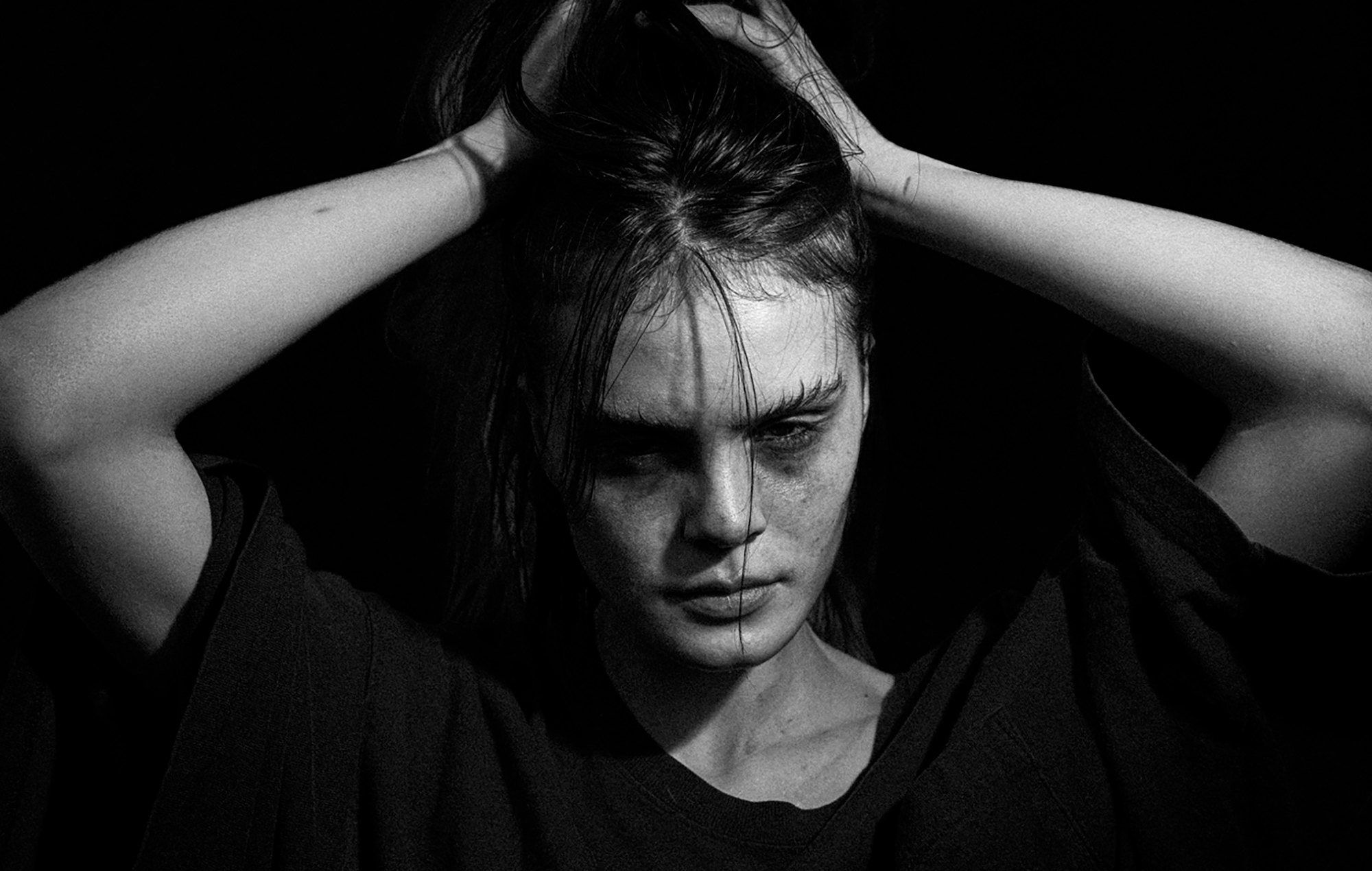
Sofia Isella trades in textures. From the breathy spoken-word of her dark, discordant pop songs to the layered visual metaphors of her eerie music videos, there’s a gritty brutality to her music, like lines scratched in dirt.
Her new EP ‘Something Is A Shell .’ turns that up an octave, prying apart lofty concepts surrounding God, morality and eternal damnation, dragging them back down to earth where Isella can break them down for parts. “I love to give a physical sensation to people, rather than just going straight to the ears,” she says.
Written from the wreckage of a cultural wasteland that pumps out porn and tradwife content with equal enthusiasm, the EP registers like a body horror, where jaws unhinge and flesh fries. “The context is not beautiful,” she nods.
“The contents that I’m talking about are horrifying. They are scary and they’re disturbing, so anything else wouldn’t make sense.”
When NME first spoke to Isella in 2024, she’d already started to gather a cult following thanks to the social media success of early tracks like ‘Everybody Supports Women’ and ‘The Doll People’. Delivered with an air of Regina Spektor flourish and NIN-esque industrial weight, her incendiary takes on misogyny and womanhood appealed to a generation of young women who could quote a line from Sylvia Plath’s “Fig Tree” with the same ease as they might a Taylor Swift lyric – an overlap that neatly crystallised with Isella supporting her at Wembley Stadium.
Back then, she told us that she’d sometimes write a line and find it would later manifest in her real life. ‘Above The Neck’ might be looked back on years from now as the starkest warning we got on yoking femininity so closely to unattainable perfection: “Everything but the imitation of youth must be given up at the desk / Everything but the look that sells / You’re 12 looking 20, or you’re 20 looking 12”.
“What is seen as attractive is to look as if there is no knowledge or life in you”
“When I wrote it, I was thinking of a combination of a bazillion different things, and one of the main ones was porn,” she explains from Los Angeles over Zoom. It’s not gone unnoticed by Isella, 21, that skirting the ‘barely legal’ line sells best. “They wear Hello Kitty underwear, they put pigtails on and they cross their eyes,” she sighs, her own obscured by steampunk glasses. “And they act as if they have no idea what’s going on. Which is hot to the men, and very disturbing and very creepy to me.”
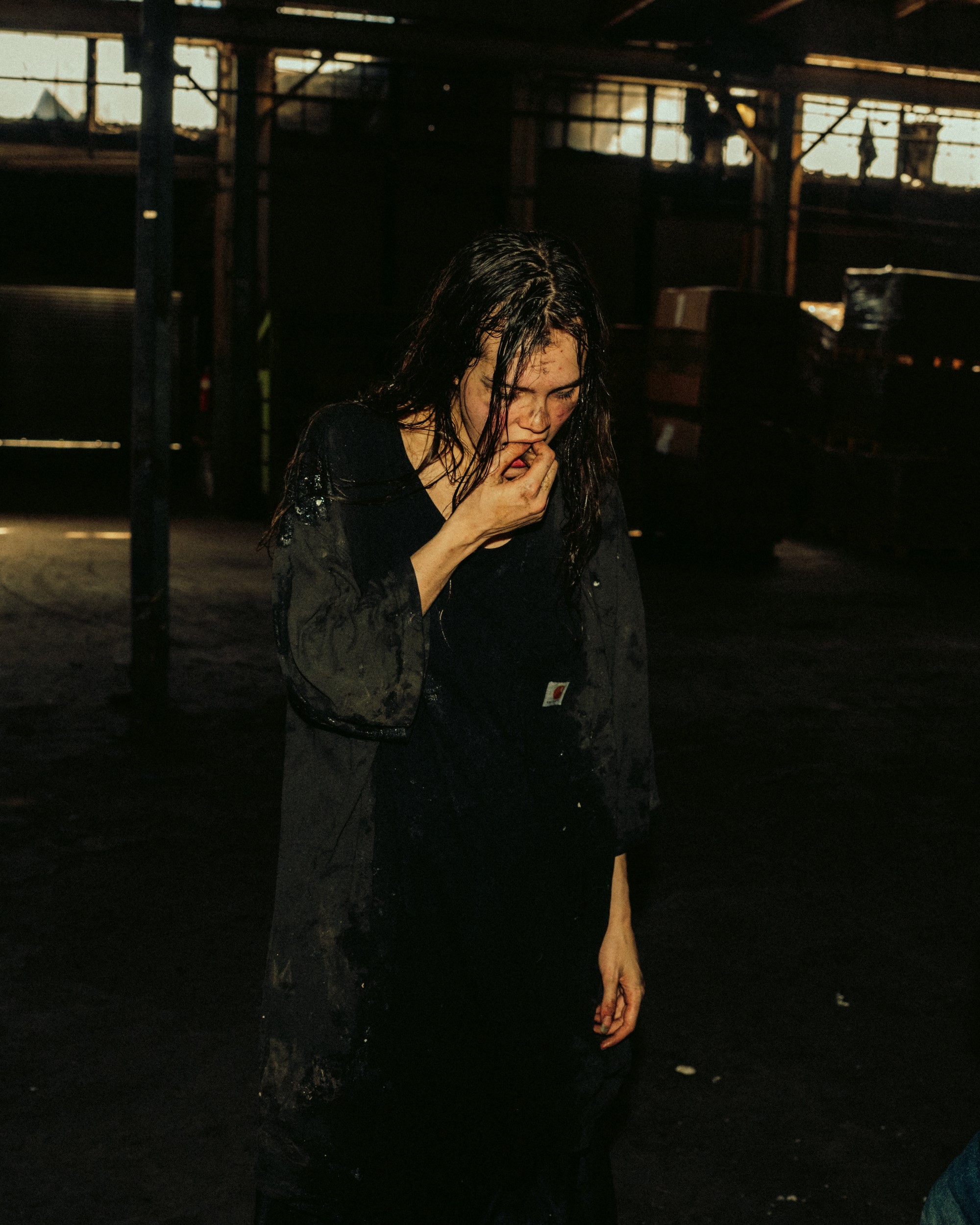
Porn is “a heightened and more obvious” reflection of trends in broader culture, she points out, as pedophilic beauty standards seep into everyday life too. “Our skin, the closer it can look to a child’s, the better. The closer our bodies can look to prepubescent, the better.” Isella seemingly responds by routinely caking herself in dirt and favouring baggy, beige clothes on stage.
Throughout our conversation, her speech is considered and unhurried, and she’s unflinching in her assessment that “everything about us has been directed by paedophiles.”
“And,” she adds, “what is seen as attractive is to look as if there is no knowledge in you, there is no life in you. There is no desire to think of anything.”
What Isella describes no longer seems like a distant horror story in light of the partial release of the Epstein files. The ugliest underbelly of the political elite has been revealed, and Isella, rather than turn away from the world’s ugliness, seems to revel in exposing it, making it sound as squalid and perverse as it is when she spits: “Men are titillated by that delicate line / Between sex, song and nursery rhyme.”
It is perhaps because of her confrontational writing that Isella has had people call her ‘demonic’ – a label she deems cliché and boring. But she was struck by one person who was “very convinced”, advising that people should pray before and after listening to her music, and wash their hands, lest her words somehow seep through the skin – a visual you can’t help but imagine she’d like.
Over the years, Isella says, her ‘live and let live’ philosophy around religion has roughened, evident on EP opener ‘Numbers 31:17-18’ when she pointedly asks: “What kind of god are you defending?”
She laughs softly and promises to be “gentle” when religion comes up, sensing her next words will be anything but.
“My problem with ‘to each their own’ now is it’s not to each their own, because when you have this type of belief system being woven into our culture and how people make laws and how people think of the world, to each their own doesn’t really hold any weight anymore.”
Isella thinks very little of those who demand reverence of “old texts” and the violent acts within them, like “child rape and mass murder, with no sense or reason”. “[When people say] we must have some deep respect for that, it’s just shocking to me. And I have completely gone against it.”
“I think the flow state of writing is the greatest feeling in the world. Everything I do feels like a love letter to that state of mind”
Isella, who was homeschooled in LA, picked up songwriting at eight and didn’t have a phone until she was 16. With social media not yet clouding her consciousness, her time was spent reading poetry, practicing violin and learning to produce music.
“I didn’t know who Ariana Grande was until I was 14. I was very detached from what to know,” she says. “A lot of why I can write, and the biggest thing I give credit for it, is I was extremely bored growing up. I had, like, acres and acres of free time, and I wasn’t around people my age all the time. I was at my house, bored.”
Despite her antipathy for religion, Isella isn’t spiritually incurious. She does feel a kind of tether – “a flow state, is that what they call it?” – to something beyond herself when she writes. “I think it’s the greatest feeling in the world, and I think that everything I do feels like a love letter to that state of mind,” she says. “And it does not feel like it is coming from me. It feels like there is something else, like some kind of long straw.”
As far as invisible cords go, you could argue there’s another one linking her to artists like Paris Paloma, Hayley Williams and RAYE. All pretty distinct in sound, but united by a refusal to shrink that empowers the women in their fanbases. Another name that might come to mind is Florence Welch, whom Isella will join on Florence + The Machine’s US tour dates this month.

“She is so mind-blowingly incredible,” she says of Welch, who has now become a friend. “She is a legendary talent, and the kindest, warmest human. Man, I am just excited to get to see her show six times. That’s what I’m looking forward to.”
With her own tour of the UK/EU looming, what is Isella looking forward to most when she heads out on her own?
“I’m a very argumentative person,” she knowingly smiles. “And a lot of times when I write songs, especially political songs, I have argued with people so much that I know exactly what they would say. I’ve discussed religion to smithereens.
“There’ve been people who come to my shows and they’ve said I’ve changed their mind on something,” she adds. That’s the thing she wants to do more of: “To change people’s minds.”
Sofia Isella’s ‘Something Is A Shell .’ is out April 17. The Her Desire, The Nemesis Tour of the UK/EU begins in May
The post Sofia Isella looks into the abyss appeared first on NME.