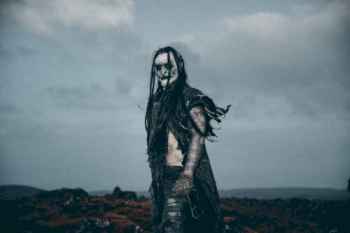
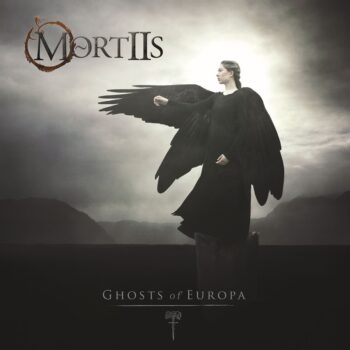
 Mortiis has cut a swath through Norway’s music scene since 1992, beginning as the inaugural bassist for black metal pioneers Emperor. When Håvard “Mortiis” Ellefsen realized the blackened arts weren’t for him, he swapped his bass guitar for a keyboard and embarked on a journey that, six years and six full-length albums later, left him a progenitor and “Godfather” of dungeon synth. Over the following vicennial, Mortiis explored other musical outlets, from darkened synth-pop to industrial rock and murky ambient before returning to his dungeon synth roots with 2020’s Spirit of Rebellion. After revisiting the genre he helped found, Mortiis releases his 11th full-length album, Ghosts of Europa—in part shaped by a subsequently abandoned collaboration with Stephan Groth (Apoptygma Berzerk)—to pay homage to old German electronica, especially Tangerine Dream and Klaus Schulze. Mortiis took those early recordings and embarked on a six-year journey to transform them into Ghosts of Europa. Will Ghosts serve as the harbinger of Mortiis’s greatness, or be cursed to haunt the darkened shadows of Norwegian mediocrity?
Ghosts of Europa is sexy, spacy, and cinematic—a synth-forward record that draws from each of Mortiis’s electronic eras—moving from dungeon scenes to movie screens. Those familiar with Tangerine Dream’s ’80s “soundtrack” era,1 will feel that theatrical presence, in addition to early Enigma, Pink Floyd, and Dead Can Dance, in the windswept, dystopian synthscapes and expansive, Gregorian chant-inspired, Middle Eastern-influenced female wails of Ghosts’ more ambient moments (“Return to the Old Fields,” “Transcending Morpheus,” “Tribes of Dystopia”). When Ghosts of Europa shifts to straightforward, beat-driven electronics (“Ghosts of Europa,” 2 “Violent Silence”) it taps a Depeche Mode and Kraftwerk vein. Still, other Mortiis Era II specters haunt Ghosts’ halls on tracks like “Tundra, Heart of Hell,” an electro-rocker that channels She Wants Revenge and The Cult, just as “Farewell Romero” has a distinct Marilyn Manson feel to its slow, painful burn. Mortiis has reached the peak of his musical prowess, wielding a conductor’s control over his collaborators and delivering one of his most emotive albums.
Heaving with atmosphere, Ghosts of Europa punctuates its vast, sweeping sonicscapes with rich vocal textures and introspective lyrics. From the repetitive refrain “When we all fall down” that dominates the opening title track to the chorus on “The Faith That Fades Away” requesting “Leave me with my sins, leave me with my thoughts,” and on through “Farewell Romero”‘s painful admission “I found a way to kill some of the pain, like a warm and cleansing summer rain,” Ghosts’ lyrics serve as an apology to the relationships Mortiis admittedly damaged along the way.3 And to further execute his no-boundaries vision, Mortiis focused on vocal arrangements in a way he hasn’t on previous efforts, partnering with a cast ranging from Sarah Jezebel Deva (Cradle of Filth) and Illiana Tsakirake (Septicflesh) to Christopher Rakkestad (Elvarhøi, Bolverk) and Skinny Puppy’s Matthew Setzer,4 who join him and, along with a vocoder and some autotune modulation, cement completely the otherworldly experience Ghosts of Europa provides.
Effortlessly flowing and expertly paced, Ghosts of Europa is permeated with a laid-back melancholy, allowing Mortiis to undulate easily between extended ambient moments and more traditional synth-pop. This ebb and flow effectively renders Ghosts of Europa’s fifty-plus-minute runtime into something that feels much shorter. As with any great film, Ghosts of Europa begs to be heard in its linear totality, rather than having any of its constituent parts relegated to a cannibalized playlist, despite some of its more traditional moments being ripe for such compartmentalization. Mortiis has provided an experience akin to getting lost in any of his early, Era I dungeon albums, if that sparks you, but with dialogue and an impactfully matured, image-conjuring vivacity. I repeatedly found myself easily lost in the Neverending Story-like feel of Mortiis’s conjuration, enamored with every moment. My one critique is reserved for the album’s editing, which could easily be attributed to the product of the promo, but rests with the abrupt and awkward resolution of some of the tracks (“The Faith That Fades Away,” “Tundra, Heart of Hell,” and “Farewell, Romero”). Not nearly enough to ruin the experience, but worth mentioning.
I have never felt FOMO for missing out on Mortiis’s back catalog. I’m not particularly fond of dungeon synth as a genre, and took minuscule note of Mortiis’s shift into more traditional territory nearly 26 years ago. I was very drawn, however, to the stark cover art of Ghosts of Europa and the soul-syncing feel of the album’s title track. The door I walked through after listening to the whole thing converted me. Ghosts of Europa has earned my highest rating this year to date, and I can only recommend that you all give it a chance as well.
Rating: 4.0/5.0
DR: 7 | Format Reviewed: 320 kbps mp3
Label: Prophecy Productions
Websites: Bandcamp | Facebook | Webstore
Releases Worldwide: June 26th, 2026
The post Mortiis – Ghosts of Europa Review appeared first on Angry Metal Guy.