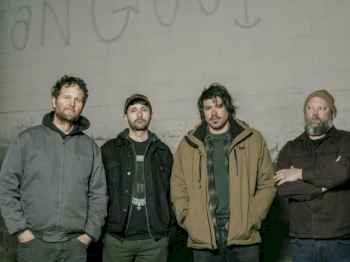
Richmond noise rockers Dumb Waiter have turned down the intellectualism and turned up the ferocity on Change, their fittingly-titled sixth record. The first from the Virginia quartet to feature vocals (and from every member, no less!), the members of Dumb Waiter explain that they sought a new method of expression. After five challenging, avant-garde albums, the inclusion of vocals allowed Dumb Waiter to get straight to the point—and you’d better believe they have plenty to say without sacrificing the interesting, non-conventional approach to heavy music they’ve employed for nearly 15 years.
New song “Drip,” which you can stream below, is a perfect representation of that balance. Guitarist Nick Crider and drummer Nathaniel Roseberry throw down aggressive vocals on this specific track, taking aim at the passage of time and at current events discussed later in the article. If you’re already familiar with Dumb Waiter, you’ll notice an uncharacteristic level of restraint in the performances (which also includes saxophonist Tristan Brennis and bassist Keith Paul), making room for the dual-vocal attack.
You can dig into “Drip” below and don’t skip Decibel‘s chat with Crider and Brennis, discussing writing with and without vocals, saxophone in heavy music and getting vulnerable with listeners. Change is out on July 31 via Ossein Records.
TB: I think it was a collective understanding from the band. The previous album Gaust Gists was very much of a covid-incubated album. It felt like we were trapped in a room for a few years writing that final avant-garde album and we got to the end of it, we were happy with it. We started writing the next album and it really just felt like we’re repeating ourselves, which is something we were really not trying to do. It felt like we weren’t sure what territory to cover instrumentally and it was this collective agreement, “I think we’ve got to start talking, start saying something.” It was a rash idea that took form over two years as we bought mics, bought stands, started seeing what it would look like.
NC: I’ve been in a bunch of bands. Some of them I did vocals in, but it was all metal vocals—screeching, screaming, grunting, stuff like that. I was very conscious of wanting to take the agitated, spoken route and it was definitely something I had to find the tone. It was harder for me… I knew how I wanted the tone to be. It was harder for me to open up enough to not feel silly doing it. Even just in the room full of these guys I’ve known forever, it takes a lot to break out of that. That was a big evolution in the singing for me.
TB: I know Nathaniel also did vocals in previous projects like Jefferson Plane Crash but a lot of them are powerviolence or grindcore bands, so it’s trying to extract the confidence that comes with that and break it down.
NC: And he’s the most melodic person on the record now. He’s the one trying to sing and he’s mostly done brutal stuff.
TB: That’s a good point from moving about something that is a subjective instrumental. I would say that the earlier work in some weird ways is still personal but when it’s instrumental, it means something different to every single person who listens to it. I think once you put words to it, it becomes much more relatable much more quickly.
NC: Even then, I found that when we were making instrumental music, I felt like people were getting the point and then I realized that they weren’t at all. Then I realized that even if I say direct things, it’s not coming from my head. Direct lines are still open to interpretation.
NC: It took a while for us to get the process down and I think you can kind of tell that on the record. We’re throwing so many things in a room and trying to make it work. This was the process of us throwing away perfectly good things. Everybody left the room at some point angry about this thing because we’re trying to cut so much and we’re trying to find enough room to put the vocals in there, and just take a more direct approach in general.
TB: I think if you listen to the full album, it’s kind of like Frankenstein’s monster. There’s cadavers, there’s parts of songs that might have been instrumental ideas. We probably had three or four instrumental songs mapped out before we really made the definitive choice to make this a vocal album. I think we might have completely shelved some of those songs, but there are definitely pieces of them. I know the first track was written and rewritten like six times. It’s definitely the oldest idea.
I would say there’s definitely a good number of these—there’s thirteen tracks and I would say at least half of them, we’d already made the shift and were more intentionally writing the songs with the rest of the album in mind. Fresh riffs with the vocals very firmly in mind.
NC: For me, I started being esoteric and very general but as I would write things, I would realize what I was trying to say to myself and lead into that. A lot of it became political for me and a lot of it was trying to digest growing older, friends and family, stuff getting fucked up and stuff being all over the place. I had to lean off the talk radio and news for a while just because I was so angry all the time and you can definitely hear that through the record.
TB: I don’t think we intended for it to be any one thing. It’s just a layer of honesty and you blink and realize we’re not stoked with the state of the world.
NC: That was one of the songs that was pre-knowing the process of vocals. We’ve wrote and rewrote that a million times. My lines—”Paint over the stained glass” is talking about indoctrination and what can we do to change this? Time is limited and numbered.
TB: There are a lot of moments where, in the instrumental history of Dumb Waiter, we give each other way too much intellectual freedom and I think we’re just lucky that, a lot of times, it works out.
NC: It’s definitely intuitive but towards the end of the writing process, there was a bit for me to reckon with trying to get everybody on the same page. Maybe we can lean a certain way if this song seems too disjointed.
I think Nathaniel would agree that “Drip drip drip” is the time passing and “Feeling trapped under ice” can definitely be direct or loose, but we’re hoping this thing winds down.
TB: There is that line of “trapped under ice” and I know ICE has existed for decades or more, but I feel like Nathaneil wrote that line far before any current escalation with current ICE.
NC: But then he realized. It was one of those moments where you’re like, “I’m singing this pretty angrily, I am pretty pissed about this word.”
TB: It’s interesting how it took a new life after it was written.
When you guys are writing, a saxophone is a kind of non-traditional instrument to have in rock or metal music. Do you ever feel like you have to balance its presence or the way you’re performing so it doesn’t feel like it’s overtaking the other elements?
TB: I think there’s definitely an intent there. In the past, I think I thought that more. Nick and I, our writing and lyrical content has intuitively leaned into each other. I think our effects patterns and our outputs over the years leaned into each other. I very much know how to play to Nick’s synthesizer-guitar and I know where the bandwidth that needs to be taken up is.
I think this album was a challenge because I was trying to do as little as possible note-wise and busyness-wise, to create as much negative space for the vocals to really shine.
This interview was edited for length and clarity.
The post Track Premiere: Dumb Waiter – ‘Drip’ appeared first on Decibel Magazine.