Futurismo has announced AMERICAN GRAVE Gothic Punk / Deathrock USA: 1978-1988, a new compilation devoted to the haunted, feral, and distinctly American mutation of goth, punk, deathrock, garage rot, horror-film glamour, and suburban dread. Arriving October 9th, 2026, the collection marks the third volume in Futurismo’s Altered Vision anthology series, following a trail of smoke through the underground spaces where punk’s speed and DIY violence turned theatrical, death-obsessed, tribal, and strange.
For decades, the familiar story of goth has often looked across the Atlantic: the Batcave, Leeds, London, Northampton, Berlin, the European cathedral silhouette. American Grave turns the mirror back toward the United States, where something equally shadowed was taking shape in different light. Here, the scenery was not always medieval stone and rain-dark alleyways. It was strip malls, evangelical panic, late-night television, Cold War dread, suburban bedrooms, horror VHS sleeves, desert roads, old blues ghosts, garage rock residue, and the collapse of the postwar promise. The music did not always agree on one sound, but it shared an atmosphere: black humor, religious symbols made profane, eyeliner and leather, cheap rooms, damaged glamour, and a sense that American culture itself had become a haunted house.
Co-curated by Wesley Eisold of Cold Cave, American Nightmare, and Heartworm Press, in collaboration with Futurismo’s Del Jae, American Grave gathers the names that helped define the public imagination of American deathrock alongside those that remained whispered between collectors, DJs, old flyers, and cult reissue wishlists. The result is less a museum display than a weather system: a storm moving through punk, hardcore, garage, blues, glam, and post-punk, pulling them toward the graveyard without asking them to wear the same uniform.
“People often think of goth as something imported from Europe, but there was a uniquely American darkness growing at the same time, born from suburban isolation, Cold War anxiety, horror films, religious iconography, and the collapse of the American dream. What makes this scene so compelling is that the bands often had less in common sonically than they did aesthetically and philosophically. Whether they came from punk, garage, blues, hardcore, or elsewhere, they shared a similar atmosphere, imagery, and distinctly American sense of dread. That story has never really existed in one place. American Grave isn’t about rewriting history but about finally letting the music speak as a movement instead of as isolated cult records. I’m proud to have helped contribute to something that I hope becomes the compilation this music has always deserved.”
Wesley Eisold, Cold Cave/American Nightmare
That sense of a movement hiding in plain sight is what gives American Grave its charge. It begins not with a single orthodoxy but with a shared impulse: punk learning to love the grave, glam turning skeletal, hardcore discovering atmosphere, garage rock crawling under the cemetery fence, and post-punk exchanging its city map for an occult diagram. Some of these artists became canonical. Others remained private obsessions. Placed together, they make a new kind of argument: American deathrock was never only one city, one sound, or one look. It was a language of dread spoken in different accents.
Christian Death opens the crypt with “Spiritual Cramp,” a piece of Los Angeles deathrock scripture where moral terror and punk convulsion meet in smeared black. NYC’s Of A Mesh follows with “Guillotine,” cold and sharpened, a doom-laden goth classic that graced the stages of CBGB’s during the mid-80s. Super Heroines bring “Convicts,” turning punk pressure into a darker dramatic charge, while T.S.O.L.’s “Code Blue” drags Southern California punk toward the morgue with adolescent provocation and corpse-cold humor.
PSI Com’s “Human Condition” stretches the compilation outward into ritualized post-punk, all tension and atmosphere, while Shadow Of Fear’s “In The Flesh” moves with the claustrophobia of a room where the walls have started listening. The Cramps appear with “Human Fly,” the primitive rockabilly-punk monster movie that made American trash culture feel like high ritual. Burning Image’s “The Final Conflict” continues the descent, surrounding deathrock’s theatrical edge with a sense of apocalyptic pressure.
The Gun Club’s “Death Party” brings the blues back as a curse rather than a comfort, while Your Funeral’s “I Want To Be You” sharpens the compilation’s obsession with identity, desire, and possession. The Brainz’ “Elementary Monster” revels in the junk-shop grotesque, and Theatre Of Ice’s “She Sleeps” treats horror imagery not as decoration but as a living temperature. 45 Grave’s “Violent World” remains one of the great statements of American deathrock anxiety, where comic-book menace, punk aggression, and graveyard camp become inseparable.
The compilation’s middle stretch makes clear that this story was never only about the most visible names. Middle Class’s “The Call” carries hardcore’s angular urgency into colder psychological space. Altar de Fey’s “Veil Of Death (Demo)” arrives like a transmission from a fogged basement, proof that demo recordings can sometimes hold more atmosphere than polished statements. Mighty Sphincter’s “Waltz In Hell” turns grotesque theatricality into a warped cabaret, while Dead Moon’s “Graveyard” reminds the listener that American darkness could also come from garage rock, raw fidelity, and a voice that sounded like it had been buried and dug back up.
Twisted Roots ask “Are There Cobwebs On My Face?” with the perfect mixture of absurdity and decay, while Fur Bible’s “Plunder The Tombs” makes a case for one of the set’s crucial rediscoveries. Kommunity FK’s “Restrictions” tightens the sound into skeletal post-punk control, and Lords Of The New Church’s “New Church” places punk charisma in a darker ceremonial frame.<
The Naked And The Dead’s “Taboo” continues the underground thread through New York, where guitarist Greg Fasolino was not only a participant but one of the scene’s great chroniclers, documenting goth and post-punk as a music journalist and archivist. Formed in 1985, his band was among the early acts in the city’s deathrock and goth underground, turning the shadows of CBGB and the Subway Club into something serrated, stylish, and forbidden.
Near the end, The Flesh Eaters bring “See You In The Boneyard,” a title that could almost stand as the compilation’s final invitation. Then Red Temple Spirits close with “Dreamings Ending,” pushing the record beyond punk’s graveyard humor into something more expansive, psychedelic, and spectral. Taken together, these tracks do not force American deathrock into one constricting shape. They show how a movement can exist as a shared shadow, a shared vocabulary of dread, even when its participants arrive from different rooms.
“This compilation is our love letter to a unique subgenre spawned in the shadows of American culture, one born of angst and impending gloom. Being a child in England during the late 80’s, Goth had eneviably floated into my view, not just the media coined music scene, but the old churches, abandoned industry, the darkness was unavoidable, compelling. This compilation is dedicated to something very different to that compulsion, because this was something uniquely American, something that just felt more punk, even if it felt at odds with the scenery. Like bats in palmtrees.
I am thrilled to create this in collaboration with my long time friend Wesley. We did our best to place artists that are ingrained in the public psyche, like Christian Death and The Cramps, alongside those who perhaps never had the spotlight they deserved, like Of A Mesh and Fur Bible. That is what makes this record so special.”
Del Jae, Futurismo
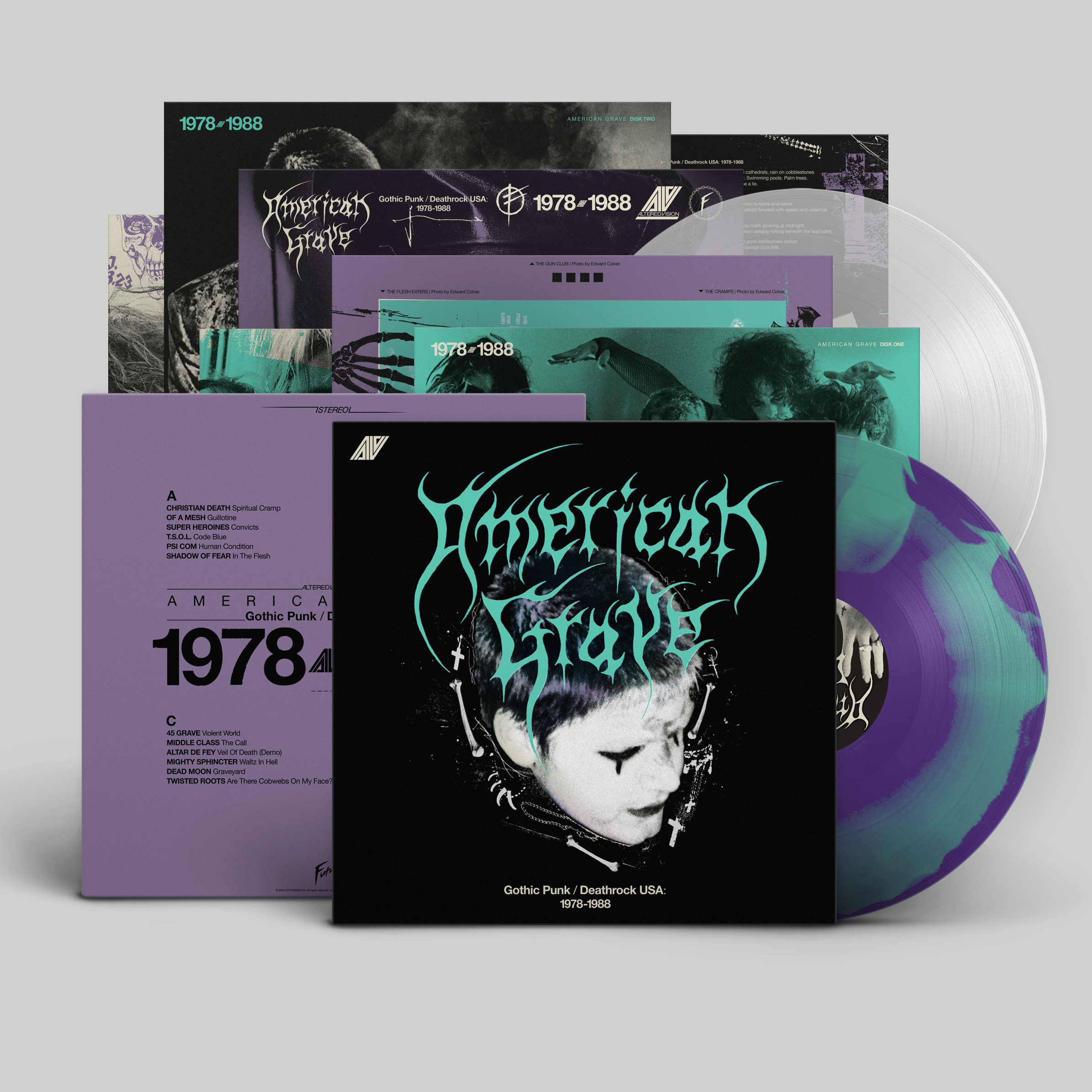
The visual world of American Grave is given equal weight. Futurismo has built the release around images by famed punk photographer Edward Colver, with the 2xLP edition housed in a gloss-laminated outer sleeve with color inner sleeves and a large fold-out poster featuring unseen Colver photos. The vinyl edition also includes words by Lisa Fancher and liner notes by Wesley Eisold. As with the best archival releases, the design does not treat the music as dead history. It restores the aura around it: the flyers, faces, gestures, symbols, and physical evidence of a scene that often survived through fragments.
AMERICAN GRAVE Gothic Punk / Deathrock USA: 1978-1988 will be released by Futurismo on October 9th, 2026. The 2xLP edition arrives in limited coloured vinyl variants, including Bat Corpse, Splintered Tomb, and the Heartworm Press exclusive Heart Worm. A CD digipak edition will also be available, housed in a gloss laminated sleeve with a fold-out featuring unseen Edward Colver photos.
Order via Futurismo here. And via Heartworm Press here.
Follow Heartworm Press:
Follow Futurismo:
The post “Like Bats in Palmtrees” — New Compilation “AMERICAN GRAVE: Gothic Punk and Deathrock USA: 1978-1988” Announced! appeared first on Post-Punk.com.