
Alone in Central Park
When nothing seems to happen
All my thoughts invaded
Memories degraded
From the “two hundred couches” invoked in their debut single “PDA,” Interpol have always understood New York from the inside out: dim rooms, temporary beds, private encounters, and the emotional residue left behind when the party—or the relationship—has run its course. Yet those rooms have never existed in isolation. Outside them, their city lives and breathes, stretching from the Village through the Lower East Side and across the river to Williamsburg and beyond—a nocturnal network of streets, apartments, clubs, and half-remembered faces from which Interpol emerged. Its magic has always depended on a measure of opacity: the freedom to vanish into a crowd, arrive unannounced, or leave no record beyond somebody else’s memory. “Iron City” asks what happens to that magic when a city like New York is placed under the gaze of AI-powered Flock license-plate cameras—when the traffic threading those streets becomes a searchable memory.
In the official visualizer for their new single “Iron City,” street-level glimpses and fragments of the skyline dissolve into close studies of circuit boards and exposed electronics, as though the city’s buildings have been opened to reveal the nervous system beneath. The sequence recasts the metropolis through the impersonal logic of an AI-powered Flock camera network: not merely watched, but indexed, with passing vehicles reduced to time, place, and description—signals that can be stored, sorted, and recalled. New York is no longer merely a setting or a reflection of the people inside it; it has become an organism in its own right—watching, processing, and perhaps preparing to outlive them.
Frontman Paul Banks has described “Iron City” as a conversation between a human narrator and a future artificial intelligence that may be running what remains, leaving open the question of whether this new technological guardian will prove benevolent or enraged.
Musically, “Iron City” unfolds with measured grandeur, its dusky piano and chiming accents opening a vast nocturnal space around the band. The guitars move in close formation over a steady forward pull, while Banks’ low, intimate delivery makes “I can feel your love, iron city” sound equally devotional and ominous.
Watch the visualizer for “Iron City” below:
Iron City is the third advance track from Interpol’s forthcoming eighth studio album, This Mirror Weighs a Ton, following the title track and “See Out Loud.” Produced by Andrew Wyatt and mixed by Dave Fridmann, the record broadens the band’s palette with strings, woodwinds, layered harmonies, acoustic guitar, and experimental sound design. Recorded at Wyatt’s studio on Manhattan’s Lower East Side, it marks Interpol’s first album sessions in their home city in more than a decade. This Mirror Weighs a Ton arrives August 28 via Partisan Records.
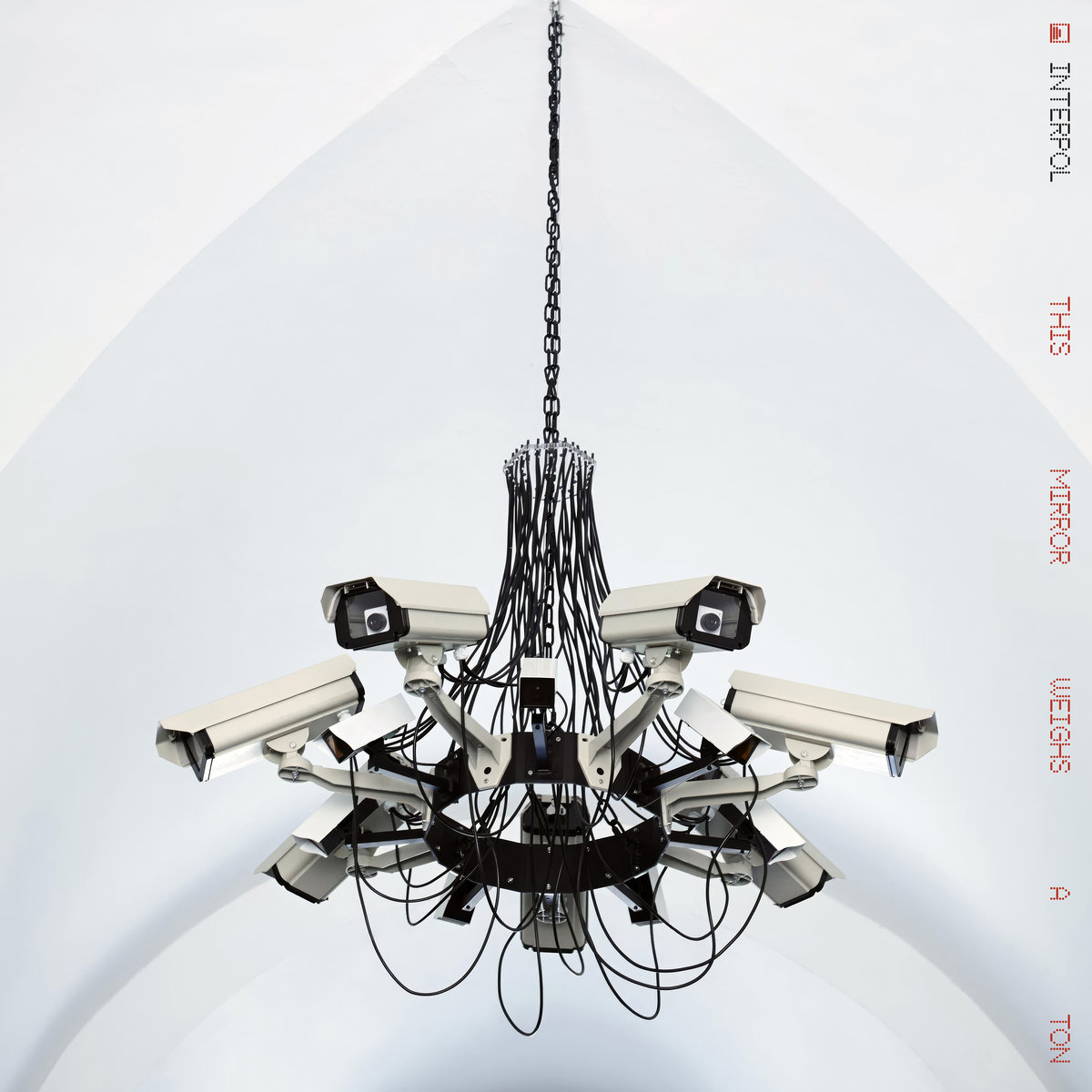
The album’s cover artwork gives that anxiety a physical form. It features Addie Wagenknecht’s 2013 sculpture Asymmetric Love Number 2, a chandelier assembled from steel, CCTV cameras, and DSL internet cables and held in the Whitney Museum of American Art’s permanent collection. Suspended in a pristine white chamber, an object associated with warmth and illumination becomes an apparatus of scrutiny—a fitting image for a record circling questions of perception, memory, and technological control.
Pre-order and pre-save This Mirror Weighs a Ton here.
Interpol will spend the remainder of 2026 moving through European festivals, an extensive North American run, a Mexican festival appearance, and an 18-date UK and European co-headline tour with Bloc Party.
For tickets and additional information, visit Interpol’s official tour page.
Interpol 2026 Tour Dates
All dates co-headlined with Bloc Party.
All dates co-headlined with Bloc Party.
Follow Interpol:
The post “Who Left a Crumbling Heart?” — Interpol Surveil the Grid in Video for “Iron City” appeared first on Post-Punk.com.