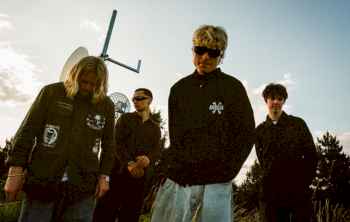
Before Neon Pilgrim became a writer and producer behind some of British television’s most acclaimed dramas, music was always the first calling.
Through UK production company Two Brothers Pictures, he has helped bring series including The Missing, Liar, The Tourist, Fleabag and The Assassin to audiences around the world. Yet long before scripts and production schedules, there were songs. Written from the age of 12 onwards, those songs have quietly evolved over decades, eventually becoming Invisible Things, his debut album.
Recorded in the English countryside with Grammy-winning producer Dom Morley, Invisible Things is a patient, richly textured record that draws from the darker corners of alternative songwriting. There are echoes of The National’s widescreen melancholy and slow-burning arrangements, with Neon Pilgrim’s deep, weathered vocal delivery carrying shades of Nick Cave’s dramatic intensity and Matt Berninger’s understated, conversational weight. These are songs that linger rather than announce themselves, built on atmosphere, restraint and the emotional pull of what remains unsaid.
The album features an accomplished group of collaborators, including Damon Minchella, Death Cab for Cutie drummer Jason McGerr, Ed Harcourt and Amber Wilson, each adding detail and depth to songs that have been years in the making.
At its heart, Invisible Things explores the unseen forces that shape our lives. It begins with the boundless imagination of childhood, that sense that another world exists just beyond our own, before following those invisible companions into adulthood where they become memory, grief, hope, fear, love and the connections that define us.
“The album is called Invisible Things. Put simply it’s zeroing in on the imagination we all have in childhood – a world beyond our world that seems instantly accessible. But also it’s about those invisible things we experience as adults. Those things we don’t see but we believe in, or the things between us that again we can’t see but mean everything.”
Each song approaches those ideas from a different perspective. ‘Peggy’, written for Neon Pilgrim’s goddaughter, imagines the endless possibilities waiting at the beginning of a life. ‘Small Black Suit’ reflects on miscarriage and the loss of something that, as the songwriter describes it, ‘was never really there’ in the physical sense. ‘All The Colours’ captures the transformative rush of young love, while ‘Heartbeat’ explores the irresistible pull towards something beautiful that also has the power to hurt.
The astronaut that appears throughout the album artwork has become the visual heart of the project. Inspired by the chorus of ‘Peggy’, it represents the optimism of childhood and the belief that anything is possible before experience begins to narrow those horizons. That same feeling runs throughout Invisible Things, finding moments of wonder and hope even within its most reflective songs.
Although many of the tracks were written over several years, the album finally found its shape after Neon Pilgrim connected with Dom Morley. Together they assembled a group of musicians capable of expanding the songs without losing their intimacy, creating arrangements that feel cinematic without becoming oversized.
For Neon Pilgrim, the release marks the start of an entirely new creative chapter. While his television work has reached millions, music offers something more immediate: a direct connection between songwriter and listener.
“Making TV shows is so different from this, and it’s exciting to do something where I’m starting from square one, in a completely new field, with a whole bunch of different views. Mainly I hope some people find something in the songs and it does something for them. If some people listen and enjoy it then I’ll keep doing it. And I love doing it.”
With Invisible Things, Neon Pilgrim arrives not as a television creator stepping into music, but as a songwriter finally revealing the work that has followed him since childhood. A record about memory, imagination and the invisible threads between people, it finds beauty in what cannot be seen, but can always be felt.