
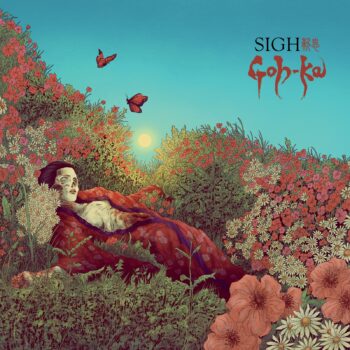
 Great records offer something deeper than what glimmers on the surface, whether conceptual, musical, emotional or otherwise. Without at least one of these tethers, connecting with an album beyond a cursory listen presents significant challenges. Yet the best music, the kind that transforms listening into an experience, extends multiple threads with which to affix. It’s no wonder, then, that I resonate with Sigh’s oeuvre with such soul-plumbing profundity. Their concepts pierce with poignant potency, their compositions astound with instrumental mélanges that seem unthinkable on paper but coalesce exquisitely in fact, and Sigh’s main man, Mirai Kawashima radiates a charismatic earnestness within his music that I find utterly charming. Now, thirteenth album Goh-Ka is here, and once again we must cast a critical eye toward one of metal’s most singular entities. After thirty-six years, can Tokyo’s wonderfully weird export still Goh the distance?
Many of Sigh’s albums flaunt high concepts, and their recent output has centered around psychological and mortal themes that prove morbidly fascinating. In Somniphobia explores the opaque limbo between the waking world and sleep, Hangman’s Hymn details the final thoughts of a sinful man leading up to his execution, and Shiki got personal for Kawashima, where he allegorizes the inevitability of death with the four seasons. Goh-Ka serves as a natural progression from Shiki, its conceptual inspirations drawn from Kuso-zu, ‘a series of Buddhist illustrations depicting the nine stages of a human body’s decomposition after death, created to encourage meditation on the impermanence of life.’1 Although Goh-Ka’s premise of decomposition and the ephemeral nature of existence might seem like it requires a dour soundtrack, Kawashima & Co. instead manifest these themes with competing currents of ebullience and pensiveness.
Sigh sounds as vibrant as ever on Goh-Ka, welding together an eclectic amalgam of instruments and styles that guides listeners through a kaleidoscopic haze of one of their lushest sonicscapes to date. Flitting melodies and crushing riffs crash and congeal on “Anzenshokon,” which starts with layered, modulated vocals recalling Black Sabbath’s “Planet Caravan,” supported by flute and tribal drumming. Then come the implacable riffs and Mirai’s harsh rasps, inciting a stimulating duality as the track progresses. “Jinmenjushin” exhibits another enthralling back-and-forth modality, beginning with a creepy crawl reminiscent of Slayer’s “South of Heaven”2 that quickly ramps up the speed into a hyper-melodic chorus lightly recalling Imperial Circus Dead Decadence. The performances on Goh-Ka astound with stunning muscle and violent grace, where myriad ideas weave together into a gorgeous tapestry of avant-garde black metal. Mike Heller’s contributions underpin all the tracks with impossibly deft rhythms and grooves, squeezing in rabid fusillades one moment and swinging into a subtle shuffle the next (“Kuso-shi 1, 2, and 3,” “Jigoku-Zoshi 1: Unkamusho”). Ginzaburo Abe lays down some striking shamisen (“Unputenpu,” “Kuso-shi 1, 2, and 3”), imbuing Goh-Ka with a tantalizing folksiness, and Mirai’s keyboards ground the record with classic hard rock heft.3

Goh-Ka unquestionably delivers conceptual and musical depth, yet it’s the emotional well I drink from deepest. Despite the macabre backdrop of death and decomposition, overwhelming doses of joy and catharsis saturate Sigh’s latest. Lead single “Unputenpu” is downright effervescent, and Mikael Åkerfeldt furnishes the perfect guest spot4 on a song that so readily evokes the psychedelic flourishes of 2010s Opeth. “Kuso-shi 4, 5, and 6” smolders with seesawing dispositions of pathos and release, electrifying me each listen with its seamless balance between the two. The latter half of “Kuso-shi 8 and 9: Mettaijakujo” likewise bubbles with an uplifting spirit even as tumultuous elements buffet the heavily synth-backed passages. By the song’s end, a satisfying finality cements the perfect capstone on an album fraught with essential moments.
Each time I spin Goh-Ka, I fall in love all over again. After thirty-six years and thirteen albums, Sigh remains unflappably equipped to slap. Their music teems with intricate layers and a boundless eccentricity that allows each release to stand on its own while always adhering to their uniquely fabulous voice. Sure, the slow fadeout from “Jinmenjushin” might stretch a tad too long and “Kuso-shi 7” feels dispensable compared to the rest, but in the end Goh-Ka leaves me in awe of the depth of Sigh’s vision and daring. If you were worried about Angry Metal Guy’s Law of Diminishing Recordings™ setting its sights on Sigh, don’t. Instead, you can rest easy knowing Sigh continues to Goh the extra mile on their best album since In Somniphobia.
Rating: Excellent!
DR: 8 | Format Reviewed: 320 kbps mp3
Label: Peaceville Records
Websites: Bandcamp | Facebook | Instagram
Releases Worldwide: September 4th, 2026
The post Sigh – Goh-Ka Review appeared first on Angry Metal Guy.