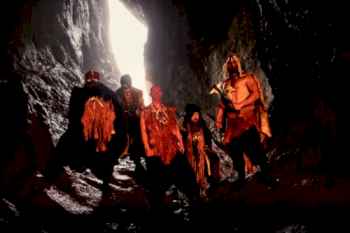
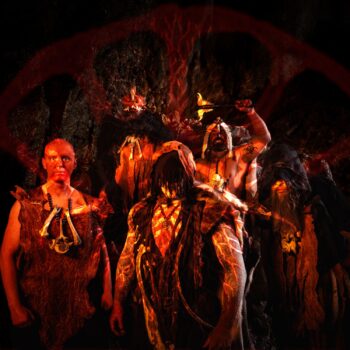
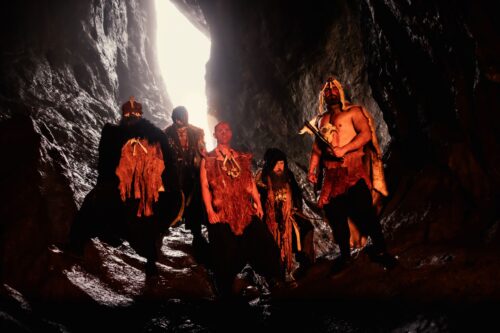
 Before the world was known, streams fed rivers, not wallets, and clouds held rain, not data. There was a time when natural phenomena birthed myth and wonder, not funding opportunities dressed up as scientific studies. It is this era, when Homo sapiens still crawled, and magic yet breathed, that drives and inspires Wyrdstæf.1 Based in the United Kingdom, Wyrdstæf harkens back to an era of great change, when Paleolithic frosts gave way to Mesolithic mists. Channeling the Stone Age through modern instruments, Wyrdstæf invites you to return to the dawn of humankind and remember what was forgotten. Is debut LP Primordial Bloodlines a doorway to a bygone age, or is all this sound and fury for naught?
Primordial Bloodlines kicks off with a ceremonial invocation, “White Spring.” Urzhan’s fierce chants and Malang’s ritualistic drums sanctify the ground and stir the blood. Strings join in the last third, adding fuel to an already potent fire. Wyrdstæf’s theatrical sensibilities here strongly evoke the likes of Nytt Land, positioning the listener amidst the proceedings, enhancing immersion. Searing black metal in the veins of Wiegedood and Kampfar erupts from the flames in the form of “Great Migrations.” Shaman and Revenant unleash descending, frostbitten riffs and determined mid-paced marches, backed by hammering double bass and blast beats. After a slightly overlong ambient intro, “Hyperborean” treks further north, adding icy synths and atavistic shouts to an already vicious, blackened brew. If Wyrdstæf continued with this formula, Primordial Bloodlines would be a very strong debut offering.
Alas, that is not the case. Primordial Bloodlines’ two longest tracks—“Parhelion” and “Primordial Bloodlines”—bring things grinding to a halt. Similar to “White Spring,” “Parhelion” focuses on ritualistic ambience, but rather than placing the listener in the middle of the action, it sounds removed, like a field recording or a documentary. As a result, the first four minutes just feel like an egregiously long sample. Two additional passages round out the track’s nine-minute runtime, but none of the three sections seem strongly connected, giving “Parhelion” a Frankenstein-esque feel. “Primordial Bloodlines” shifts to a more cinematic, heavy metal sound. While it does have a more modern and accessible musical structure, it struggles under the weight of a nine-minute runtime, as well. The title track strives for culminating, emotional poignancy, but without strong prior material to support it, “Primordial Bloodlines” falls flat, feeling toothless and hollow.
These last two tracks drive notable pacing and momentum issues on Primordial Bloodlines, but that’s not my biggest gripe here. Ranging from black metal to grandiose heavy/post-metal and incorporating tribal ambience, both immersive and detached, shows Wyrdstæf to be quite talented and committed, but they’re terribly unfocused. The promo material hints at a loosely conceptual nature to the album, but had I not already known, I certainly wouldn’t have gleaned that from the music itself. Even allowing for the compositional flexibility of a concept album, Wyrdstæf doesn’t establish a baseline from which to branch out. Playing three or four separate styles across five tracks feels more like an ill-advised compilation than a cohesive album. Focusing on any one of these would have lent Primordial Bloodlines some much-needed stability.
Primordial Bloodlines started incredibly strong. “White Spring” and “Great Migrations” are both killer tracks that work well together. Red flags began to appear with “Hyperborean,” but its blackened fury was enough to sit through a questionable, sample-adjacent front half. It’s the back half of the album where Wyrdstæf really drops the ball. “Parhelion” feels aimless and nearly anthropological, and the overly ambitious title track fails to achieve its goal and ultimately feels like another waste of time. Combined, they cover more than half of Primordial Bloodlines’ 32-minute runtime. When Wyrdstæf hits, they really hit, but with precipitously diminishing returns past the 14-minute mark, Primordial Bloodlines fails as an album. If the band can settle on a singular compositional identity and use that as a base to incorporate other elements moving forward, there’s potential for a much more impressive offering. But as it stands, the most I’ll recommend is cutting out choice tracks for playlist fodder.
Rating: 2.0/5.0
DR: 5 | Format Reviewed: 320 kbps mp3
Label: Apocalyptic Witchcraft Recordings
Websites: Bandcamp | Facebook | Instagram
Releases Worldwide: September 4th, 2026
The post Wyrdstæf – Primordial Bloodlines Review appeared first on Angry Metal Guy.