Decibel Books is proud to announce the publication of Deconstructing Towers: The Story of Hydra Head Records. Forged from an uncompromising vision and bound only by handshakes, Hydra Head Records’ trailblazing, nuanced aesthetic redefined what was possible for an extreme music label. Founded by future Isis frontman and Neurosis guitarist/vocalist Aaron Turner, Hydra Head rose around Boston’s metal and hardcore scenes of the mid-’90s, proceeding to shroud genre-defining records of the era in artistically fearless artwork and packaging. Within a decade, the label relocated to Los Angeles where the lights were brighter, but the descent came from much greater heights.
At over 500 pages (in addition to a 32-page color section), including countless rare and previously unpublished images, and featuring exclusive stunning new cover art from Turner himself, Deconstructing Towers illustrates the once untold history of one of extreme music’s most influential and revolutionary record labels. Fans can pre-order their copy now. Books have an expected ship date of early December.
Deconstructing Towers: The Story of Hydra Head Records, authored by longtime music journalist and Great Falls bassist Shane Mehling, chronicles Turner’s nearly two-decade journey running Hydra Head through detailed accounts from the label’s artists, his former bandmates and ex-employees who played pivotal roles in its incomparable history.
“Hydra Head Records was a complicated, gratifying, frustrating and ultimately life-changing enterprise to be a part of,” says Aaron Turner. “Central to its existence was a dedication to musical freedom and creative integrity, coupled with a focus on fostering friendships through collaboration. Though the label fell short of those lofty intentions from time to time (and to be frank was a downright mess in certain departments), I like to think that the heart was always in the right place—and that what came out of the label left a lasting and positive impression within the underground realm it occupied.
“I am grateful to Mr. Mehling for diving headlong into the detritus left in the wake of Hydra Head’s existence, to all the folks who took the time to talk with him about it, and who made it what is was in the first place: a sprawling, ungovernable, ferocious and (hopefully) endearing beast.”
For an exclusive preview of Deconstructing Towers, fans can read the first excerpt below, which takes readers back to the early 2000s as a major label bidding war for Hydra Head’s homegrown heroes Cave In was underway on the strength their breakthrough album Jupiter.
——————
“Don’t ever think for a minute that signing to a major label is a vacation, by any means. The four of us have never been worked harder in our lives—but it’s something that we were all well aware of diving into the whole thing. Hopefully our band metabolism can keep us a few steps ahead of it all…” —2003 Cave In bio, written by Steve Brodsky.
Spin magazine’s “Year in Music” issue for 2000 features Eminem on the cover, dressed like a Droog from A Clockwork Orange. He’s Artist of the Year; Radiohead christened Band of the Year, having released the then-confounding Kid A only a couple of months earlier.
Inside there’s a review of Limp Bizkit’s Chocolate Starfish and the Hot Dog Flavored Water, an article about John Lennon by Elliott Smith, an AT&T ad selling a new technology called “2-way text messaging,” a ton of stuff about Napster and, with slightly more magazine real estate than fellow “New Artist” Sigur Rós, a profile of Cave In.
“Indie rock’s answer to metal?” it asks before describing the band as making “a tuneful, rhythm-minded bombast that abandons grindcore’s fuzzy shitstorms but holds on to its power.” It proclaims that Cave In is for “emo fans with a secret yearning to bang their heads but are scared off by mainstream metal’s stoopidity [sic, obviously].”
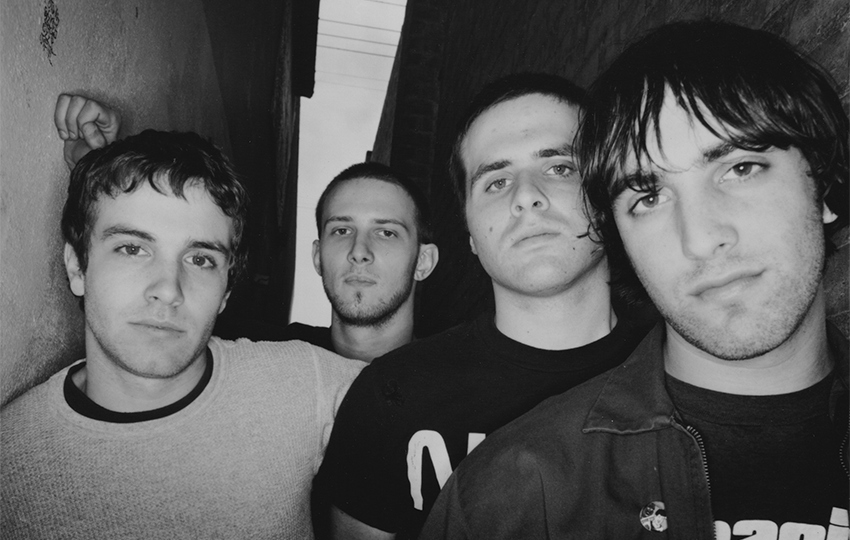
“That was weird,” Cave In guitarist/vocalist Steve Brodsky says. “It was a formal photo shoot for a one-page thing. We were like, ‘All right, that’s some validation that we can show to our parents. Hey, we’re in this glossy magazine that you’ve probably heard of.’ And locally, things felt different, too.
“I think the Boston rock scene really embraced us,” he continues. “Looking back, I can see how it would be interesting that here’s a hardcore band that cut their teeth in the suburbs and had the energy of a punk and hardcore band in that transition to Jupiter where we were playing hard and loud, but also very melodic. I just don’t think a lot of people in Boston had really seen anything like that. It was cool, and we just thought, ‘Where is this all going?’”
Before Spin, there was a big write-up in alt weekly The Boston Phoenix with a couple photos (one where drummer JR Conners is apparently voguing) and, like with Spin, compares the band to Radiohead, referring to “Innuendo and Out the Other” as the band’s “Subterranean Homesick Alien,” a track off 1997’s momentous OK Computer.
Chris Rucker hosted an early ’00s hardcore/metalcore/indie show called New England Product, which spun regional bands on famous alternative state WFNX—the station that worldwide debuted Nirvana’s Nevermind from start to finish.
“Jupiter was a landmark record,” he says. “It was impactful in Boston, New England, the East Coast. It was massive. They were front-page news here for sure, the outlier above and beyond anybody else or anything else that was going on with Hydra Head. And the media types, the guys at WFNX or The Boston Phoenix [owned by the same company], the managers, the booking agents, we all thought they were gonna rise to the top with a bullet.”
“Promoters in Boston were wanting and willing to take a chance on our band,” Brodsky says. “They would book us at the Middle East upstairs, which a year or two before that, it wasn’t even on our map of what we wanted to do. And all of a sudden, a promoter was willing to throw us on a bill with Jets to Brazil. Rainier Maria was another band, and that seemed to work really well. We were branching out a little bit into these other worlds, and it felt cool, and we felt accepted, but also, we’re still the harder-hitting band. Our roots are in hardcore, and we wanted to play hard. And even if it sounds pretty, we want it to be, like, the loudest pretty that it can be.”
The band was especially nervous when they got a chance to play shows with Neurosis.
Guitarist Adam McGrath remembers thinking, “‘Oh, shit, we’re not really playing the old stuff anymore. Are we going to be heavy enough? Is this going to be accepted enough?’ We played ‘In the Stream of Commerce,’ and I’m like, ‘Is this going to be okay for the Neurosis crowd? But again, it was accepted in that world. And Neurosis seemed to be into what we were doing as well, which kind of gave us a lot of confidence, because they were like grown men compared to what we were. We were kids showing up, and I mean, it was a scary sound check, just standing alone in the room. So I was very intimidated by them. But it seemed to work in all these different realms, with Jets to Brazil and Neurosis. It seemed just to work.”
———————————————————
Aaron Turner remembers a meeting he and label manager Mark Thompson had with Caleb Scofield, bassist for Cave In. After the success of Jupiter, they were now the biggest band on the label. They were all sitting on the back porch of the Hydra Head office in Mission Hill, still based out of Turner’s bedroom, and Scofield had shown up to talk business.
“He was airing a grievance about something,” Turner says. “We didn’t have the records in press as regularly as we should have, or didn’t have the records available to them in high enough quantities for touring purposes. And it was like one of the first confrontations we’d ever had with the band, where they directly were like, ‘Hey, you guys, we feel like you’re dropping the ball.’ And we’re saying, ‘Oh yeah, shit, okay,’ and this whole time we’re talking, I’m rolling a huge joint and smoking it.
“I remember Caleb looking at me, and I didn’t interpret the look correctly at the time. But in retrospect, it was very clear to me. It meant, ‘Dude, can you not smoke weed for like five minutes so we can talk about how our band would like to have some records to sell on tour?’”
It’s not just one thing about this story, but really the whole scene that Turner reflects on when he thinks about Cave In’s move away from Hydra Head.
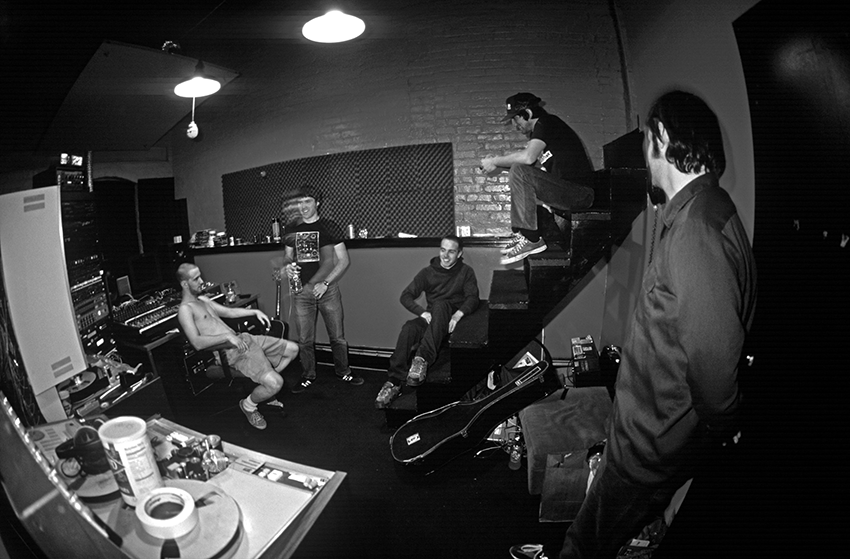
“This is not to disparage any of our efforts,” Turner says, “because I think we were doing the best we could on Cave In’s behalf, but we definitely fucked up some stuff. And we knew there was a lot happening for them, and we were probably not equipped to deal with it beyond the level they had already reached. Maybe a year after Jupiter came out was the kind of ceiling for us in terms of our capabilities, and they definitely needed something else.”
“I never remember it being a question whether or not we would stay on Hydra Head,” Conners says. “I felt like we were gonna be on there until, you know, whenever.”
“Jade Tree reached out and talked to us a bit,” McGrath says of the somewhat bigger but still indie label. “And Mark was definitely not keen on us talking to them, but he also said, ‘They’re a good label, but I also think that they couldn’t do any more for you than we already could do. If Cave In wanted to leave Hydra Head, I just want it to be for a place where we couldn’t do what that label could do for you guys, whatever label you end up on.’ And Jade Tree didn’t feel like a step up to him.”
People offering those steps up, though, started calling, some of them legit and others just lying oddballs.
“There was definitely some characters that came out of the woodwork,” McGrath recalls. “I’m not gonna mention any names, but different people that are lawyers or managers saying, like, ‘I manage this guy,’ or, ‘I was a lawyer for this guy, and I can show your band to these people,’ and things like that.
“We were very naive to it,” he continues. “We didn’t realize how weird the music industry is with all these different characters who—some of them are actually who they say they are—and some of them are just snake oil salesmen.”
“I think a lot of people were excited about Cave In,” Turner says, “and a lot of people saw an opportunity with Cave In to further their own careers or to participate in furthering Cave In’s career.”
Jessica Hopper, hired to run PR for Jupiter and doing so successfully for Hydra Head, introduced the band to Brigitte Wright, who would go on to be their manager. She managed Rage Against the Machine and worked with Wu-Tang Clan, and that’s when the major labels came calling.
“Most of the labels were trying to circumnavigate us because no major wants to pay another label to pick up a band,” Turner says. “And as far as they were concerned, in many instances, we were like a bug on their windshield more than any kind of asset to their agenda.”
“We put a degree of trust in Brigitte,” Brodsky says. “There was an interesting list of musical heads in the world that she had been a part of directly or indirectly. And we weren’t thinking #1 hit song or #1 album. It was more like, ‘how can we do what we’ve been doing but more efficiently. Play with bigger bands that would embrace Cave In and their audiences as well.’ And we were just trying to be strategic and figure out, like, ‘How can we make this work in a major label setting? Like, can it actually work?’ There was the idea of taking a step further in the independent world. Maybe not Jade Tree, but Epitaph was a label we were looking at or thinking about. So it wasn’t just strictly major label. It was the whole spectrum of what is a potential step up or forward.”
But that didn’t mean they were going to turn down a little wining and dining from the suits.
“We were open to hearing what they had to say,” McGrath recalls. “But it also seemed like such a foreign experience, especially when we started talking to A&R people, and they would bring us to record stores and be like, ‘Buy whatever you want,’ or, ‘We’re gonna bring you out to dinner and eat whatever you want.’ It just, like, you know, kid-in-a-candy-store type of shit. It was insane.”
Conners remembers Brian McTernan, who had recorded Jupiter and had his own major label trials with Miltown [HH666-09; 27], had given them a warning: ‘Be careful who you work with and how they’re dealing with you.’
“I think they didn’t take the label meetings very seriously,” McTernan says. “I think early on they were just like, ‘This is a joke. These people are just gonna spend money on us, and fuck ‘em.’ And I think they ended up going with people that really had no concept of who they really were or the world that they were coming from.”
Conners feels like they were mindful of the “shady and sketchy shit that happens,” he says. “We kept in the back of our minds collectively that we’re still an independent punk or hardcore band. I feel like we went into it with the mindset of let’s be careful about what we’re doing and who we’re talking to. I don’t think it was deer-in-the-headlights. But we were definitely naive.”
Cave In had kept writing and was already playing a new one called “Day Trader” on their first tour supporting Jupiter.
“And ‘Seafrost’ was an early one, too,” Brodsky says. “We played CMJ [New Music Seminar], which was a big deal, and found ourselves in [Washington] D.C. with some time to kill, and Brian [McTernan] was just like, ‘Hey, if you got any new songs, let’s just record them.’ And these early versions of ‘Day Trader’ and ‘Seafrost’ ended up becoming the demo that we were showing A&R people, like, ‘Hey, here’s a sneak preview of where Cave In’s going.’ ‘Day Trader’ was a song that really stuck out to Bruce Flohr, who was A&R for RCA. He was very into that song and saw a lot of potential with that. It’s funny to think back, though, because ‘Day Trader’ didn’t even end up going on the record.”
There’s a little foreshadowing for how the band’s major label experience would end up, but Cave In signed with RCA in April of 2001, less than a year after Jupiter was released. The contract stipulated that Hydra Head would have the option to handle the vinyl and certain other releases, including a pre-album EP.
“I was bummed that Cave In was going to be leaving, but the band seemed to have the potential to ascend far beyond our world,” Turner says. “And I wanted that for them. I would have liked for them to be massively popular. This is the kind of thing that should be happening for them. I also wanted to be included in the sense that I felt like we’d put a lot of work into building them up to some degree. And I was hoping it could be like a Sub Pop/Nirvana-type situation, where maybe we could have some hand in it, which we did with Antenna. We did the vinyl for it. And they hired me as the designer for that record, which I was excited about. Sub Pop benefited from having Nirvana blow up, and that essentially allowed them to become a more stable, long-term entity. And we hoped, kind of all along, that that might happen for Cave In or another band, where we’d have one fucking massive record or two or a catalog from a band that would allow us to perpetuate the rest of the stuff that we were doing.
“We thought that was a realistic possibility,” Turner continues. “We certainly weren’t banking on that. But even when our label was doing well, we were always scrambling to fucking figure out how to pay for the records that were in press, not just because running a small label was difficult, but because we were also mismanaging it in quite a number of ways. There’s also the possibility that we could have gotten a shit ton of money one way or another and ended up totally blowing it. But there was that fantasy for us. We were like, ‘Oh shit, if Cave In blows up and they’re like the next Foo Fighters and we’ve got their back catalog, that’s going to be great for us and the rest of our roster, because we’ll be able not to have to scrape so much, and maybe be able to function on a more legit level.
“And this was in the wake of OK Computer, which in some ways I thought of as a sort of model for what might happen for Cave In, where it was like, this very new-sounding form of pop music with a very luminous and creative edge to it that was not apparent with a lot of other bands of that size. And to a lesser extent, bands like A Perfect Circle, who Cave In opened for a couple of times. I remember thinking this is a time when it seems there is a wide audience who might be receptive to this kind of very creative, almost proggy, sort of psychedelic pop. I was convinced they were gonna be fucking huge.”
Pre-order Deconstructing Towers: The Story of Hydra Head Records exclusively from Decibel Books here.
The post Pre-Order ‘Deconstructing Towers: The Story of HYDRA HEAD RECORDS’ from Decibel Books! Read an Exclusive Excerpt Now! appeared first on Decibel Magazine.