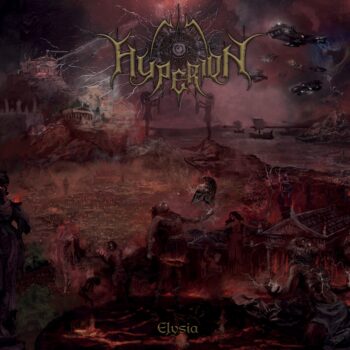
After ten long orbits of the Earth around the Sun, Hyperion has finally returned. Back in 2016, Seraphical Euphony made waves for its exceptional Dissection of Emperor, earning all but the highest honor here at AMG. Whether the test of time has deemed this an overrating, one thing is undeniable: Hyperion’s debut doesn’t shrink under the shadow of its mighty influences, offering melodic black metal uniquely ferocious, grandiose, and beautiful. With much hype, Elysia arrives, along with some new faces; Joel Hagroth (guitars) and Mauritz Flodin (drums/orchestrations) join Erik Molnar, Mikael Malm (guitars), Harry Lauraéus (vocals), and Raul Vincente (bass).1 Seraphical Euphony is an epic record, but its follow-up is epic, clocking in at a whopping 74 minutes. With great runtimes comes great responsibility—we shall see if Elysia conscientiously wields its extra twenty minutes and lives up to the Hyperion.
The new players slot comfortably into Hyperion, which sounds like a bigger, bolder version of itself. In joining Molnar and Malm on guitars, Hagroth returns the band to its stunning triple-axe attack. With brighter, sharper tones than Seraphical Euphony, the guitar Cerberus of Elysia bites through savage blackened tremolos, chews on Opethian acoustic reprieves, and smiles with pure harmonized bliss, often in one song (“Fides Novem”). Vincente’s bass punches through the mix even more than on the debut, occasionally carrying a clang I’d expect in tech-death/thrash (“Perennial Transcendence”). Lauraéus’s harshes are as harrowing as ever, smoothing over tempo/key changes with his rough rasp.2 Flodin’s drum performance recalls that of Anders Peterson, though his subtle rhythmic fluctuations frequently enliven these blasty, thundering beasts (“Iliou Persis”). It’s Flodin’s orchestrations, however, in tandem with Molnar’s synthesizer programming, that truly distinguish the sophomore outing from its predecessor. Seraphical Euphony is epic—Elysia is cinematic.
Elysia runs close to film length because it has a sprawling space yarn to unwind. In 3549, with humanity on the verge of intergalactic expansion, the religious dictatorship ruling Earth sends nine vessels on a colonial pilgrimage, but the universe itself has something to say about this adventurism.3 A “Rapturous Overture” kicks off the mission with orchestral bombast, segueing into a tantalizing trio of mid-length bangers. At the heart of the experience lies “Paraphrosynia”—a 12-minute monster that bursts In Flames with folky melodicism akin to The Jester Race—and “Perennial Transcendence”—a symphonic ass-beater à la At the Welkins at Dust. After an acoustic “Vigil of Longing,” Elysia ends mostly with epics. Here, orchestral instruments truly shine; the booming brass in “Epic of Tribulation” fuels soul-lifting triumphalism, while the skittering harpsichord in “Epoch’s Eventide” delightfully classicizes the song’s irresistible fretboard runs. Concluding the album with a dénouement swelling to goosepimple-inducing proportions, “The Primordial Wellspring” sends us off with an eerie string echoing over gentle chords, reminding me of another ending to a 70-minute epic: Parallax 2: Future Sequence (BTBAM). It’s an undertaking, but Elysia mostly thrills across its mammoth runtime. Every listen makes each song stickier, revealing new layers.

Of course, Elysia contains flaws, and—of course—these flaws mostly relate to its length. For starters, the middle of the album does drag a little. The middle of “Paraphrosynia,” in fact, is Elysia’s draggiest moment, feeling less vital than its surrounding material. “Vigil of Longing” feels almost unnecessary. For an album with so many acoustic breaks, it’s questionable whether it needs a two-minute stand-alone acoustic track. Also, some transitions snag the ear. “Epic of Tribulation,” for one, makes prog-style modulations that sound more jarring than seamless. And finally, the album’s non-Lauraéus clean voices sometimes hit and sometimes miss. I love the battle choir on “Iliou Persis,”4 but the deep voiceover running throughout the album is too muffled. As a character in the narrative, it would be nice to discern a few key terms, at least. All of these, however, are minor issues that don’t detract from the overall experience.
Coupling a great runtime with great quality, Hyperion have returned with a bang. Like finely crafted genre cinema, Elysia newly rewards with each engagement while offering melodic black metal enthusiasts exactly what they want. Fans may prefer Seraphical Euphony as the tighter, more digestible offering, but many will find its follow-up the better record, on account of its consistent execution of a grand design.5 Enough nitpicks coalesce to keep Elysia from excellence, but Hyperion clearly have the chops to scale that summit. Hopefully, we won’t have to wait until 3549 to get album three. All aboard the Hyperion train!
Rating: 4.0/5.0
DR: 8 | Format Reviewed: 320 kbps mp3
Label: Willowtip Records
Websites: Official | Instagram | Facebook
Releases Worldwide: November 6th, 2026
The post Hyperion – Elysia Review appeared first on Angry Metal Guy.